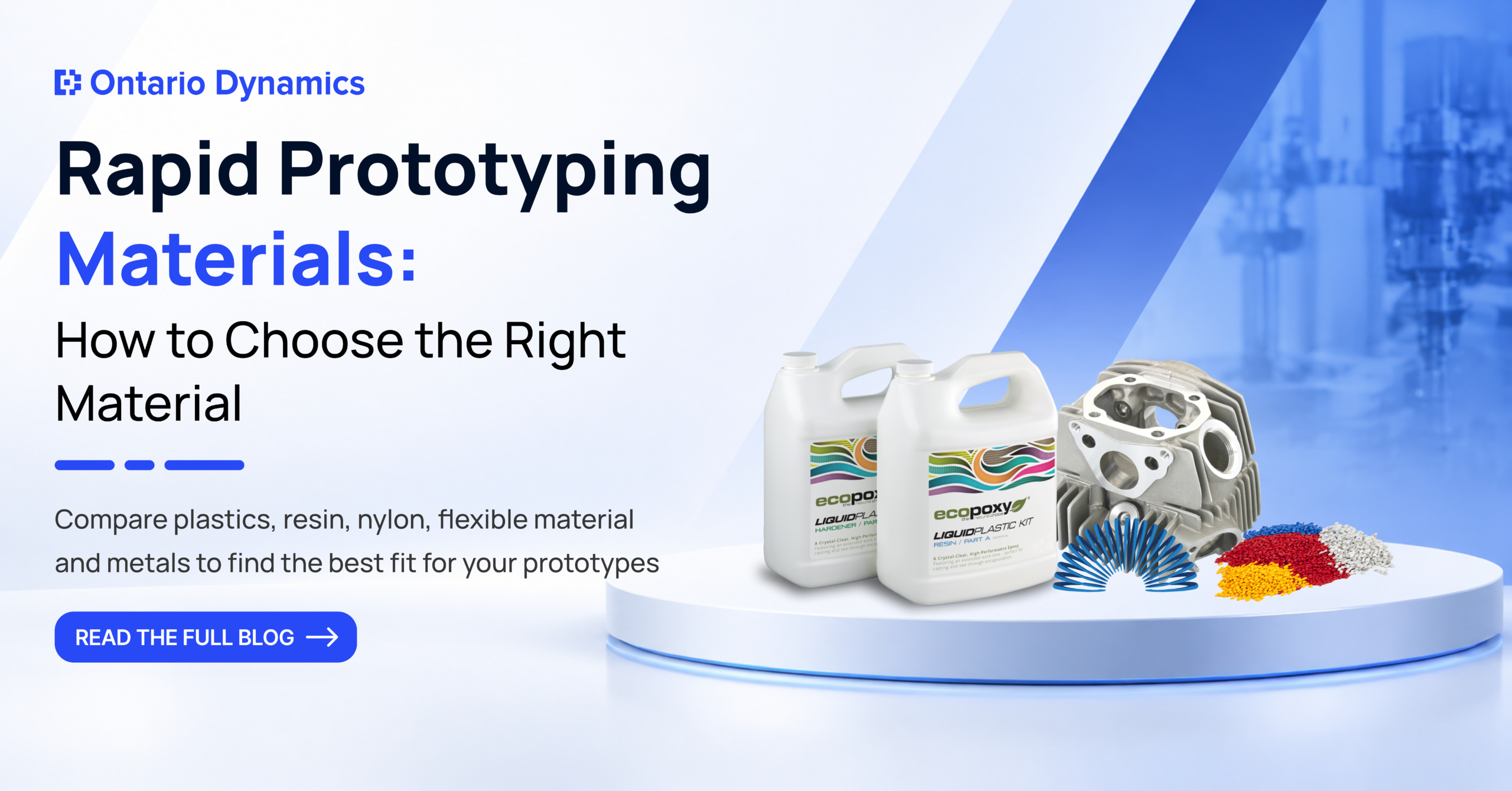
Rapid Prototyping Materials: How to Choose the Right Material
Objective
Help product teams choose a prototype material based on heat, load, flex, process, and cost.
Key Takeaways:
- Choose the material based on the test the part must pass, then match a process to it.
- Heat is the usual failure. PLA softens near 55 °C, ABS near 96 °C, and nylon between 52 and 84 °C under load.
- Printed metal can match machined aluminum on strength, but it stretches about half as far.
Table of Contents
- What Are Rapid Prototyping Materials?
- How Do Common Plastics Compare for Heat and Strength?
- Is Nylon the Right Choice for Functional Parts?
- When Do Resins Make Sense for Prototypes?
- What Flexible Materials Work for Seals, Grips, and Hinges?
- How Do Metals Compare for Strength and Process Fit?
- How Do Cost Implications Change the Choice?
- Frequently Asked Questions
- Pick the Material After You Pick the Test
A part passes every fit check, then softens in the first heat test. The geometry was right. The material was not. Rapid prototyping materials decide whether a test tells you something real about the final part, or only something about the prototype.
At Ontario Dynamics, we pick the material after we know the test: heat, load, flex, or finish. This guide compares plastics, nylon, resins, flexible materials, and metals, with published data you can check.
TL;DR: Choose the material from the test, not from the printer. PLA softens near 55 °C, while ABS holds to about 96 °C and High Temp resin to 238 °C. Machined 6061-T6 aluminum gives 310 MPa, and printed nylon about 45. TPU and silicone cover flex. Printed AlSi10Mg matches 6061 on strength but stretches about half as far.
What Are Rapid Prototyping Materials?
Rapid prototyping materials are the plastics, resins, nylons, elastomers, and metals used to build test parts by 3D printing, CNC machining, or casting. The material sets the heat limit, strength, flexibility, finish, and cost, so it decides which tests the part can honestly pass.
Material and process come as a pair. FDM runs thermoplastics, SLA runs resins, SLS and MJF run nylon and TPU powders, DMLS runs metal powders, and CNC cuts metal or plastic stock. All of it sits inside the wider rapid prototyping process.
How Do Common Plastics Compare for Heat and Strength?
Among FDM plastics, PLA softens first, and PC-ABS lasts longest. Xometry lists heat deflection temperatures of 55 °C for PLA, 68 °C for PETG, and about 118 °C for PC-ABS. Stratasys rates ABS-M30 at 96 °C.
Print direction matters too. ABS-M30 is rated at 31 MPa in its strongest build orientation and 26 MPa in its weakest, about 16% lower. Orient the part so the main load runs along the layers.
Is Nylon the Right Choice for Functional Parts?
Nylon PA12 suits functional plastic parts that need toughness, thin walls, or snap fits. Printed by SLS or MJF, it reaches about 42 to 48 MPa tensile strength. Heat is its weak point: data sheets list heat deflection at 52 to 84 °C under a 1.8 MPa load. SLS PA12 White Spec Sheet HLH Rapid +4
Its surface is rougher than SLA. In our guide to rapid prototyping with 3D printing, SLS is the process we point to for functional parts, assemblies, and snap fits.
When Do Resins Make Sense for Prototypes?
Resins suit fine detail and smooth surfaces, and specialty grades cover tough or hot jobs. Formlabs lists Tough 1500 at 33 MPa tensile strength and 51% elongation, with polypropylene-like behavior. Its High Temp resin reaches 238 °C heat deflection at 0.45 MPa, the highest among its resins.
Cure matters. Resin parts need post-curing to reach rated properties, and Tough 1500 should be cured on supports to avoid warping.
What Flexible Materials Work for Seals, Grips, and Hinges?
TPU and silicone cover flexible prototypes. SLS and MJF TPU runs about Shore 86 to 90A, stretches 220 to 500% before breaking, and tolerates 90 to 130 °C. Silicone suits heat, seals, and repeated compression better, but it needs casting or molding instead of printing.
Filament TPU is more limited. Ultimaker’s data sheet advises against parts exposed above 100 °C. Our silicone prototyping methods guide covers the casting routes.
How Do Metals Compare for Strength and Process Fit?
Machined 6061-T6 aluminum gives 310 MPa tensile strength and 17% elongation and a rating to about 170 °C. Printed AlSi10Mg matches it on strength at about 300 to 345 MPa but stretches only 8 to 10%. Pick by what the part sees: bulk strength and finish favor CNC, internal channels favor printing.
Stainless needs a choice too. 17-4 PH is far stronger than 316L but has much less elongation, so 316L suits parts that may bend before they fail. We cover the machining side in our prototype manufacturing process guide.
How Do Cost Implications Change the Choice?
Material cost matters most for metals and least for FDM plastics. One manufacturer prices SLA resin from $0.4 per gram and nylon from $0.7, while CNC stock runs from about $3 to over $200 per kilogram. That is $400 and $700 per kilogram for the printing materials. Printing uses only the material the part needs, though, and machining cuts much of the billet away.
In our 3D printing guide, relative cost climbs from FDM ($) through SLA and SLS ($$) and MJF ($$$) to DMLS ($$$$). For worked pricing, see how much a prototype costs. At Ontario Dynamics, we match the material to the stage: a cheap placeholder early, production-like material for the test that counts. Our guide to different types of prototypes shows where each stage sits.
Material | Process | Heat Limit | Strength | Relative Cost | Best For |
PLA, PETG | FDM | 55, 68 °C | 37 to 50 MPa | $ | Visual and fit checks |
ABS-M30 | FDM | 96 °C | 26 to 31 MPa | $ | General functional tests |
Nylon PA12 | SLS, MJF | 52 to 84 °C | 42 to 48 MPa | to $ | Snap fits, tough parts |
Tough 1500 resin | SLA | 52 to 66 °C | 33 MPa | $$ | Springy, snap fit parts |
TPU | SLS, MJF | 90 to 130 °C | 7 to 20 MPa | to $ | Seals, grips, hinges |
6061-T6 | CNC | About 170 °C | 310 MPa | Varies | Load and heat tests |
AlSi10Mg | DMLS | Not listed here | 300 to 345 MPa | $$$$ | Metal with internal channels |
Heat figures use different test methods, so use them to rank materials, not to set a design limit.
FAQ
Among the materials here, High Temp resin lists the highest heat deflection temperature at 238 °C. Machined aluminum works to about 170 °C. PLA softens near 55 °C, so keep it away from warm environments.
Yes, for fit and shape. Not for strength, heat, or wear, because properties change with material. Use production-like material, or the same family, when the test depends on load, temperature, or fatigue.
FDM plastics such as PLA, PETG, and ABS usually cost the least, since FDM sits in the lowest cost tier of our guide. Cost per part still depends on size, orientation, and supports.
Ready to Build Your Product?
Let’s turn your idea into a production-ready product engineered for success.