Types Of Prototypes In Product Development: 7 Types And When To Use Each
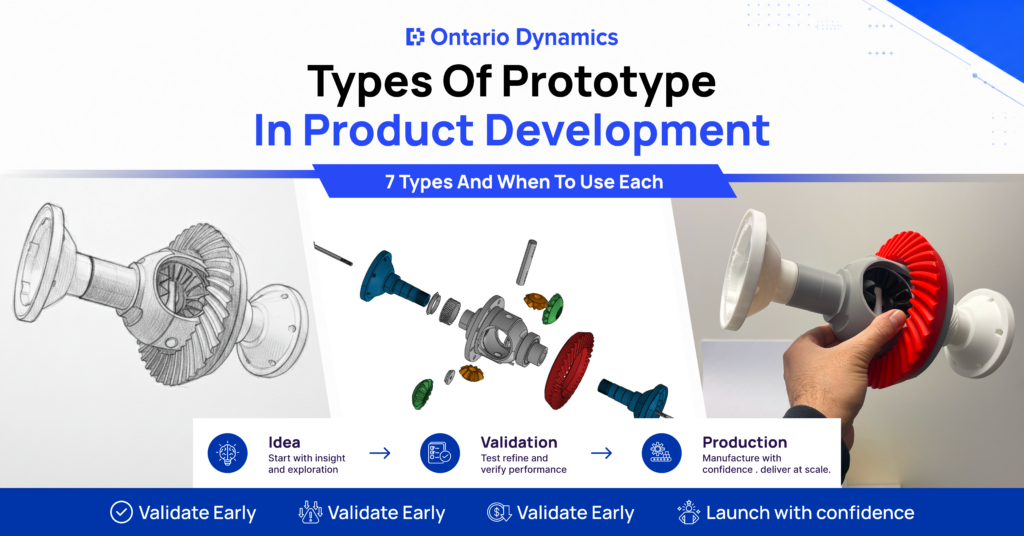
To explain the main types of prototypes used in product development, what each one proves, and how to choose the right prototype stage before spending money on the wrong build.
Key Takeaways
- Prototype types are not interchangeable. Each one answers a different question.
- Early prototypes reduce uncertainty before CAD, tooling, supplier quotes, and production planning become expensive.
- Over-building too early wastes budget. Under-building too late creates rework.
- Most physical product projects need two or three prototype stages, not one.
- Ontario Dynamics supports prototypes as part of product and equipment development, not as isolated sample builds.
Most product teams make one of two mistakes. They either over-prototype and spend too much on detail before the idea is proven, or they under-prototype and skip validation until problems appear during tooling, sourcing, or production planning.
The types of prototypes you choose should follow the maturity of the product. A sketch aligns the idea. A proof-of-concept checks the core function. A production prototype validates the process that will make the final part.
Prototype types sit inside a broader product development journey — How to Turn an Idea Into a Market-Ready Product covers where each stage fits.
Why The Type Of Prototype You Choose Determines Your Launch Timeline
Choosing the wrong prototype does not only affect the prototype budget. It affects the launch path.
Build too much too early, and the team spends money polishing details that may be removed after the first test. Skip the early stages, and the team may find basic problems after suppliers, tooling, and production plans are already moving.
McKinsey has warned that delayed launches or products released before they are ready can cost companies heavily, and last-minute changes are often the cause. That is why prototype timing matters. A change during concept review may be a sketch update. The same change after tooling may require new parts, new fixtures, supplier changes, fresh samples, and another validation round.
For 2026 product teams, the practical rule is simple: match the prototype type to the question you need answered now. Do not ask a sketch to prove durability. Do not ask a production prototype to fix a concept that was never tested properly.
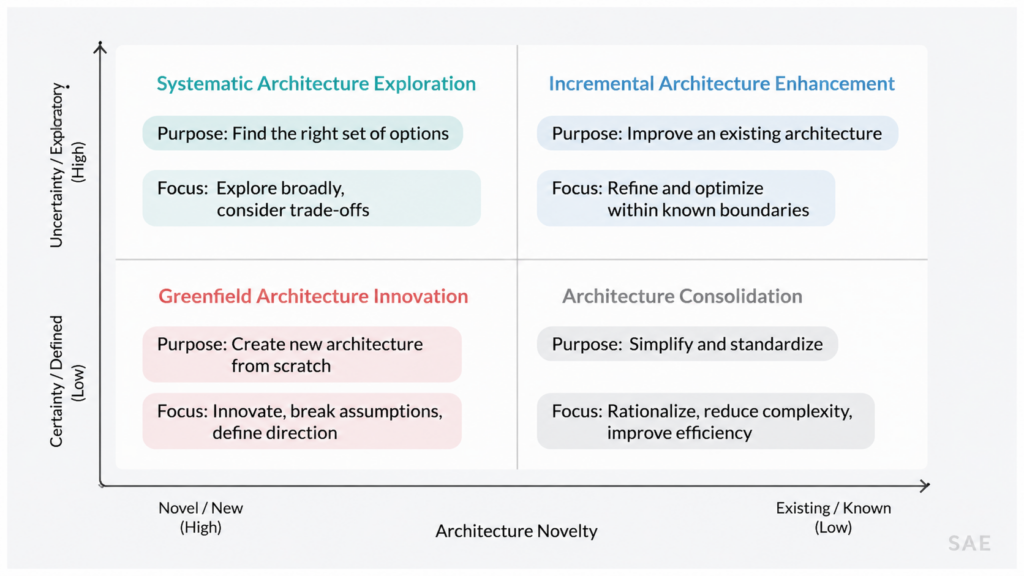
7 Types Of Prototypes In Product Development — And When To Use Each One
The seven major types of prototyping are concept sketch prototypes, proof-of-concept prototypes, digital simulation prototypes, visual model prototypes, functional rapid prototypes, pre-production alpha prototypes, and production prototypes.
Each one has a job. The goal is not to use every type on every project. The goal is to use the right one at the right moment.
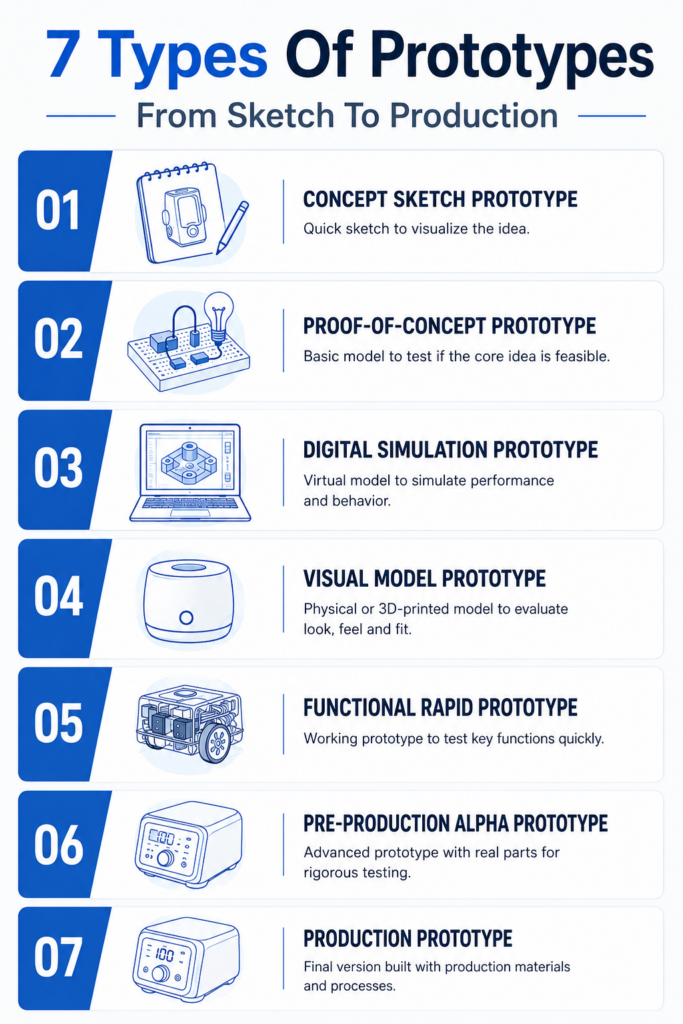
Type 1: Concept Sketch Prototype
A concept sketch prototype turns an early idea into a visible direction. It can be hand-drawn or digital. There is usually no build cost at this stage.
Prototype sketches help teams compare layouts, shapes, user touchpoints, access points, part positions, and basic product structure before CAD time is spent. Startups use them for investor communication. Manufacturers use them for internal alignment.
Type 2: Proof-Of-Concept Prototype
A proof-of-concept prototype tests whether the core idea works. Form does not matter yet. Appearance does not matter yet.
A locking mechanism, lifting feature, sensor mount, latch, hinge, feed system, or test fixture may all need proof before the full product shape is defined. This is the stage where teams find out if the main action is practical enough to continue.
Type 3: Digital Simulation Prototype
A digital simulation prototype is a virtual prototype used before physical build. It may include FEA, motion study, load review, stress review, or a digital twin-style model for equipment development.
This stage helps teams check structural performance, movement, load paths, weak areas, and clearance risks before material is cut. It is useful for machinery, brackets, housings, fixtures, moving assemblies, and parts exposed to load or vibration.
Type 4: Visual Model Prototype
A visual model prototype looks like the final product but does not work like it. It is used for appearance review, user testing, marketing photos, trade show previews, and investor demos.
This is where people usually ask, “how does the prototype look like?” The answer depends on the purpose. A visual model should show size, finish, colour, shape, grip, and user-facing details.
Type 5: Functional Rapid Prototype
A functional rapid prototype works like the product and looks close enough to test real behaviour. This is where 3D printing, CNC machining, sheet metal samples, laser-cut parts, and silicone prototyping often come in.
Teams often jump here too early. That wastes budget because functional prototype designs need more detail, tighter tolerances, better materials, and more review time. Use this stage when the concept is stable enough to test fit, motion, handling, assembly, and early performance. Rapid Prototyping With 3D Printing Guide explains one common route.
Type 6: Pre-Production Alpha Prototype
A pre-production alpha prototype is the first full build using near-production materials, layout, and assembly logic. The goal is to find manufacturability issues before tooling and production documents are locked.
This stage is common for startups approaching launch and manufacturers improving a product line. It helps test assembly sequence, supplier choices, tolerances, access, serviceability, compliance risks, and real operating conditions before the project moves forward.
Type 7: Production Prototype
A production prototype is built using the actual production process or final production-intent setup. It validates manufacturing, not just product function.
This stage checks whether the part or product can be made consistently. It may include final tooling, production-line fixtures, inspection checks, packaging trials, and process documentation. Regulated sectors often need evidence from this stage before release.
How To Choose The Right Prototype Type For Your Development Stage
The best prototype is not the most detailed one. It is the one that answers the current risk at the lowest useful cost.
Here is a practical comparison.
Prototype Type | Best For | Accuracy | Lead Time | Relative Cost |
Type 1: Concept Sketch | Idea alignment, investor communication | N/A | 1–2 days | $ |
Type 2: Proof-Of-Concept | Mechanism validation, works-like test | Low | 3–7 days | $ |
Type 3: Digital Simulation | FEA, digital twin, pre-physical review | High, virtual | 1–5 days | $$ |
Type 4: Visual Model | User testing, marketing, investor demo | Form only | 5–10 days | $$ |
Type 5: Functional Rapid | Fit, function, early performance data | Medium–High | 7–14 days | $$$ |
Type 6: Alpha Prototype | Manufacturing validation, compliance preparation | High | 10–20 days | $$$ |
Type 7: Production Prototype | Final production-line validation | Production | 14–28 days | $$$$ |
Some projects can skip a stage. A simple rigid part with low risk may move from sketch to CAD to a functional sample. A mature design may not need a visual model. A startup with limited funding may combine proof-of-concept and functional testing in one controlled build.
That said, one prototype rarely proves everything. Two or three prototype types are typically needed across a single project, especially when the product has moving parts, electronics, seals, tight tolerances, user interaction, or production constraints.
Before choosing a type, understand what it will cost — How Much Does a Prototype Cost in 2026 breaks down pricing by prototype stage.
What To Look For In A Product Prototyping Partner
A good prototyping partner should not push one method for every project. The method should follow the stage, risk, material, and production path.
1. Stage Coverage
Can they support concept sketch through production prototype, or only one stage? Ontario Dynamics works across product and equipment development, so prototype work can connect with concept review, CAD, validation, and production planning.
2. DFM Capability
Do they flag manufacturability issues before the physical build, not after? DFM review helps catch wall thickness problems, poor access, weak fastening points, tolerance issues, and assembly risks before they become shop-floor problems.
3. Method Range
Do they offer 3D printing, CNC, silicone, simulation, fixture planning, and supplier-ready documentation, or are they locked into one method? A broader method range helps teams choose based on proof needed, not supplier limitations.
4. Production Handoff
Does the prototype feed directly into production documentation, or does the client restart with a new supplier? A useful prototype should lead to drawings, BOMs, tolerance notes, validation data, and next-stage decisions.
Tell us your development stage we will recommend the right prototype type and approach for where you are. Learn more through Product Development Services and Product Prototyping Services — Ontario Dynamics.
Conclusion
Ready to Build Your Product?
Let’s turn your idea into a production-ready product engineered for success.
The type of prototype you choose should match your development stage and what you need to prove. It should not be based only on what is cheapest, fastest, or most familiar.
A sketch can align a team. A proof-of-concept can test the main mechanism. A production prototype can confirm whether the product can be made repeatedly and reliably.
Ontario Dynamics, Canada supports product and equipment development for startups and manufacturers by connecting prototype strategy with DFM, validation, CNC, simulation, documentation, and production planning. To discuss your stage and next build, visit the Ontario Dynamics contact page.