Rapid Prototyping vs Traditional Manufacturing: What Every Product Team Needs to Know
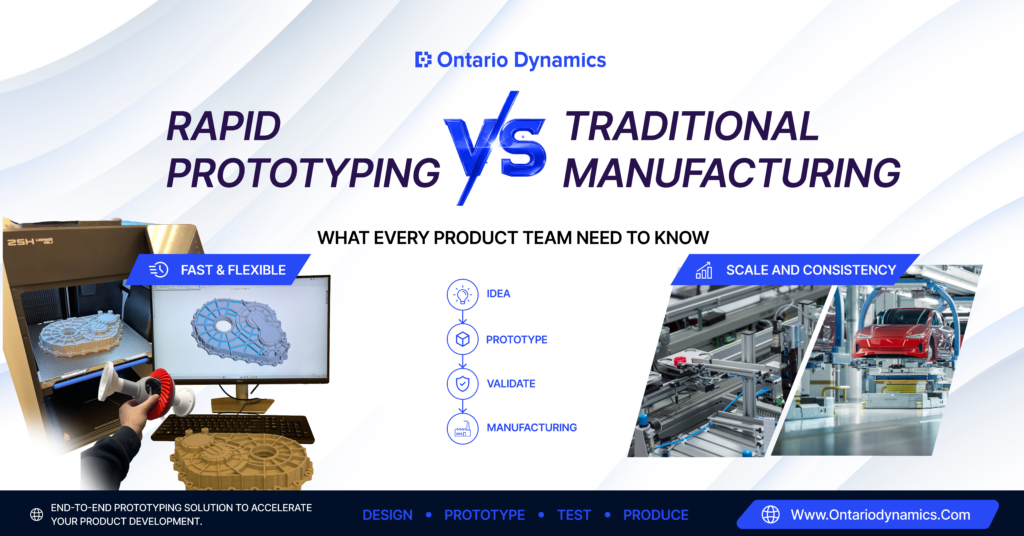
Product development services for small startups and large enterprises look very different today than they did ten years ago. The way companies build, test, and launch physical products has changed significantly. Two approaches sit at the center of that shift, rapid prototyping and traditional manufacturing. Choosing the right one at the right stage can save months and hundreds of thousands of dollars. Choosing wrong can do the opposite.
This article breaks down both methods clearly, what they are, how they differ, when to use each, and why the smartest product teams rarely treat them as opposites.
What Is Rapid Prototyping?
Rapid prototyping is the process of quickly building a physical version of a product or part, usually to test a design, validate a concept, or identify problems early.
The word “rapid” matters here. The goal is speed. You are not building the final product. You are building something fast enough to learn from before committing to full production.
Common rapid prototyping methods include:
- 3D printing (FDM, SLA, SLS), best for geometry validation and early functional tests
- CNC machining of prototypes, used when material properties matter for testing
- Laser cutting and sheet metal prototyping, common for enclosures and structural parts
- Soft tooling, low-volume injection molding for near-final material testing
Each method has trade-offs in cost, speed, and material accuracy. The right one depends on what you are trying to learn from the prototype.
What Is Traditional Manufacturing?
Traditional manufacturing refers to established production processes used to make parts and products at scale. These include:
- Injection molding
- Die casting
- Stamping and forging
- High-volume CNC machining
- Extrusion and forming processes
These methods produce parts with tight tolerances, consistent quality, and low per-unit costs at volume. But they require significant upfront investment, in tooling, setup, and engineering documentation, before a single part comes off the line.
The Core Differences
Here is where most teams get confused. The differences between rapid prototyping and traditional manufacturing are not just about speed.
Factor | Rapid Prototyping | Traditional Manufacturing |
Speed the first part | Days to weeks | Weeks to months |
Upfront cost | Low | High (tooling investment) |
Per-unit cost | High | Low in volume |
Design flexibility | Very high | Limited after tooling |
Material accuracy | Varies | Matches the final product |
Volume suitability | Low (1–500 units) | Medium to high |
Risk exposure | Low | High if the design is wrong |
The key insight here is this: rapid prototyping is cheap to start and expensive to scale. Traditional manufacturing is expensive to start and cheap to scale. That single fact should drive most of your decision-making.
Why the Stage of Development Matters Most
Many product teams make the mistake of jumping to traditional manufacturing too early. They finalize tooling before the design is truly validated. Then they find a problem, a fit issue, a structural weakness, a usability flaw, and suddenly a ₹50,000 prototype fix becomes a ₹5,00,000 tooling rework.
The right framework is simple:
Early stage: Use rapid prototyping aggressively. Test your assumptions. Change the design. Test again. The cost of iteration is low. The cost of being wrong is manageable.
Later stage: transition to traditional manufacturing deliberately. Once the design is proven, you lock it down, invest in tooling, and optimize for production cost and quality.
This staged approach is not just theory. It is how disciplined product development actually works in practice, across industries from consumer hardware to automotive components.
When Rapid Prototyping Gives You a Clear Advantage
There are specific situations where rapid prototyping is not just useful, it is the obviously correct choice.
You are validating a concept. If you are not sure the design will work mechanically, build it fast and cheaply first. A 3D-printed model on a desk tells you more than a CAD file on a screen.
You need stakeholder buy-in. Physical prototypes communicate ideas in ways that renderings and drawings simply cannot. A working model accelerates decisions.
You are in a regulated industry. Medical devices and aerospace components require extensive documentation and validation before production tooling is committed. Prototypes allow testing to happen without financial catastrophe if changes are needed.
Your design is still evolving. If the engineering requirements are not fully locked down, prototyping keeps your options open. Committing to hard tooling with an unstable design is an expensive mistake.
When Traditional Manufacturing Is the Right Call
Traditional manufacturing earns its place when:
- The design has been fully validated through multiple prototype iterations
- You need consistent material properties that only production-grade processes deliver
- Volume demand justifies the tooling investment
- Tolerances are tight, and repeatability is critical
- The product will operate in demanding environments, thermal, mechanical, or chemical
For industries like automotive, industrial machinery, and high-volume consumer products, there is no replacement for traditional manufacturing at scale. The economics do not work any other way.
The Hybrid Approach That Smart Teams Use
Here is something experienced product development teams understand that newer teams often miss: rapid prototyping and traditional manufacturing are not competing options; they are sequential stages of the same process.
The teams that move fastest and waste the least money follow a clear path:
- Concept prototypes, fast, cheap, disposable. Purpose: prove the idea works.
- Functional prototypes, closer to final materials and geometry. Purpose: test performance.
- Pre-production prototypes, built with near-final processes. Purpose: validate manufacturability.
- Production, traditional manufacturing with locked design and optimized tooling.
Skipping any of these stages to save time usually costs more time in the end.
What This Means for Product Development Services for Small Startups and Large Enterprises
The gap between how startups and large enterprises approach this is narrowing, but the pressures are different.
Startups are usually capital-constrained and need to prove product-market fit fast. For them, rapid prototyping is not just a tool; it is a survival strategy. Getting a working prototype in front of customers or investors quickly can determine whether the company continues. The goal is to spend the minimum amount necessary to learn the maximum amount possible.
Large enterprises have more resources but face different risks, production downtime, regulatory exposure, and supply chain disruption. For them, prototyping is about de-risking expensive manufacturing decisions before scale. A transmission test rig built on a verified prototype process will outperform one rushed to tooling with unresolved design questions every time.
In both cases, the underlying principle is the same: validate early, commit late, and never invest in production tooling before the design has earned it.
Ready to Build Something That Works?
If you are working through a product development challenge, whether you are an early-stage startup with a concept or a manufacturer preparing for production, the decisions you make around prototyping and manufacturing will define your timeline, your budget, and your outcome.
Ontario Dynamics works with product teams at every stage of this process, from early concept validation and prototype fabrication through production-ready mechanical design and documentation. If your project needs hands-on engineering depth and a team that understands both sides of the prototyping-to-production journey, reach out at ontariodynamics.com.
Ready to Build Your Product?
Let’s turn your idea into a production-ready product engineered for success.
Rapid prototyping prioritizes speed and design flexibility at low volumes. Traditional manufacturing prioritizes cost efficiency and quality consistency at higher volumes. They serve different stages of the product development process.
Generally no. Rapid prototyping methods, such as 3D printing, often use materials and processes that do not meet production-grade performance standards. They are best used for testing, validation, and iteration before committing to production tooling.
There is no fixed number, it depends on the product's complexity and the level of design uncertainty. Most well-managed product development projects go through two to four meaningful prototype iterations before locking the production design.
It depends on the process. Injection molding typically becomes cost-effective between 500 and 5,000 units, depending on part complexity and tooling costs. CNC machining at volume can break even at lower quantities. The right threshold depends on your specific part and process.
Yes. Functional prototyping uses materials and processes that are close enough to the final product to test actual performance, load-bearing, thermal response, fit, and assembly. The method chosen (CNC machining, SLS printing, soft tooling) depends on what specifically needs to be validated.
The most common mistakes are committing to hard tooling before the design is fully validated, skipping functional prototype stages to save time, and treating prototyping as optional rather than as a necessary investment in de-risking production. All three tend to cost significantly more than the prototyping they avoided.