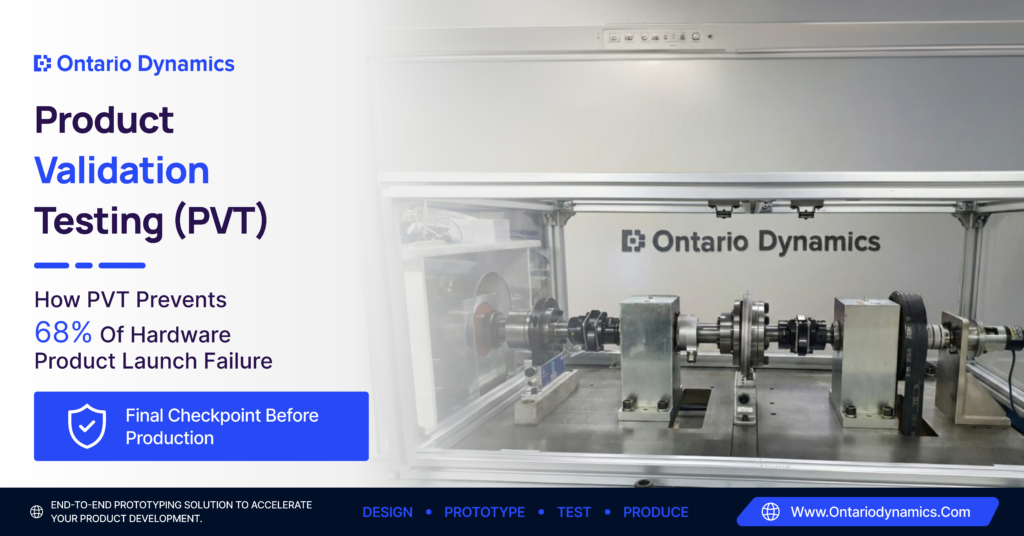
How Product Validation Testing (PVT) Prevents 68% Hardware Product Launch Failure
Hardware products do not usually fail because of one big mistake.
They fail because small issues were missed before production. A supplier changed a part. The tolerance was too loose. A test was conducted on a prototype rather than a production unit. A product worked well in the lab but failed when built on the actual line. That is where Product Validation Testing, or PVT, becomes important.
PVT is the final testing stage before mass production. It checks whether the product can be built at scale with real tooling, parts, suppliers, and production methods. It is not just about proving the design works. That should already be done before this stage. PVT proves the product is ready for production. For startups and manufacturers, this stage can prevent expensive launch failures. Once mass production begins, mistakes become harder and more costly to fix.
What Is Product Validation Testing?
Product Validation Testing is the final pre-production phase in hardware development. It comes after EVT and DVT. EVT checks whether the engineering concept works. DVT checks whether the design performs safely and consistently. PVT checks whether the product can be manufactured at scale without losing quality, performance, or compliance.
Understanding how EVT, DVT, and PVT differ across the product development lifecycle is essential because each stage validates a different part of the product journey from concept feasibility to design reliability and finally manufacturing readiness.At this stage, the question is no longer, “Does the product work in a controlled lab?” The question is, “Can the factory build this product again and again, using the final parts, final tooling, and final process?” That is a very different test. A few hand-built prototypes can look perfect. But a production line introduces new pressure. Operators work at speed. Suppliers ship full production lots. Tooling is locked. Packaging, labelling, compliance, and process control all matter. PVT brings all of that together before full production starts.
Where PVT Sits In The Hardware Development Timeline
This timeline matters because each phase has a different purpose. Skipping steps creates risk. Rushing from DVT to production creates even more risk. PVT gives the team one last chance to find production problems before those problems become customer problems.
Phase | Full Name | Primary Question | Who Signs Off |
EVT | Engineering Validation Test | Does the design work at all? | Engineering team |
DVT | Design Validation Test | Does it work consistently and safely? | Engineering + QA |
PVT | Production Validation Test | Can we build it at scale? | Engineering + Manufacturing + Supply Chain |
MP | Mass Production | Build it | Operations |
What A PVT Plan Includes And Why Most Teams Build It Too Late
A PVT plan should not be created when PVT starts. It should be created near the end of DVT. That way, the team enters production validation with clear test methods, owners, and pass/fail criteria. Without a plan, teams often rely on gut feeling. That is not enough when tooling, suppliers, compliance, and production costs are involved. A strong PVT plan usually includes the following five areas.
1. Production-Intent Build Specifications
PVT units must be built like real production units. That means using final supplier components, final tooling, final assembly methods, final packaging, and final labelling. If the build is still using “close enough” parts from earlier prototypes, the results are not reliable. A production-intent build usually includes a locked Bill of Materials, final supplier SKUs, production tooling, jigs, fixtures, and documented assembly steps. This is where many teams make a costly mistake. They run PVT with almost final parts. Then, after tooling is cut or production starts, they discover supplier variation issues. That is not a true PVT result. It is only another prototype test.
2. Defined Pass/Fail Criteria For Every Test
Every test in Product Validation Testing (PVT) must have clearly defined pass/fail criteria before testing begins. Results should be measurable and tied to customer-facing performance specifications, regulatory compliance standards like UL, CE, CSA, and FCC, as well as internal reliability targets such as MTBF, cycle life, and thermal limits. This ensures the product meets quality, safety, and manufacturing standards before mass production. You can also explore “how verification vs validation criteria differ in product testing” for a better understanding of testing benchmarks across the product development lifecycle.
3. Manufacturing Process Validation Documentation
PVT not only tests the product. It also tests the process used to build the product. A design may be strong, but the assembly process may still fail. Operators may miss steps. Torque settings may vary. A fixture may not hold the part correctly. A station may take too long, slowing down the line. Manufacturing process validation checks whether the production line can build units within spec repeatedly. This may include process capability studies, Statistical Process Control baselines, operator training records, assembly time studies, and First Article Inspection reports. These documents may sound boring, but they matter. They show whether the product can move from a good design to a stable production process.
4. Supply Chain Qualification Sign-Off
Suppliers can make or break a launch. A sample part may pass DVT. But full production parts may come from another batch, another shift, another machine, or another sub-supplier. That can create small changes in size, material, finish, or performance. Before PVT closes, every critical supplier should be qualified. This means supplier audits are complete, material certifications have been reviewed, lead times are confirmed, minimum order quantities are understood, and backup suppliers have been identified for single-source parts. Supply chain risk is often underestimated. It only becomes urgent when production is already waiting. A proper PVT process brings that risk forward while there is still time to act.
5. Regulatory And Compliance Pre-Submission Review
Compliance testing should be done on PVT-built units, not early prototypes. This is especially important for products entering markets like Canada, the United States, or the European Union. If a product needs UL, CSA, FCC, or CE approval, the tested unit should match the final production build. A common mistake is using DVT units for compliance testing. Then, between DVT and PVT, a component changes. The product may still look the same, but the compliance risk has changed. That one change can delay certification and affect the launch. A compliance review before PVT helps catch these issues early.
What Gets Tested In The PVT Phase?
PVT testing should cover the full product and production process. Each category needs a clear owner, a clear method, and a clear pass criteria. This test matrix is important because launch failures are rarely limited to a single area. A product can pass functional testing and still fail packaging. It can pass mechanical testing and still fail compliance. It can pass DVT and still fail when supplier parts arrive in production lots. PVT consolidates all these risks into a single final validation stage.
Test Category | What It Evaluates | Common Failure Mode |
Functional Performance | Core product function under real-use conditions | Works in lab, fails in field environment |
Thermal & Environmental | Performance across temperature, humidity, altitude | Thermal throttling, seal failures, condensation |
Mechanical Stress | Drop, vibration, fatigue, load cycling | Tolerance stack-up, fastener failure, bracket cracking |
Electrical & EMC | Signal integrity, power draw, emissions, immunity | EMI failures, ground loops, voltage drop under load |
Safety & Compliance | UL/CE/CSA/FCC requirements | Non-compliant component swaps from DVT |
Assembly & Process | Cycle time, torque specs, operator error rates | Inconsistent assembly, missed steps, damaged parts |
Packaging & Shipping | ISTA/ASTM drop and vibration simulation | Cosmetic damage, component shift, seal failure |
Supplier Component | Part-to-part variation across production lots | Dimensional drift, material substitution |
The 5 Most Common PVT Failures And How To Prevent Each One
Most PVT failures are not random. They happen for familiar reasons. The same problems appear across hardware products, machines, devices, assemblies, and production systems. The good news is that many of these problems can be prevented with better planning before PVT starts.
Failure 1: Tolerance Stack-Up That Was Not Caught In DVT
Each part may have its own drawing. But when all parts are assembled, small variations can add up. This is called tolerance stack-up. It often appears in PVT because DVT units are usually handled carefully. Engineers may adjust, fit, or correct parts during prototype assembly. In PVT, operators build the product using standard work instructions. There is less room for manual correction. The result is a product that looks fine on paper but does not assemble correctly at scale. The best prevention is a formal tolerance stack-up review before PVT. Teams should study the worst-case assembly condition before building production-intent units.
Failure 2: Thermal Performance Under Real Load Conditions
Thermal testing in a lab can be too controlled. PVT should test the product under realistic and worst-case conditions. That may include high ambient temperature, full load, restricted airflow, or long operating cycles. A product may pass DVT thermal checks and still fail PVT if the earlier test did not match the real use case. This is common in products with motors, electronics, batteries, sealed enclosures, or high-duty cycles. The prevention is simple. Define thermal test conditions based on the toughest expected field environment, not the average one.
Failure 3: Supplier Component Variation Across Production Lots
Supplier samples do not always represent production lots. A sample may be perfect. But production parts may vary slightly in size, coating, material, strength, or finish. Even a small change can create problems during assembly or field use. This is why First Article Inspection matters. Every critical supplier should provide verified production parts before PVT authorization. The team should not assume that sample approval covers full production. Supplier qualification should be treated as part of product validation, not as a purchasing task.
Failure 4: Regulatory Non-Compliance After Component Changes
Component changes are common after DVT. A part may be replaced because of cost, lead time, availability, or supplier preference. The change may seem minor, but it can affect compliance. For example, an electrical component, enclosure material, cable, adhesive, or power supply may have compliance implications. If the change is not reviewed, the product may fail certification later. The prevention is a formal Engineering Change Order process. Every change after DVT should include a compliance impact review. This helps the team avoid late surprises.
Failure 5: Assembly Process That Works In The Lab But Not On The Line
Prototype assembly is slow and careful. Production assembly is different. Operators follow instructions. The line has timing targets. Tools, fixtures, and workstations affect the build. Small process gaps become bigger when repeated hundreds or thousands of times. A product may be easy for an engineer to build, but hard for an operator to build consistently. That is a serious PVT risk. Prevention is a production-readiness review before PVT begins. The team should walk through the assembly process, check the tooling, review the operator instructions, and measure the cycle time. The production line should be tested with real pressure, not just reviewed in a meeting.
Why PVT Planning Should Start Before DVT Ends
One of the biggest mistakes is treating PVT as a final checklist.
It is not. PVT works best when the plan is built before DVT closes. By that point, the team should already know what needs to be tested, what pass/fail criteria will be used, which suppliers are locked, and what production risks still need attention.
Late PVT planning creates delays. It also creates confusion between engineering, manufacturing, QA, and supply chain teams. When PVT planning starts early, the team enters the phase with fewer unknowns. That makes the process faster, cleaner, and more useful.
Conclusion
Product Validation Testing is the last major checkpoint before a hardware product moves into mass production. It helps teams catch the problems that prototypes do not always reveal. These problems may come from tooling, supplier variation, assembly methods, thermal conditions, compliance changes, or packaging. The key lesson is simple. PVT failures are usually predictable. They are often connected to decisions made during DVT. That is why PVT planning should begin before DVT closes, not after.
A strong PVT process helps reduce launch risk. It protects the product, the production line, the budget, and the customer experience. For Canadian startups and manufacturers moving through the EVT, DVT, and PVT processes, Ontario Dynamics provides product and equipment development support built on practical engineering, testing, and production-readiness.
Explore product and equipment development services at OntarioDynamics.com
Ready to Build Your Product?
Let’s turn your idea into a production-ready product engineered for success.
FAQ’s
Product Validation Testing, or PVT, is the final testing stage before mass production. It checks whether the product can be built consistently using final parts, final tooling, final suppliers, and the real production process.
PVT helps catch production problems before the product reaches customers. It can reveal issues with assembly, supplier parts, tooling, packaging, compliance, and quality control. Fixing these problems before launch is much easier than fixing them after production starts.
EVT checks whether the engineering concept works. DVT checks whether the final design performs in real-world conditions. PVT checks whether the manufacturing process can build the product at scale without quality or performance problems.
A PVT plan should include production-intent build details, pass and fail criteria, supplier sign-off, manufacturing process checks, compliance review, packaging checks, inspection steps, and clear documentation for approval.
Products often fail during PVT because of tolerance stack-up, supplier variation, thermal issues, late component changes, weak assembly instructions, poor tooling, or compliance gaps. These issues may not appear during early prototype testing.
PVT planning should start before DVT ends. This gives the team enough time to lock suppliers, prepare test methods, confirm pass and fail criteria, review compliance needs, and reduce production risks before the final validation stage begins.