EVT Vs. DVT Vs. PVT: What Do These Hardware Product Validation Stages Actually Mean?
What do EVT, DVT, and PVT mean in hardware development?
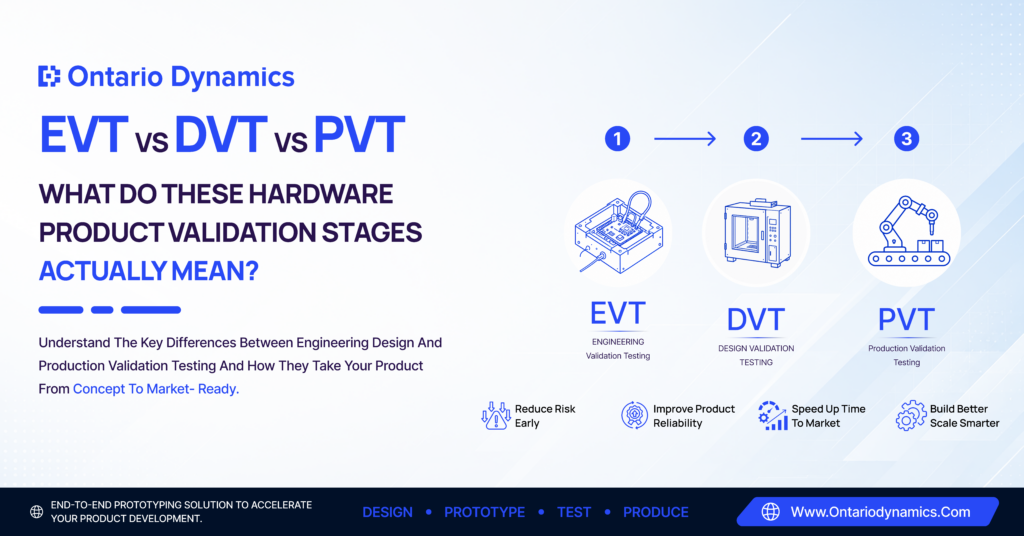
EVT (Engineering Validation Testing) confirms the design works at a functional level. DVT (Design Validation Testing) confirms it performs under real-world conditions. PVT (Production Validation Testing) confirms the manufacturing process can build it at scale. Together, the EVT DVT PVT sequence takes a hardware product from a working prototype to a production-ready, market-validated build. Each stage has a distinct pass criteria and must be completed before the next begins.
Key Takeaways
- EVT DVT PVT are the three primary hardware development stages between prototype and full production
- What does EVT mean: Engineering Validation Testing, proving the core design function works
- DVT vs EVT: DVT tests real-world performance; EVT tests whether the design works at all
- DVT vs PVT: DVT locks the design; PVT validates the manufacturing process that produces it
- PVT hardware version is the final build type before volume production commitment
- Skipping or compressing any stage does not save time, it creates rework that costs more than the stage itself
A hardware product does not become market-ready because the prototype works. It still has to prove three separate things. The design must work. It must work under real conditions. Then the manufacturing process must prove it can build the product consistently at scale. That is what EVT DVT PVT are for. These three hardware development stages give product teams, startups, and manufacturers a structured path from working prototype to production-ready product. They also create the documentation trail that supports regulatory submissions, supplier alignment, and quality control at volume.
This guide defines each stage, explains the EVT DVT PVT hardware development stages definition, and covers what teams need to know to move through all three without costly rework.
What do EVT, DVT, And PVT Mean In Hardware Product Validation Stages?
EVT DVT PVT are three sequential product validation stages used in hardware development:
- EVT stands for Engineering Validation Testing
- DVT stands for Design Validation Testing
- PVT stands for Production Validation Testing
Each stage answers a different question. EVT asks: does the design work? DVT asks: does it work in the real world? PVT asks: can the production process build it reliably at scale?
The stages are sequential because each one builds on the previous. You cannot validate real-world performance before the design works. You cannot validate the production process before the design is locked. Skipping a stage is technically possible on simple products, but the risk compounds at every subsequent stage.
Stage | Full Name | Core Question | Who Leads |
EVT | Engineering Validation Testing | Does the design work? | Design and development team |
DVT | Design Validation Testing | Does it perform in real conditions? | Design team and QA |
PVT | Production Validation Testing | Can manufacturing produce it at scale? | Manufacturing and QA |
What Is EVT? Engineering Validation Testing Explained
EVT, Engineering Validation Testing, is the first formal proof stage. The team is asking one question: does this product do what the design says it should do?
At EVT, the product does not need to look final. The enclosure may be rough. Materials may not be production-grade. Assembly may be manual. That is all expected. The purpose is not to produce a finished product. The purpose is to prove the core function before investment goes deeper.
What is EVT testing in practice?
If the product is a mechanical assembly, does it move correctly through its full range? If it has sensors, are they reading within spec? If it includes electronics, do the primary circuits perform? EVT validates function against the Product Requirements Document (PRD). The PRD is the checklist, it defines what the product must do, the limits it must meet, and what cannot be deferred.
Common EVT failure points:
- Mechanical fit that does not hold under load
- Sensor readings outside the specified range
- Heat build-up in electronics that was not modelled
- Parts that do not assemble in the sequence assumed
- Material behaviour that differs from the simulation
A pass at EVT means the core functional requirements in the PRD are met. It does not mean the product is ready for users or production. It means the foundation is sound enough to build on.
What Is DVT? Design Validation Testing Explained
DVT, Design Validation Testing, comes after EVT. At DVT, the product is much closer to its final form. Materials, components, and layout should be stable. The team is no longer asking only whether the design works. They are asking whether it will keep working when real users, real environments, and real operating conditions are involved.
What is DVT testing in practice?
DVT test plans typically include: temperature cycling, vibration and shock testing, drop testing, cycle and fatigue testing, ingress protection (IP) testing for dust and water, electrical safety checks, user handling review, and reliability testing. The exact scope depends on the product category. An automotive component and a consumer device will not have the same DVT requirements.
DVT checklist:
- Performance verified against all PRD requirements
- Environmental testing completed (temperature, humidity, vibration)
- Mechanical stress and fatigue testing passed
- Assembly fit reviewed with production-intent parts
- Material compliance confirmed
- Safety requirements met
- User handling and ergonomics reviewed
- Failure modes documented and resolved
- Design for Manufacturability (DFM) reviewed
- Documentation updated to reflect all changes
Some changes during DVT are acceptable, minor material refinements, firmware updates, small dimensional adjustments. Major changes are different. If the core mechanism, primary material, or electrical architecture changes during DVT, earlier test results may no longer be valid and DVT may need to restart from a defined point.
DVT is also where design for manufacturability becomes most critical. Changes at this stage are expensive. Changes after PVT are more expensive still.
DVT vs EVT: The Key Difference
DVT vs EVT is a question about scope, not sequence. EVT tests whether the design works. DVT tests whether it continues to work under the conditions the product will face in use.
EVT means: the product passes its functional specification in a controlled setting.
DVT means: the product passes its performance specification under stress, environmental variation, and real operating conditions.
A product can pass EVT and fail DVT, that is expected and normal. A product that fails DVT repeatedly without clear root cause is a sign that the EVT stage was not thorough enough, or that the PRD did not capture real-world requirements accurately.
What Is PVT? Production Validation Testing Explained
PVT, Production Validation Testing, is the final major validation stage before full production commitment. At PVT, the product design should be locked. The question shifts from the product to the process.
Can the manufacturing line produce units to specification? Can the quality system catch defects at production speed? Can suppliers deliver stable parts consistently? Can the assembly sequence be followed by a production operator, not just a development team?
PVT hardware version refers to units built using actual production tooling, production-grade materials, and the intended production assembly process, not prototyping methods. These are the builds that prove the process, not the concept.
The manufacturing team and quality assurance team lead PVT. Development supports the process but the ownership has shifted toward production readiness.
A pass at PVT means: the process can produce conforming units at the required volume with zero critical defects. Pass criteria are set by the PRD and final specification sheets.
When PVT fails, the root cause must be identified before production proceeds. Common sources include: tooling variation, supplier part instability, assembly step ambiguity, operator error in the work instructions, test equipment calibration, packaging damage, or in some cases a design issue that DVT did not catch. If the design is the root cause, the team may need to return to DVT before PVT can complete.
PVT is never a formality. It is the stage that proves the product can survive the transition from development to the production floor.
DVT vs PVT: The Key Difference
DVT vs PVT is a question about what is being tested, the design or the process.
DVT tests the product design under real-world conditions. PVT tests the manufacturing process under production conditions using the locked design.
DVT output: a design-locked unit with all performance requirements confirmed. PVT output: a production-ready line with documented process capability and zero critical defects at volume.
A product that passes DVT can still fail PVT, if the production process cannot reliably reproduce the design at scale. This is why design freeze before PVT is not optional. Testing a moving target does not produce reliable process data.
EVT DVT PVT Side-by-Side Comparison
EVT | DVT | PVT | |
Full name | Engineering Validation Testing | Design Validation Testing | Production Validation Testing |
Core question | Does the design work? | Does it work in real conditions? | Can manufacturing produce it at scale? |
Who leads | Development team | Design team and QA | Manufacturing and QA |
Product state | Prototype, may use substitute materials | Near-final design, production-intent parts | Production tooling and process |
PRD role | Functional benchmark | Performance benchmark | Production specification |
Key output | Revised prototype with confirmed function | Design-locked unit | Production-ready line |
Pass criteria | Functional requirements met | All validation tests passed | Zero critical defects at production volume |
Acceptable changes | Design revisions expected | Minor refinements only | No design changes |
PVT Sign Off: What It Covers and Why It Matters
PVT sign off full form refers to the formal approval process that closes the Production Validation Testing stage and authorises the transition to volume production. It is not a single document, it is a package.
A complete PVT sign off covers:
- Confirmation that production units meet all PRD requirements
- First-article inspection report with dimensional and material verification
- Process capability data showing the line can hold critical tolerances
- Quality plan with defined inspection methods and accept/reject criteria
- Approved supplier list with confirmed part specifications
- Completed assembly and work instructions
- Packaging and labelling review
- Regulatory and compliance documentation (CE, UL, CSA where applicable)
PVT sign off is the formal gate between development and production. Without it, the team has no documented basis for the production decisions that follow. For regulated industries, medical, electrical, automotive, aerospace, PVT sign off is also the foundation of the regulatory submission package.
TVT vs PVT Testing: Is There a Fourth Stage?
TVT vs PVT testing is a question that comes up on programs where a distinct tooling validation stage is separated from the broader production validation. TVT, Tooling Validation Testing, specifically validates that the production tooling (moulds, dies, fixtures, jigs) produces parts within specification before full assembly-level PVT begins.
Not all programs use TVT as a labelled stage. On programs where it is used, the sequence becomes EVT, DVT, TVT, PVT. TVT isolates tooling risk before it compounds into a full production line failure.
For most mechanical and industrial programs, tooling validation is handled within the PVT scope rather than as a separate named stage. The important point is that tooling is validated before volume production begins, whether that is labelled TVT, first-article approval, or first-off-tool review within PVT.
The Role of the PRD Across All Three Stages
The Product Requirements Document is not a planning artefact from the start of the project. It is the live reference that governs every validation decision across EVT, DVT, and PVT. The PRD defines what the product must do, the limits it must meet, the conditions it must survive, and the quality level it must achieve. As the product moves through each stage, the PRD should reflect what the team has learned, not stay frozen at the original version, but also not change without control.
When teams let the PRD drift without version control, the consequences are predictable. Development tests against one set of requirements. QA checks against another. Manufacturing prepares for a specification that has already changed. The result is repeated prototypes, unclear test results, supplier confusion, and production delays that trace back to a document nobody was maintaining. A strong, version-controlled PRD is the communication layer between all three stages. For teams entering EVT for the first time, getting the PRD right before the first build is one of the highest-value investments in the project.
When to Bring In a Product Development Partner
The best time to bring in a product development partner is before EVT begins. At that stage, the partner can shape the PRD, review the design for known failure modes, plan the prototype sequence, and reduce the risk of arriving at DVT with avoidable problems.
Bringing in support during DVT is still useful, but the work is harder. By then, design decisions, test failures, and supplier choices are already in place, and some are expensive to unwind.
Consider bringing in a partner if:
- The prototype works, but test results are inconsistent
- The team does not have a defined EVT, DVT, and PVT plan
- The PRD is incomplete or changing without version control
- The product needs mechanical testing, durability testing, or formal production validation
- The team is approaching manufacturing but still has unresolved design uncertainty
- Suppliers are asking questions the internal team cannot answer clearly
For startups and manufacturers in Canada, shaft material selection and component specifications for mechanical assemblies, including decisions about shaft material steel, material of shaft, and shaft materials for drive components in industrial products, are the kind of technical decisions that benefit from a development partner who has done production-level validation before. Getting material shaft decisions wrong at DVT means discovering the problem at PVT when production tooling is already committed.
Ontario Dynamics supports hardware teams across Canada through all three validation stages, from PRD definition through prototype manufacturing and PVT sign off.
Conclusion
EVT DVT PVT are not process labels. They are the structured proof that a hardware product is ready for the user, the market, and the production line.
DVT vs EVT comes down to this: EVT proves the design works; DVT proves it works in the real world. DVT vs PVT comes down to this: DVT locks the design; PVT proves the process can build it at scale. The PVT hardware version is the final confirmation before volume production begins.
For startups and manufacturers across Canada, these three hardware development stages replace guesswork with documented evidence. They create the proof that investors, regulators, and production teams all need before money moves at scale.
Teams who move through EVT, DVT, and PVT with a clear plan and a development partner who understands what each stage actually requires reach market faster, with fewer surprises, and with a product the production floor can actually build consistently.
Talk to the Ontario Dynamics team about where your product sits in the validation sequence. We will help you build a clear path through all three stages.
Ready to Build Your Product?
Let’s turn your idea into a production-ready product engineered for success.
EVT stands for Engineering Validation Testing. It is the first formal proof stage in hardware development. The team builds a prototype, which may not be final in appearance or materials, and tests it against the functional requirements in the PRD. A pass at EVT means the core design works. It does not mean the product is ready for real-world use or production. That is what DVT and PVT are for.
DVT (Design Validation Testing) tests the product design under real-world conditions, heat, vibration, drop, load, user handling. The design is validated and locked at the end of DVT. PVT (Production Validation Testing) then tests whether the manufacturing process can build the locked design consistently at scale. DVT owns the design. PVT owns the process.
PVT sign off is the formal approval that closes the production validation stage and authorises the move to volume production. It covers: first-article inspection results, process capability data, approved supplier list, completed work instructions, quality plan, regulatory documentation, and confirmation that production units meet all PRD requirements. Without PVT sign off, there is no documented basis for the production decisions that follow.
Skipping a stage is possible on very simple products with no unproven mechanisms, but the risk compounds. A product that skips EVT may arrive at DVT with a design that fails under real-world conditions, and fixing it at DVT costs more than fixing it at EVT would have. A product that skips DVT may pass PVT builds but fail in the field after launch. The stages exist because each one catches problems at the cheapest possible moment.
TVT (Tooling Validation Testing) specifically validates that production tooling, moulds, dies, fixtures, produces parts within specification. PVT validates the full production process, including tooling, assembly, quality systems, and supplier parts. On programs that use TVT, it runs before PVT and isolates tooling risk before full assembly-level validation begins. Many programs handle tooling validation within the first-article inspection scope of PVT rather than as a separate named stage.
Hardware version PVT refers to units built using actual production tooling, production-grade materials, and the intended production assembly process. These units are not prototypes, they are the builds that prove the manufacturing process, not the design. PVT hardware units are what the quality and manufacturing teams use to confirm the line is ready for volume production.