Product Development Cost Guide
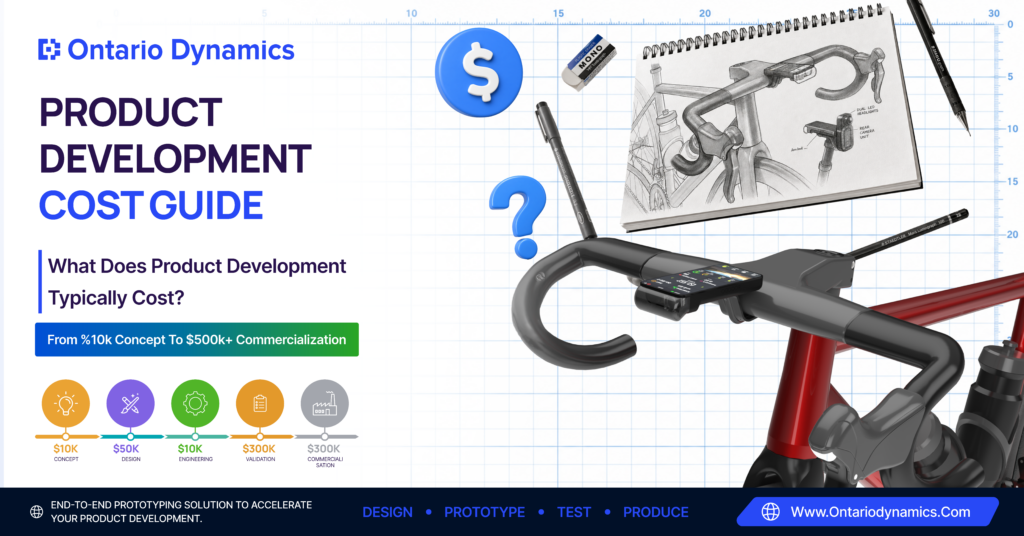
What Does Product Development Typically Cost?
Product development typically ranges from $20,000 for a simple product to $500,000+ for full commercialization but this cost depends on the maturity of the idea, the complexity of the product, the level of engineering required, and how close the design needs to be to real-world deployment. A rough prototype, a fully engineered product, and a manufacturing-ready system are very different levels of work.
Industry cost references commonly show that physical product development can range from smaller feasibility budgets to full commercialization programs exceeding several hundred thousand dollars, especially when engineering, prototyping, testing, and manufacturing preparation are included.
Practical Product Development Cost Benchmark
Type of Work | Typical Budget Range | What It Usually Includes |
Small concept / feasibility | $10k–$50k | Early design, requirements review, rough prototype, limited engineering |
Product design phase | $50k–$150k | Industrial design, mechanical/electrical concept, prototype development |
Full engineering development | $100k–$300k+ | Mechanical design, electronics, firmware, DFM, testing, design iterations |
Full commercialization program | $250k–$500k+ | Design, engineering, prototypes, validation, manufacturing setup |
Professional engineering engagement minimum | $50k–$100k+ | Structured product-development work with defined scope and deliverables |
Full-service engineering rate | $100–$450/hr | Multidisciplinary design, engineering, testing, and commercialization support |
Specialized product-development rate | $150–$200/hr | Senior engineering, product architecture, technical integration, and design execution |
Small Concept / Feasibility: $10k–$50k
This stage is used when the idea is still early and the main goal is to answer basic technical and commercial questions. The work may include requirements review, concept sketches, early CAD models, rough calculations, initial component selection, and a basic proof-of-concept prototype. This phase is not intended to produce a finished product. Its purpose is to reduce uncertainty before committing to a larger engineering program.
Product Design Phase: $50k–$150k
At this stage, the product begins to take shape as a real engineering system. The work may include industrial design, mechanical architecture, electronics packaging, initial DFM thinking, prototype development, and early testing.
This is usually the stage where major product decisions are made: size, layout, materials, manufacturing approach, usability, serviceability, and integration strategy.
Full Engineering Development: $100k–$300k+
Full engineering development is where the product becomes technically mature. This may include detailed mechanical design, electronics integration, firmware coordination, tolerance strategy, drawings, BOM development, supplier input, prototype iterations, and functional testing.
This level of work is typically required when the product must move beyond a demonstration model and become reliable enough for real use.
Full Commercialization Program: $250k–$500k+
Commercialization includes everything needed to move from a working prototype toward a manufacturable product. This may include engineering refinement, validation testing, manufacturing drawings, supplier coordination, tooling strategy, assembly process planning, certification support, and production preparation.
This level of investment is usually required when failure in the field, manufacturing issues, or late-stage redesigns would be expensive.
Professional Engineering Engagement Minimum: $50k–$100k+
A structured engineering engagement usually includes more than design time. It includes planning, technical decision-making, documentation, review meetings, project management, supplier coordination, and responsibility for defined deliverables.
For this reason, professional product-development work often starts at a higher cost than simple CAD or drafting services.
Full-Service Engineering Rate: $100–$450/hr
Hourly rates vary depending on the level of expertise, project complexity, and whether the team includes industrial design, mechanical engineering, electronics, firmware, prototyping, testing, and manufacturing support.
Higher rates are typically associated with multidisciplinary teams that can take responsibility for product architecture, risk reduction, and commercialization readiness.
Specialized Product-Development Rate: $150–$200/hr
Specialized engineering work often requires senior-level judgment. This includes mechanical architecture, test equipment development, ruggedization, validation planning, product integration, DFM, and troubleshooting complex field or prototype issues.
For companies developing industrial equipment, validation rigs, or mechanically complex products, this level of support can reduce costly redesigns and accelerate development.
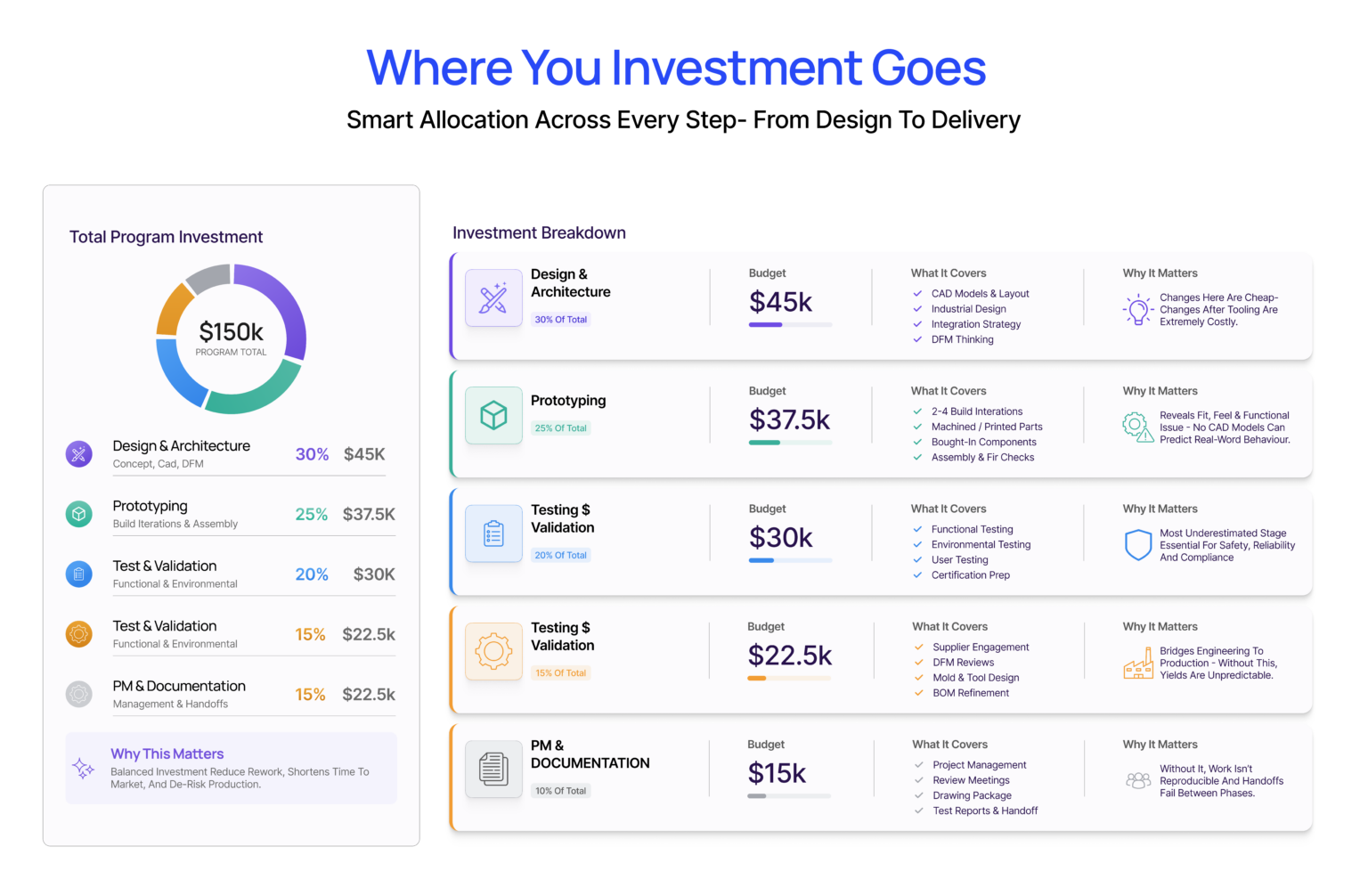
The Product Development Journey: Stage by Stage
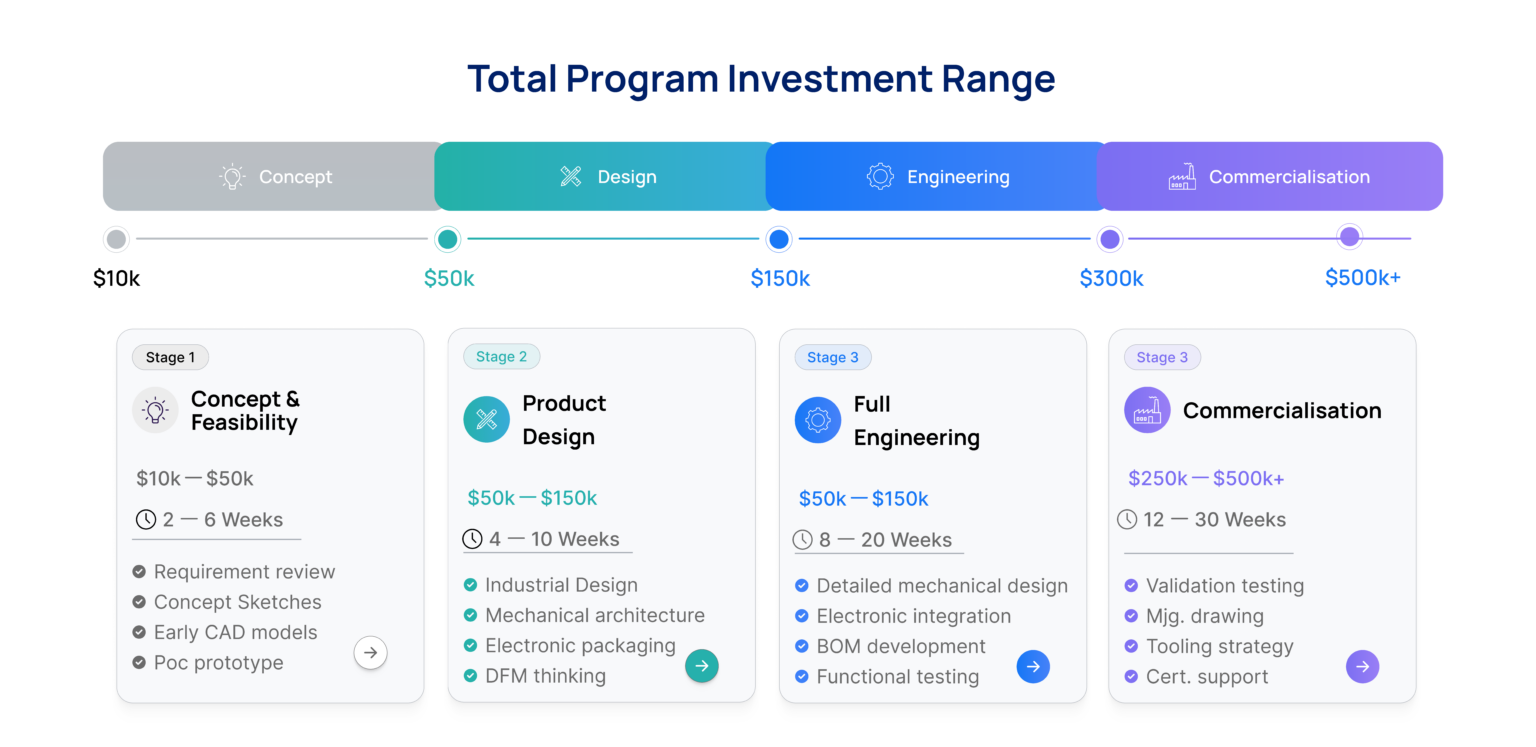
Most products move through a sequence of stages, each building on the last. Not every product needs every stage – but understanding the full journey of product development services helps you budget accurately and make better decisions about where to start and when to commit more investment.
Stage 1 – Concept and feasibility: $10k–$50k | 2–6 weeks
This stage is used when the idea is still early and the main goal is to answer basic technical and commercial questions. The work may include requirements review, concept sketches, early CAD models, rough calculations, initial component selection, and a basic proof-of-concept prototype. This phase is not intended to produce a finished product. Its purpose is to reduce uncertainty before committing to a larger engineering program.
Stage 2 – Product design: $50k–$150k | 4–10 weeks
At this stage, the product begins to take shape as a real engineering system. The work may include industrial design, mechanical architecture, electronics packaging, initial DFM thinking, prototype development, and early testing. This is usually the stage where major product decisions are made: size, layout, materials, manufacturing approach, usability, serviceability, and integration strategy.
Stage 3 – Full engineering development: $100k–$300k+ | 8–20 weeks
Full engineering development is where the product becomes technically mature. This may include detailed mechanical design, electronics integration, firmware coordination, tolerance strategy, drawings, BOM development, supplier input, prototype iterations, and functional testing. This level of work is typically required when the product must move beyond a demonstration model and become reliable enough for real use.
Stage 4 – Testing and validation: included in engineering or $20k–$80k separately
Before a product can be released or manufactured at scale, it needs to be validated against performance, durability, and regulatory requirements. This stage includes functional testing, environmental testing (temperature, vibration, ingress protection), user testing, and certification preparation. For regulated industries – medical, electrical, or food-contact products – validation is not optional. It is also one of the most common stages that clients underestimate or omit from early budgets, leading to costly surprises later.
Stage 5 – Manufacturing preparation and commercialization: $250k–$500k+ total program
Commercialization includes everything needed to move from a working prototype toward a manufacturable product. This may include engineering refinement, validation testing, manufacturing drawings, supplier coordination, tooling strategy, assembly process planning, certification support, and production preparation. This level of investment is usually required when failure in the field, manufacturing issues, or late-stage redesigns would be expensive.
Note- on how stages are quoted and paid: Most product development firms, including Ontario Dynamics, quote and invoice stage by stage. The first stage is usually quoted as a fixed figure. Later stages are estimated in advance and firmed up as the project develops. This gives clients more control over spend and lets them progress at a pace that suits their funding and goals.
Ready to Build Your Product?
Let’s turn your idea into a production-ready product engineered for success.
The Product Development Journey: Stage by Stage
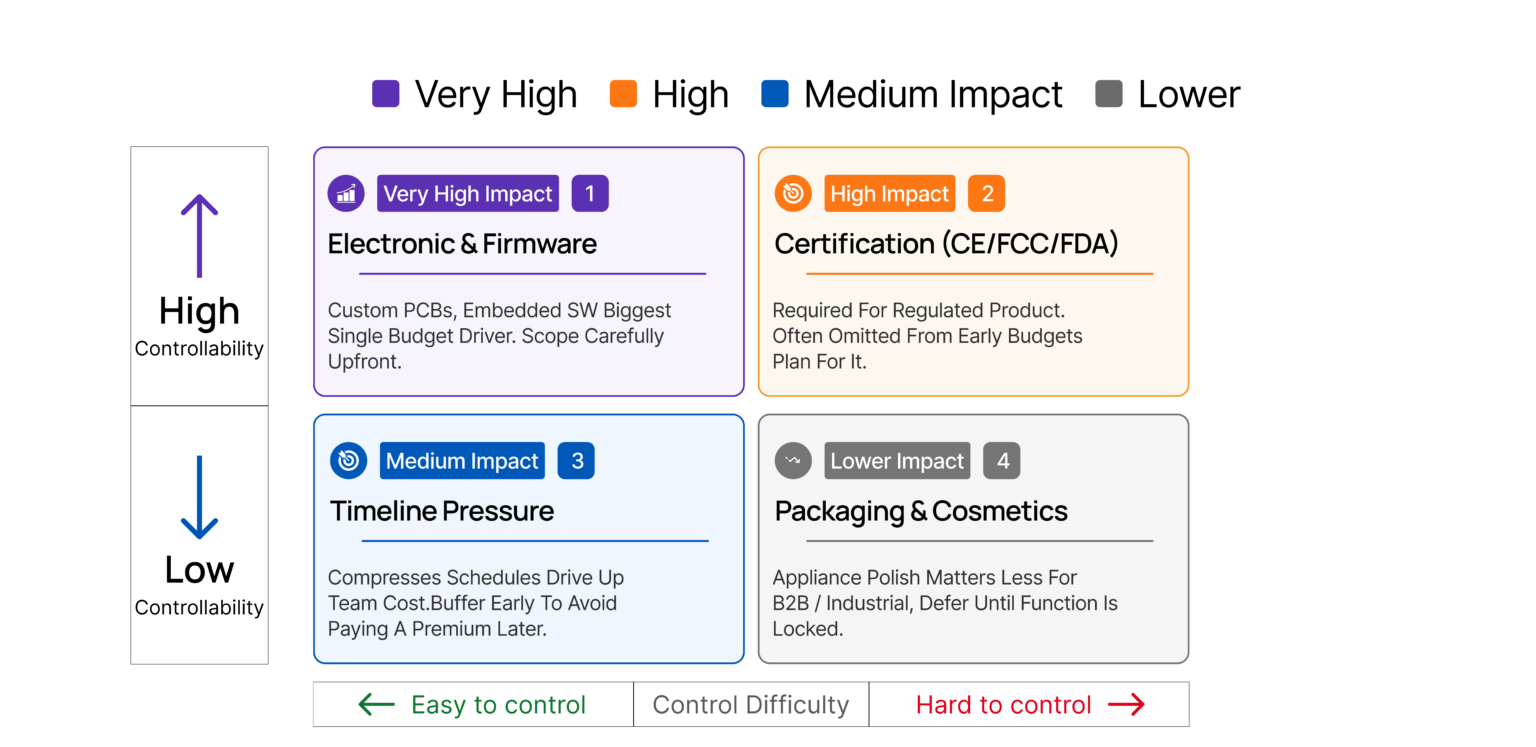
The cost depends on several factors:
- Product complexity
- Mechanical and electrical integration
- Number of custom components
- Required level of prototype quality
- Testing and validation requirements
- Material and manufacturing method
- Documentation and drawing requirements
- Timeline pressure
- Level of reliability expected
How to estimate costs for your specific product
None of your current sections help a reader self-estimate. Competitors use checklists or question frameworks to walk readers through this. It’s one of the highest-value additions possible – it keeps readers on the page longer and builds trust.
Framework: 3–5 questions that help readers bucket their project (simple/complex, electronic/mechanical, prototype/commercial-ready)
How complex is the product? (simple consumer vs. multi-component electromechanical)
What stage are you at? (idea only, working concept, existing prototype)
What does “done” look like for you? (proof of concept, pre-production, ready to manufacture)
Are there regulatory requirements? (CE, FCC, FDA, etc.)
How Ontario Dynamics Approaches Product Development
Ontario Dynamics focuses on practical engineering outcomes: products, prototypes, validation equipment, and special-purpose machines that need to work in real environments.
Our work is typically suited for clients who need to:
- Convert lab concepts into field-ready prototypes
- Improve durability, usability, and manufacturability
- Develop custom mechanical systems or test equipment
- Validate product performance through structured testing
- Reduce risk before investing in production tooling
- Support internal teams with focused mechanical engineering capacity
We help clients choose the right level of engineering effort for the stage they are in – from feasibility and concept development to prototype builds, validation systems, and manufacturing-ready designs.
The Right Question to Ask
The real question is not simply:
“How much does design cost?”
The better question is:
“What level of risk do we need to remove?”
A small feasibility project may be enough to confirm whether an idea is worth developing. A larger engineering program may be required when the product must be safe, reliable, manufacturable, and ready for real-world use.
Product development cost should be viewed as an investment in reducing uncertainty, avoiding rework, and making better engineering decisions earlier.
Ready to Build Your Product?
Let’s turn your idea into a production-ready product engineered for success.
Product development from scratch typically costs between $20,000 and $500,000+, depending on how complex the product is and how far it needs to go. A concept feasibility study runs $10,000–$50,000. A full engineering development program runs $100,000–$300,000+. A complete commercialization program - taking a concept all the way to a manufacturable product - can exceed $500,000.
Product development typically takes 3 to 18 months from concept to production-ready design, depending on the complexity of the product and how many stages are included. A concept and feasibility study takes 2–6 weeks. A product design phase takes 4–10 weeks. Full engineering development takes 8–20 weeks. These stages are usually sequential - skipping one rarely saves time because the problems it would have caught surface later, at higher cost. Products with electronics, firmware, or regulatory certification requirements consistently take longer than purely mechanical products.
A prototype proves that a concept works. A production-ready product proves that it can be made reliably, consistently, and at acceptable cost. Most products require several types of prototypes before reaching production readiness - a proof-of-concept prototype to validate the idea, a functional prototype to test real-world performance, and a pre-production prototype to verify that the manufacturing process itself produces consistent results.
No - a patent is not required before starting product development, and waiting for one will typically slow you down without protecting you any better. In most cases, engineering work should begin as soon as there is sufficient clarity on what the product needs to do.
A patent protects an idea once it is disclosed; it does not help you figure out whether the idea is technically feasible, manufacturable, or commercially viable.
Yes - a sketch or idea is a valid starting point for product development. The concept and feasibility stage exists precisely for this situation. Starting from a sketch, an engineering team can review requirements, identify technical risks, explore concept directions, build early CAD models, run basic calculations, and produce a proof-of-concept prototype - all without a finished design.
What matters at this stage is not how developed the idea is, but how clearly the problem it solves is understood. A sketch with well-defined requirements is a better starting point than a detailed concept with none.
DFM stands for Design for Manufacturability. It is the practice of designing a product so that it can be manufactured efficiently, consistently, and at acceptable cost - not just so that it works as an engineering object. DFM considerations include part geometry, material selection, tolerances, assembly sequence, fastener choice, and the manufacturing processes available to the supplier making the part