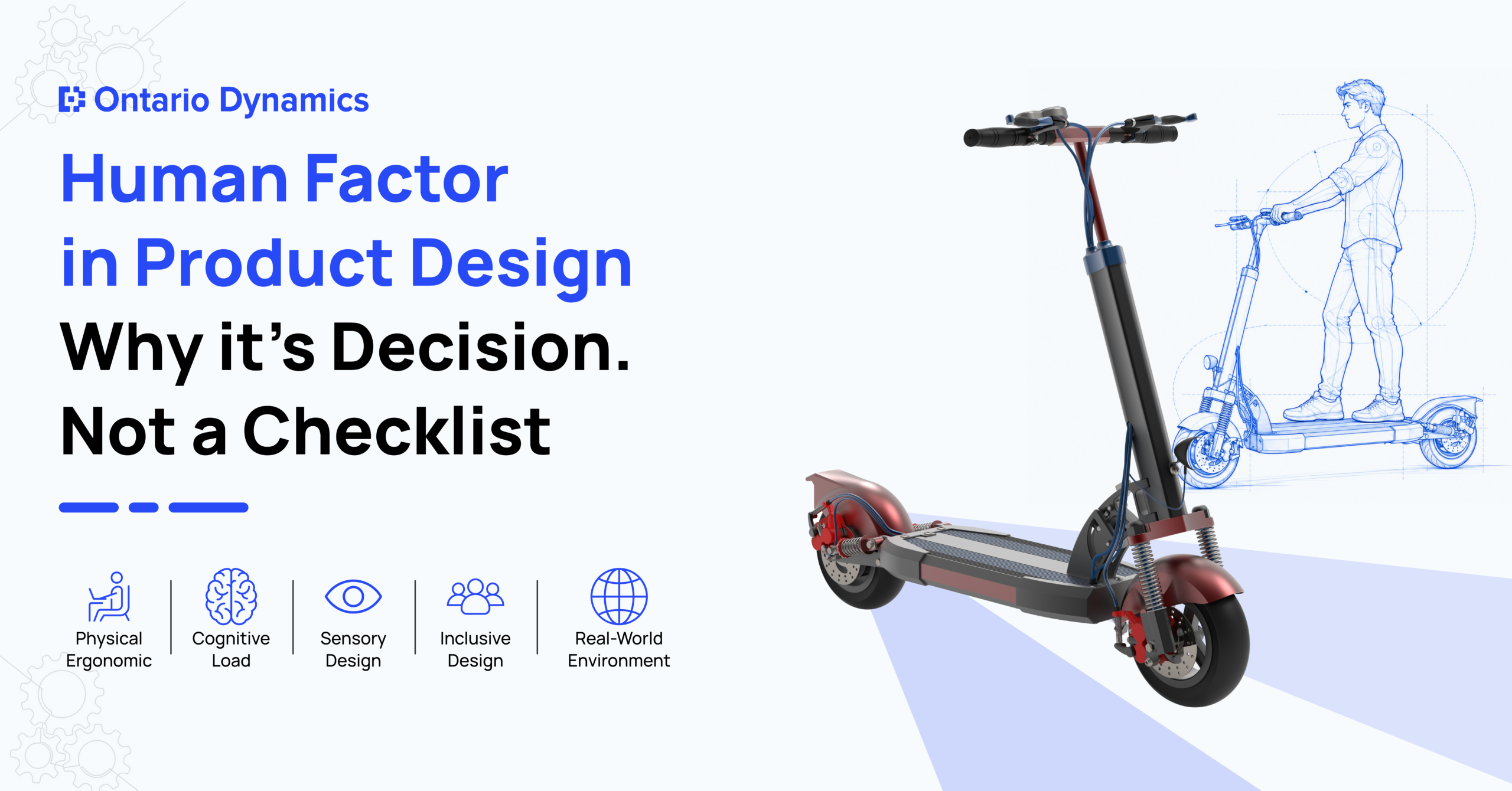
Human Factors in Product Design: Why It’s a Decision, Not a Checklist
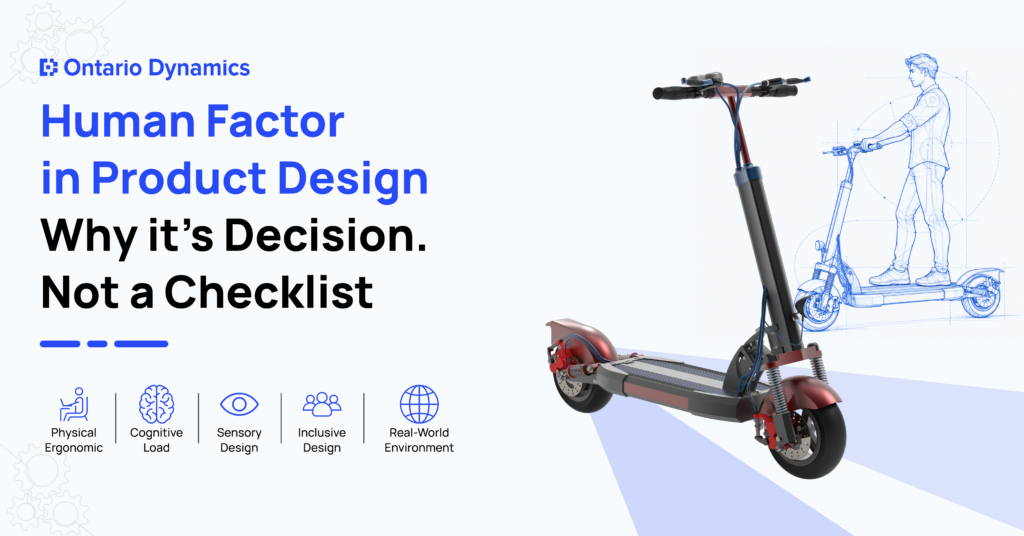
Human factors in product design means shaping a product around real human abilities, limits, and behavior, instead of an idealized user. The goal is safe, comfortable, error-free use. It applies from the first concept through final validation, not as a late review.
Most usability problems show up after launch, not during testing. By then, tooling and manufacturing are locked, and every fix costs more. This article helps you decide when human factors work changes outcomes.
Key Takeaways:
- Human factors covers physical, cognitive, and sensory fit between people and products.
- It focuses on safety and error prevention. UX covers the wider experience.
- Late fixes cost far more than early ones.
- Five elements and five principles give you a practical framework.
- Early involvement protects budget, timeline, and users.
What Are Human Factors in Product Design?
Human factors design is the discipline of fitting a product to the people who use it. It looks at body mechanics, mental effort, and the senses. It also looks at the setting where the product is used.
People often confuse it with UX. The two overlap, but they ask different questions. Human factors asks, “Can someone use this safely, without error or strain?” UX asks, “Does the whole experience feel good and make sense?”
A medical pump with an easy-to-misread dial has a human factors problem. A pump with a dull startup screen has a UX problem. Both matter, but only one can hurt someone.
Why Does Human Factors Matter in Product Development?
Human factors matter because mistakes found late cost much more than mistakes found early. That affects your budget and your launch date, not just your users.
Regulators are paying close attention too. In May 2026, the FDA issued final guidance on human factors information in medical device marketing submissions. It covers 510(k)s, De Novo requests, PMAs, and humanitarian device exemption applications. It sets a risk-based framework for what to document, which makes use-related risk a planning item from day one.
The wider cost pattern is well documented, though it covers design defects in general. One review of past studies cites a Ricoh case where a fix cost $35 in design versus $690,000 in field service. The same review notes that NASA found defects caught only in operation cost 50 times more than those caught at the concept stage. Another study found that design decisions made before design freeze account for 86% of total expected program cost.
Skipping this work leads to specific problems:
- Recalls and warranty claims
- Accessibility complaints
- Failed or delayed regulatory submissions
- Redesign after tooling is cut
What Are the Core Elements of Human Factors Design?
Human factors design rests on five elements: physical ergonomics, cognitive load, sensory and perceptual design, inclusive and accessibility design, and environmental context. Each covers a different way a product can fit, or fail to fit, its user.
1. Physical Ergonomics
This is how shape, size, weight, grip, and reach fit the human body. Think of button placement on a handheld device. If a thumb can’t reach the main control without shifting the grip, people will drop it or avoid it.
2. Cognitive Load
Cognitive load is the mental effort needed to operate a product. Good design reduces memory demands and confusion. It also looks at design psychology, meaning how people actually decide and act under real conditions, such as time pressure or distraction.
3. Sensory and Perceptual Design
This covers visual indicators, color coding, sound alerts, and tactile feedback. Emotional response lives here too. Color, typography, and sound all shape how a product feels, so they don’t need a separate category.
4. Inclusive and Accessibility Design
Products should work across ages, abilities, and skill levels. Design for aging is part of this: weaker hearing and vision, the need for better lighting, and larger critical details. Culture also matters, since people read colors, shapes, and symbols differently.
5. Environmental Context
Lighting, noise, and stress change how people perform. A control panel that works in a quiet lab may fail on a loud, dim shop floor. Test in the real setting, not only the ideal one.
Which Design Principles Guide Human Factors Work?
Five principles guide most human factors decisions: visibility and affordance, feedback, consistency, error management, and user control. Together they make products easier to learn and harder to misuse.
Principle | What it means | Example |
Visibility and affordance | A control’s look shows what it does and how to use it | A handle that clearly invites a pull |
Feedback | Users get clear confirmation that an action worked | A click, light, or vibration after a press |
Consistency | The same action gives the same result every time | Matching button layouts across a product line |
Error management | The design expects mistakes and limits the damage | Confirmation steps for critical actions, easy undo |
User control | People can adjust or override automated behavior | A manual mode when automation misreads a situation |
Error management deserves extra attention. Good design prevents critical errors, makes recovery easy, and explains clearly when something goes wrong. User control matters just as much. Forcing one fixed path on every user rarely works in the field.
What Happens When Human Factors Is Skipped?
Skipping human factors usually means problems appear after launch, when they cost the most to fix. You may face rework after tooling is locked, higher return rates, user errors in safety-critical tasks, and regulatory delays.
Area | Designed with human factors | Designed without it |
Usability | Validated with real users before launch | Issues surface in the field |
Cost of fixes | Caught and resolved at design stage | Rework after tooling and manufacturing are locked |
Regulatory path | Documentation supports submission, where applicable | Risk of delays or rejected submissions |
Accessibility | Usable across age and ability ranges by design | Excludes users outside the “ideal” profile |
The cost is not only money. A recall damages trust. A confusing interface in a safety-critical product can hurt people.
Human factors also sits inside a bigger picture. It is the usability and safety layer within the broader industrial design process, which covers form and function as a whole.
How Ontario Dynamics Approaches Human Factors
Ontario Dynamics builds human factors thinking into the development process, so use decisions are made alongside decisions about structure, materials, and manufacturing. The same team that plans a project also handles design, drawing review, and support through delivery.
In practice, the process looks like this:
- Understand the use. We start with who will use the product, where, and under what conditions.
- Validate early. Proof-of-concept builds and prototypes let real people try the design before tooling is committed.
- Build for manufacture. Design for manufacturability and product testing keep usability decisions intact through production.
For medical device work, Ontario Dynamics designs with the design history file in mind from the start, not as an afterthought.
If you are planning a new product, our product development services cover this full path from concept to production documentation. Tell us about your product’s use setting and user base through the contact page. We will respond with where human factors should sit in your development timeline.
Conclusion
Human factors is not a polish step at the end. It is a design decision that determines whether a product is safe, usable, and ready for the field. Making that decision early protects your users, your budget, and your timeline.
Ontario Dynamics is a Canada-based product and equipment development company that works with startups and manufacturers. To see where human factors fits in the wider journey, read our guide to the design for manufacturability checklist.
FAQ
They are the physical, cognitive, and sensory characteristics of people that a product must fit. Designers use them to make products safe, comfortable, and easy to use correctly.
Human factors focuses on safety, error prevention, and body mechanics. UX covers the full experience, including emotion and satisfaction. A product needs both, but human factors comes first when harm is possible.
At the concept stage. Early decisions on shape, controls, and layout set most of a product’s cost and usability. Waiting until final review leaves little room for change.
No. Medical devices face formal rules, such as FDA guidance. But the same thinking helps automotive, industrial, and consumer products, where confusing controls and poor fit cause errors and returns.
Ergonomics is one part of it. Physical ergonomics covers body fit. Human factors also covers mental effort, the senses, accessibility, and the use environment.
Ready to Build Your Product?
Let’s turn your idea into a production-ready product engineered for success.