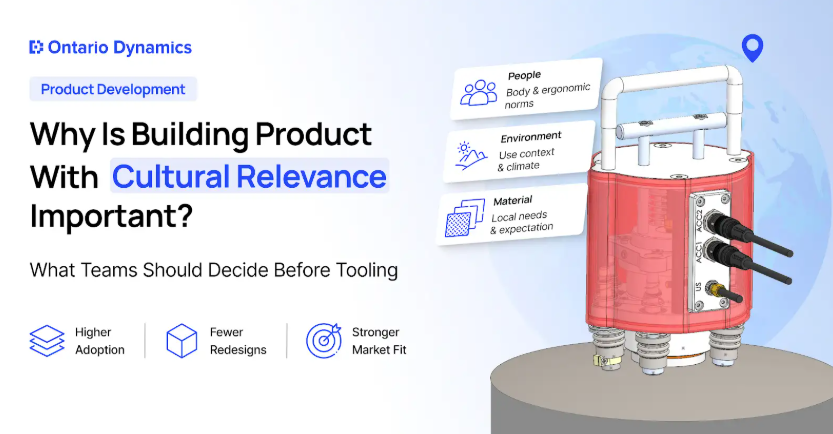
Why Is Building Products With Cultural Relevance Important? What Teams Should Decide Before Tooling
Most teams treat culture as a launch or marketing problem. It’s really a development decision. Use context, body norms, materials, symbols and local standards are all locked in before tooling is cut. That’s why building products with cultural relevance is important long before launch day.
A peer-reviewed study in Design Science found that choices made before design freeze set 86% of a program’s total expected cost.
Cultural relevance means fitting a product to the beliefs, habits, use environments and expectations of the people who will actually use it. Get it right and you see higher adoption and trust, fewer late redesigns and fewer failed market entries.
This blog is for startups and manufacturers designing products for different cultures. It covers what to decide before tooling for a new market.
Key Takeaways
- Cultural relevance is about how, where and by whom a product is used. It’s decided during development, not at launch.
- It goes deeper than product localization. It can change size, materials, controls and capacity.
- Late fixes cost far more. Problems found late can cost over 10 times as much to fix.
- Adapt in proportion to how different the market is: light, moderate or deep.
- The cheapest point to catch a mismatch is just before design freeze.
What Does Cultural Relevance Mean in Product Development?
Cultural relevance is how well a product fits the way it’s used, where it’s used and who uses it. It covers habits, environment, body norms, symbols and local expectations. It’s set during design and development, not added at launch.
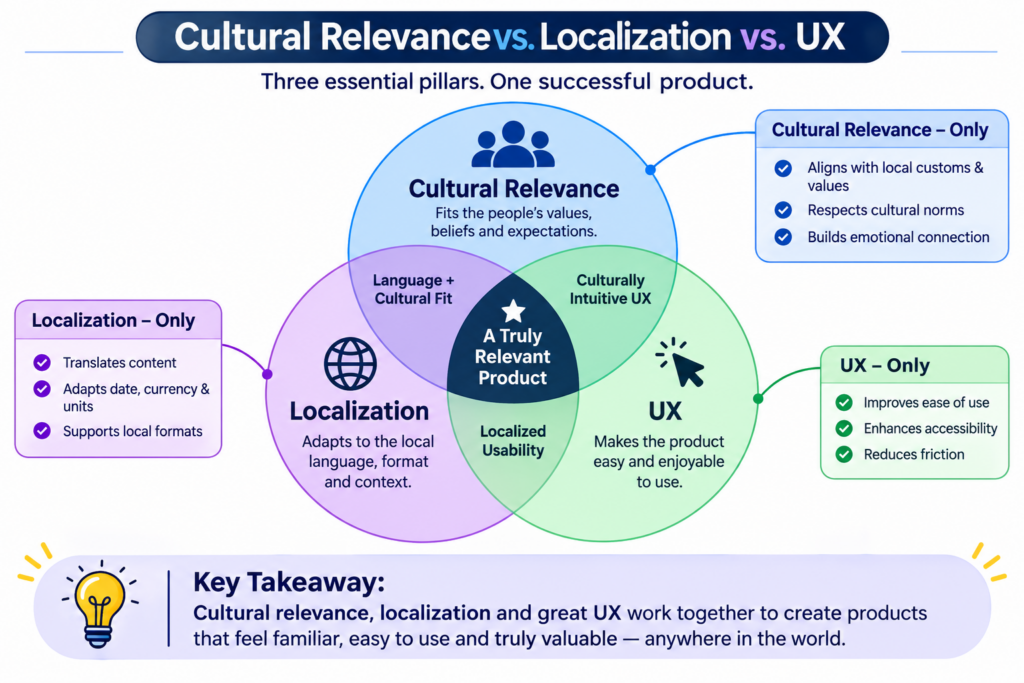
Cultural relevance in product design differs from two related ideas:
- Product localization changes language, packaging, currency and regulatory text. The product stays the same.
- UX makes a product easy for a defined user. Cultural relevance asks whether you’ve picked the right user and context in the first place.
It comes down to four things:
- Use context: home, workplace or site, and the climate.
- Body and ergonomic norms: height, hand size, grip and reach.
- Symbols, colour and form: what shapes, colours and icons mean locally.
- Local standards and expectations: certification, power and labelling rules.
Localization | Cultural relevance | UX | |
What changes | Words, packaging, units | The product and how it’s expected to be used | Interface flow and clarity |
Decided when | Late (pre-launch) | Early (concept to prototype) | Throughout design |
Typical owner | Marketing, translation | Product development, research | Design |
What a Cultural Mismatch Costs in Product Design
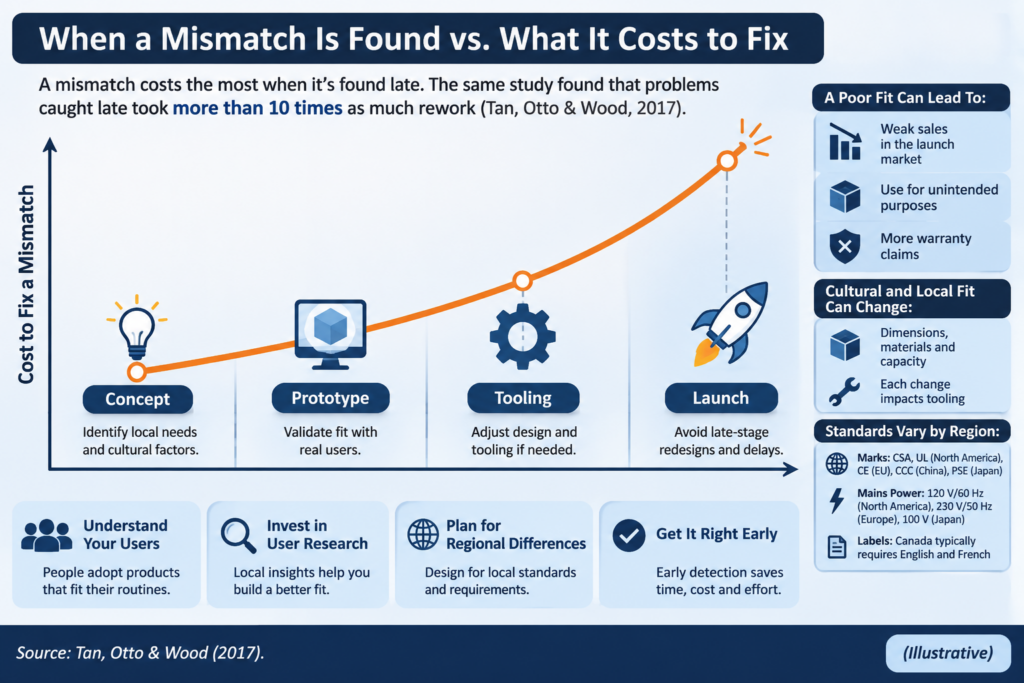
A mismatch costs the most when it’s found late. The same study found that problems caught late took more than 10 times as much rework to fix.
Adoption and Trust
People adopt products that fit their routines and avoid ones that force new habits. A poor fit means weak sales in the launch market, people using the product for jobs it wasn’t built for, and warranty claims from that misuse.
Avoiding Late-Stage Redesign
Cultural fit changes dimensions, materials and capacity, and each of those affects tooling. Find a mismatch late and you face retooling, re-certification, a missed launch window and another round of user testing.
Competitive Differentiation
Local fit comes from user research and knowing how people actually use a product. Competitors can copy a feature list. They can’t copy months of field observation in your market.
Regulatory and Standards Fit
Standards change the design itself, not just the paperwork:
- Marks: CSA and UL in North America, CE in the EU, CCC in China, PSE in Japan.
- Mains power: 120 V/60 Hz in North America, 230 V/50 Hz in most of Europe, 100 V in Japan.
- Labels: Canada generally requires English and French on consumer products.
Where Cultural Relevance Shows Up in a Physical Product
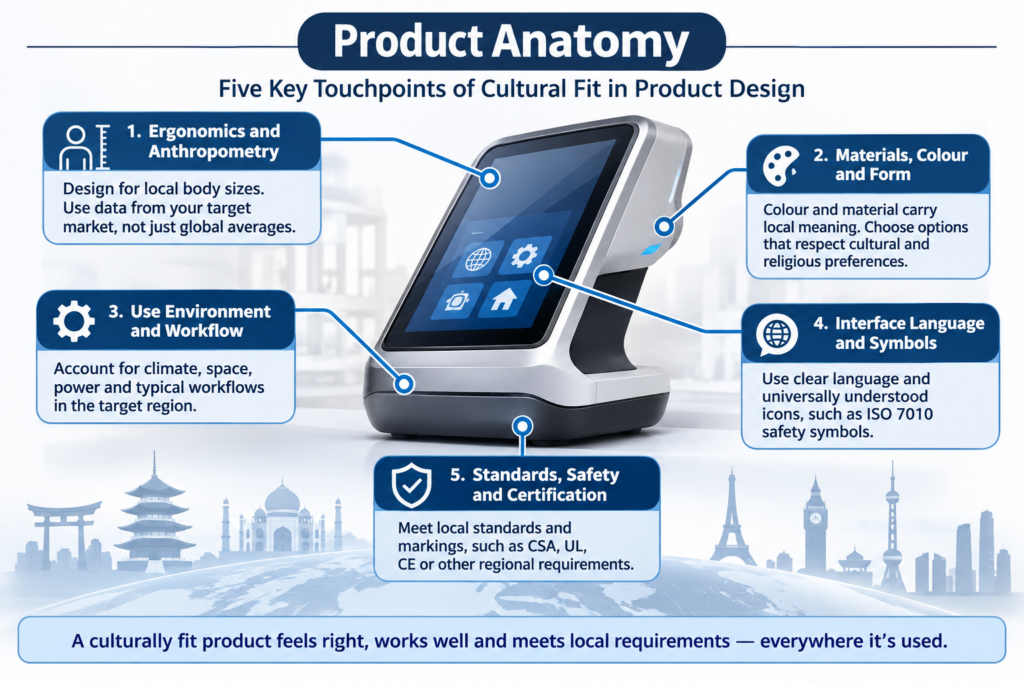
It shows up in five places:
- Ergonomics and anthropometry
- Materials, colour and form
- Use environment and workflow
- Interface language and symbols
- Standards, safety and certification
Ergonomics and Anthropometry
Body sizes differ across populations, so teams usually design for the 5th to 95th percentile of the target population’s measurements. A US Army dataset such as ANSUR II won’t automatically fit civilian operators in Southeast Asia. That’s why ergonomics data has to come from the market you’re selling into.
Materials, Colour and Form
Colour and material carry local meaning. White signals mourning in parts of East Asia, and pork-derived gelatin can rule a product out for halal or kosher buyers.
Use Environment and Workflow
Climate, dust, power, space and workflow all shape the design. Dyson made its DC26 about 30% smaller for Japanese homes. For equipment, plant power is often 600 V three-phase in Canada but 400 V/50 Hz in Europe, and glove sizes and floor space vary from site to site.
Interface Language and Symbols
Labels and safety signs must make sense to local users, and icons aren’t universal. ISO 7010 safety symbols help warnings work across languages.
Standards, Safety and Certification
Local standards affect clearances, materials and markings, so check them before tooling. In regulated categories, medical device labeling rules can change how much content has to fit on the device. That belongs in your human factors work.
What Happens When Products Miss Their Market?
People find workarounds, return the product or don’t buy it at all. These three examples show different levels of adaptation.
Dyson DC26, Japan (moderate). In 2009, Dyson launched compact vacuums for smaller Japanese homes. The DC26 was about 30% smaller than its base models at 205 × 320 × 266 mm, roughly the size of an A4 sheet. It was sold only in Japan, with a target of 250,000 units a year.
Haier XPB40-DS, rural China (deep). A Sichuan farmer’s drain kept clogging because he was washing sweet potatoes in his machine. Haier built a model with a very large drain outlet that cleans both clothes and produce. It was priced at 848 yuan (about €110), and its first 10,000 units sold out.
Both cases are old but well documented. More recently, LG studied more than 1,200 Indian families before launching its Essential Series in October 2025.
The same rule applies in all three: the later you find a mismatch, the more it costs to fix. Use this table to decide how far to adapt:
Depth | What changes | Signals you need it | Example |
Light | A small change to a physical feature | People use the product for the same task, but local work practices affect how they handle it | Spacing control buttons farther apart so operators wearing thick gloves can press one button at a time |
Moderate | Size, ergonomics, materials, controls | Different space, bodies or environment | Dyson DC26 |
Deep | The core use case | Users do something you didn’t plan for | Haier XPB40-DS |
The table below shows what changes when teams consider cultural relevance from the start of product development.
Area | Cultural relevance considered from the start | Cultural relevance overlooked during development |
Research timing | At the start of product design and development, before choosing a concept | After launch |
Redesign risk | Caught at prototype | Found after tooling |
Adoption | Fits local use | Returns, workarounds |
Cost of fixes | Small changes | Retooling, re-certification |
How to Build Cultural Relevance Into Product Development?
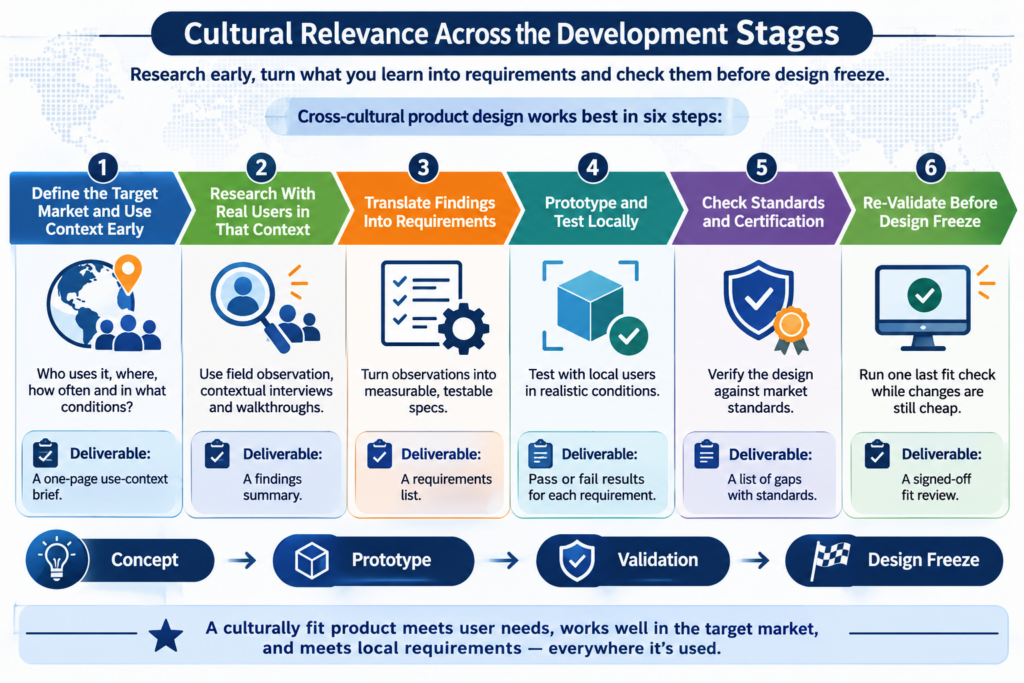
Research early, turn what you learn into requirements and check them before design freeze. Cross-cultural product design works best in six steps:
- Define the target market and use context
- Research with real users
- Translate findings into requirements
- Prototype and test locally
- Check standards and certification
- Re-validate before design freeze
Step 1: Define the Target Market and Use Context Early
Who uses it, where, how often and in what conditions? Deliverable: a one-page use-context brief the team agrees on before the concept is locked.
Step 2: Research With Real Users in That Context
Don’t rely on desk surveys. Use field observation, contextual interviews and walkthroughs where the product is actually used, and include local advisors in your user research. Deliverable: a findings summary.
Step 3: Translate Findings Into Requirements
Turn what you observed into measurable, testable specs: dimensions, capacity, materials, labels and standards. Deliverable: a requirements list you can trace through design and testing.
Step 4: Prototype and Test Locally
Test with local users in realistic conditions. Match the prototype’s level of detail to the question you’re answering at each of the stages of prototyping. Deliverable: pass or fail results for each requirement.
Step 5: Check Standards and Certification
Before tooling, check the design against the market’s standards: CSA for Canada, UL and FCC Part 15 for the US, CE for the EU, and CSA Z432 or ISO 12100 for machinery. Deliverable: a list of gaps between the design and those standards.
Step 6: Re-Validate Before Design Freeze
Run one last fit check while changes are still cheap. Cultural adaptation decided here costs far less than after tooling, and good industrial design keeps form and manufacturability in step. Deliverable: a signed-off fit review.
Create Culturally Relevant Products With Ontario Dynamics
At Ontario Dynamics, cultural relevance starts with the design brief. We look at who will use the product, where they’ll use it and how it needs to fit into their work. Those findings become requirements we can test. For example, if operators routinely wear thick gloves, we specify how much space they need between controls and test the prototype with those gloves on.
Our team takes products and equipment from concept through production, so the same requirements guide prototyping, engineering and the final production specifications. Before tooling, we check that the design works in realistic conditions, meets applicable standards and can be manufactured as intended. Explore our product development services.
Tell us your target market and product stage. We’ll show you where cultural-fit research belongs in your timeline.
Conclusion
Cultural relevance is a development decision, not a launch fix. Adapt in proportion to how different the market is, and check before design freeze while changes are still cheap. That’s why building products with cultural relevance is important for any team entering a new market.
Ontario Dynamics is a product and equipment development firm in Toronto, Canada, that helps startups and manufacturers take products from concept through production. To go deeper, read Human Factors in Product Design.
FAQ
No. Inclusive design makes a product usable by as many people as possible. Cultural relevance makes it fit one market’s habits and environment.
Industrial equipment needs to fit the conditions people work in. Local power supplies, safety standards, operator body dimensions and available floor space can all affect how the equipment is designed.
Ready to Build Your Product?
Let’s turn your idea into a production-ready product engineered for success.