How to Choose the Right Product Development Partner for Your NPD Timeline and Budget
In Brief
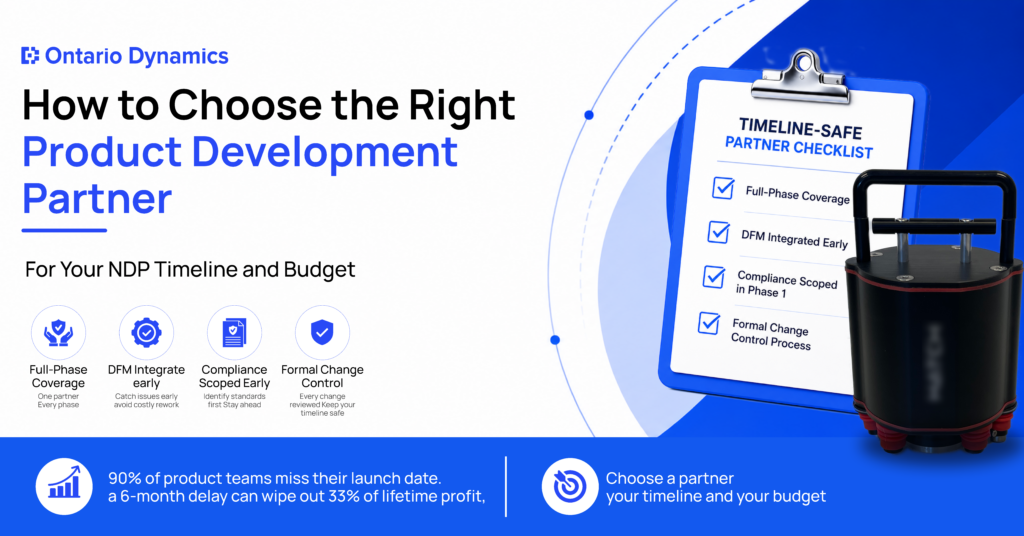
- Full-phase coverage, early DFM, Phase 1 compliance scoping, and formal change control are the four things that actually protect your timeline.
- 90% of product teams miss their launch date, and a 6-month delay can wipe out a third of a product’s lifetime profit.
- Ask about DFM timing, compliance scoping, and change control before you sign anything.
- Ontario Dynamics builds these safeguards into every product development engagement from kickoff.
Objective
This guide provides product teams and startup founders with a practical framework for evaluating a product development partner before signing a contract, ensuring that timeline risk is identified in Phase 1 rather than Phase 4.
Key Takeaways
- Partner selection is a timeline decision first, a cost decision second.
- Handoffs between vendors add weeks. Full-phase coverage removes that cost entirely.
- DFM done during design, not after design freeze, prevents most late-stage rework.
- A documented ECO process is the single biggest predictor of whether a project ships on time.
Most product teams treat product development partner selection the same way they’d pick a supplier for packaging tape. Compare a few quotes, glance at the portfolio, and choose the one that feels the most polished. That approach works fine for tape. It doesn’t work for a partner who will influence every mechanical decision your product makes for the next six to nine months.
The problem with the wrong partner never shows up in the quote. It shows up in Phase 4, when a design flaw that should have been caught in Phase 2 forces a change order, and that change order eats the engineering budget you’d set aside for something else entirely.
This guide walks through what to look for in a product development company, the questions worth asking before you sign, and the red flags that predict a delay before any real work begins.
Why Choosing the Wrong Partner Always Shows Up Late in the Product Development Schedule
Partner selection is a timeline decision. Treating it as a cost decision is where most of this goes wrong.
The numbers back this up. Roughly 25% of outsourcing relationships fail within two years. Every handoff between phases, from concept to prototyping to manufacturing setup, adds weeks of re-briefing and documentation realignment. AI-augmented development teams are now showing 30% faster cycle times than commodity vendors, largely because they carry fewer coordination gaps between stages.
The consequences compound fast. About 90% of product teams miss their original launch date. A six-month delay can destroy a third of a product’s lifetime profitability. None of that risk is visible in a proposal document. It lives entirely in how the partner runs the process, which is exactly why product development timeline risk needs to be evaluated up front, not discovered later.
How Do You Evaluate a Product Development Partner for Timeline Risk? Four Criteria That Matter
Criterion 1: Full-Phase Coverage From Concept Through Production
Ask whether the partner supports idea validation, concept design, prototyping, testing, compliance, and manufacturing setup, or only a slice of that list.
A partner who describes their service as “design and prototyping” and points to “their network” for manufacturing setup is telling you where the first handoff will happen. Every handoff between teams costs three to six weeks of re-briefing and trust-building, even when both sides are competent.
Ask which phases they’ve delivered in the last twelve months, and ask for documented handoff packages from those projects. Vague answers here are the clearest early signal.
Criterion 2: DFM Integration in Phases 2 to 3, Not Phase 4
DFM product development partner practices separate serious teams from the rest. The question is timing. Does design-for-manufacturability review happen while the design is still being shaped, or after it’s already frozen?
A partner who calls DFM a “final review before production” is telling you it happens too late to matter. When manufacturability issues surface after design freeze, they trigger post-freeze change orders that can consume 33 to 50% of the remaining budget. Ask when the DFM review is typically completed relative to the design freeze in their standard workflow.
Criterion 3: Compliance Scoping in Phase 1
Compliance scoping product development should start at kickoff, not at the point where the product is ready for testing. A partner who identifies applicable standards, FCC, CE, UL, FDA, CSA, before the engineering scope is finalized has already removed one of the biggest sources of late-stage delay.
Compliance surprises discovered in Phase 5 add six to twelve weeks, regardless of how fast the rest of the project moves. Lab lead times don’t compress for anyone. Ask for a sample Phase 1 deliverable and check whether it includes a compliance standards matrix.
Criterion 4: Formal Change Control From the Outset
ECO change control partner processes separate a well-run project from a chaotic one. Design changes are inevitable. What matters is whether every change gets evaluated for timeline and budget impact before it’s approved, or whether it just gets absorbed into the schedule through email threads.
Informal change management is the single most consistent cause behind that 90% launch-delay statistic. Ask how a mid-project design change gets handled in their process, and whether that process is documented anywhere outside someone’s inbox.
Seven Questions to Ask a Product Development Partner Before You Sign
Before signing anything, run through these:
1. Which phases have you delivered in the last 12 months, with documentation to show for it?
A good answer names specific projects and deliverables. A weak answer says “we cover the full journey” without specifics.
2. When does DFM review happen relative to the design freeze?
Concurrent with Phases 2 to 3 is the answer you want. “Before production” is a red flag.
3. What compliance standards did your last three hardware projects require, and when did you identify them?
Phase 1 identification is the standard. “Depends on the product” isn’t.
4. How is a mid-project design change handled?
Look for a formal ECO process with documented cost and timeline review, not “we’re flexible.”
5. What does your production handoff package include, and who produces it?
You want a specific list, BOM, drawings, and PVT report, produced by the same team that did the design work.
6. Can you show me a project where the timeline slipped, and what caused it?
Every real partner has one. A partner who claims none ever slipped isn’t being straight with you.
7. What happens if a key person on your team leaves mid-engagement?
Look for a documented backup plan and IP protection built into the contract, not just reassurance.
Which Partner Behaviours Predict a Blown Timeline Before Any Work Begins?
Some of these show up before the contract is even signed.
They quote before asking about the compliance scope. A price that arrives before anyone asks which markets the product will sell into is a price built on guesswork. That gap resurfaces in Phase 5 as an unexpected cost.
They talk about prototyping as one event. Most hardware products need three to five prototype cycles. A partner who treats “the prototype” as a single deliverable will bill each additional round as scope creep instead of planning for it upfront.
No one owns DFM. If nobody on the team can tell you who’s responsible for DFM review and when it happens, it’s happening informally, which usually means after design freeze.
Changes get managed over email or Slack. Conversations don’t carry a documented timeline impact. Decisions do.
The handoff package isn’t defined until the end. Ask what’s included before you sign. If there’s no specific list, the handoff is whatever’s convenient when the project wraps, not a planned deliverable.
How Does Ontario Dynamics Protect a New Product Development Timeline?
The four criteria above describe how a timeline-safe partner operates. Here’s how Ontario Dynamics builds each one into its process.
Full-phase coverage: projects run from concept through production validation with a single team and a single documentation trail. There’s no handoff gap because there’s no handoff.
DFM in Phase 2 to 3: DFM review runs alongside detailed design work, not as a gate stuck in front of production.
Compliance in Phase 1: applicable standards are identified and written into the project brief before the technical scope is locked in.
Formal change control: every design change goes through a documented evaluation for timeline and budget impact before it’s approved; the same framework is used across every project.
Tell us your current phase and product type, and we’ll give you a realistic timeline estimate along with a clear picture of where your highest timeline risk sits right now. Take a look at our product and equipment development services to see how this plays out across a full project.
FAQ
Most companies spend two to four weeks evaluating options if they run a structured process with the questions above. Rushing this step is usually where the timeline problems start.
It depends heavily on product complexity, but a full development cycle from concept to production-ready documentation typically runs five to nine months, and budget scales with that timeline. Fixed-fee, phase-based pricing gives the clearest picture upfront.
Yes, and it usually happens gradually. A missed compliance requirement, one undocumented design change, and one handoff between vendors. Each one adds weeks, and they stack.
Any serious partner will sign one before any technical discussion happens. If a company is reluctant to sign an NDA before hearing details, that's worth noting.
The mechanical fundamentals don't change by industry. A partner with strong core process discipline can usually still help, but ask directly and expect an honest answer about fit.
Choosing the right partner isn’t about finding someone who agrees with every decision. It’s about finding one who flags the decisions that will cost you time before they’re made. Full-phase coverage, early DFM, Phase 1 compliance scoping, and formal change control aren’t extras. They’re the baseline.
Ontario Dynamics works with startups and manufacturers across Canada on product and equipment development, and every project runs on this same framework from day one. If you want a realistic product development timeline for your next project, start with our timeline guide or reach out directly and tell us where you’re starting from.
Ready to Build Your Product?
Let’s turn your idea into a production-ready product engineered for success.