Product Development Timeline 2026: A Realistic Phase-by-Phase Guide for Product Owners
Objective
Give product owners and manufacturers a realistic, phase-by-phase view of what a product development timeline actually looks like in 2026, why most timelines slip, and what separates teams who hit their launch date from teams who don’t.
Key Takeaways
- A standard product development timeline runs from 3 months for simple software to 3+ years for regulated hardware.
- Most physical products take 12–24 months across seven phases: discovery, concept, prototyping, testing, compliance, manufacturing setup, and launch.
- The most common cause of timeline overrun isn’t a slow phase; it’s a decision made in Phase 1 that surfaces as a problem in Phase 5.
- Top-performing teams finish 20–25% faster, and the gap comes from process discipline at each phase gate, not from moving faster.
They budgeted six months. It took eighteen. They planned for one build cycle and ran four. Then, somewhere around Phase 5, someone asked whether the product needed CE certification, a question that should have been answered before the first sketch was drawn.
None of this is bad luck. A product development timeline doesn’t fall apart because the team was slow. It falls apart because it was never fully scoped in the first place, and the gaps don’t show up until they’re expensive.
This guide walks through the new product development process as a realistic timeline: how long each phase actually takes, what pushes it longer, and what the fastest teams do differently. A product development timeline ranges from 3 months for simple software to 3+ years for regulated hardware. Most physical products take 12–24 months across seven phases: discovery, concept, prototyping, testing, compliance, manufacturing setup, and launch. Most delays trace back to a decision made in Phase 1 (complexity, compliance scope) that wasn’t caught until Phase 4 or 5. Teams that lock requirements early and run design-for-manufacturing work in parallel, not after, launch 20–25% faster.
How Long Does Product Development Actually Take?
Most first-time founders underestimate this by a wide margin. Software timelines compress with faster iteration. Hardware doesn’t work that way; sourcing, tooling, certification, and production setup add months that no amount of iteration speed can remove.
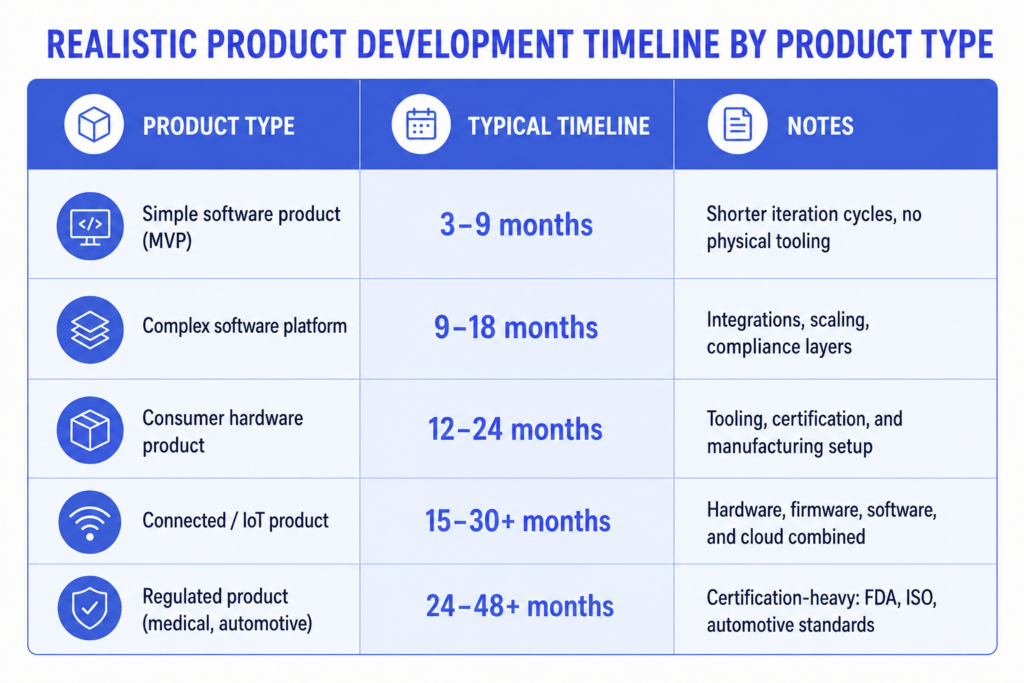
The scope of the innovation matters as much as the product category. A line extension or minor reformulation of an existing product typically runs 6–9 months. A core innovation within a category you already know takes 9–15 months. A genuinely new-to-market or technically complex product runs 12–24+ months; this is where the NPD timeline by industry benchmarks varies the most, since regulatory load and supply chain maturity differ so much by sector.
However you slice it, the honest answer to how long does product development take is: it depends on what you’re building, but rarely as little as first estimated.
What Really Causes Product Development Timeline Delays?
The reason most timelines slip has little to do with a development team moving slowly. It has everything to do with decisions made early, in discovery and concept, that reveal their cost months later.
Three numbers explain most of it:
- 90% of product launches are delayed. The most common cause is a late-stage design change triggered by a decision that should have been resolved earlier in the process.
- A 6-month slip destroys roughly a third of lifetime profitability. Industry benchmarking research consistently frames this as a profit problem, not a scheduling inconvenience.
- Top performers finish 20–25% faster. The gap isn’t speed. It’s discipline at each phase gate; nobody moves into the next phase with open questions from the last one.
The 7 Phases of a Realistic Product Development Timeline
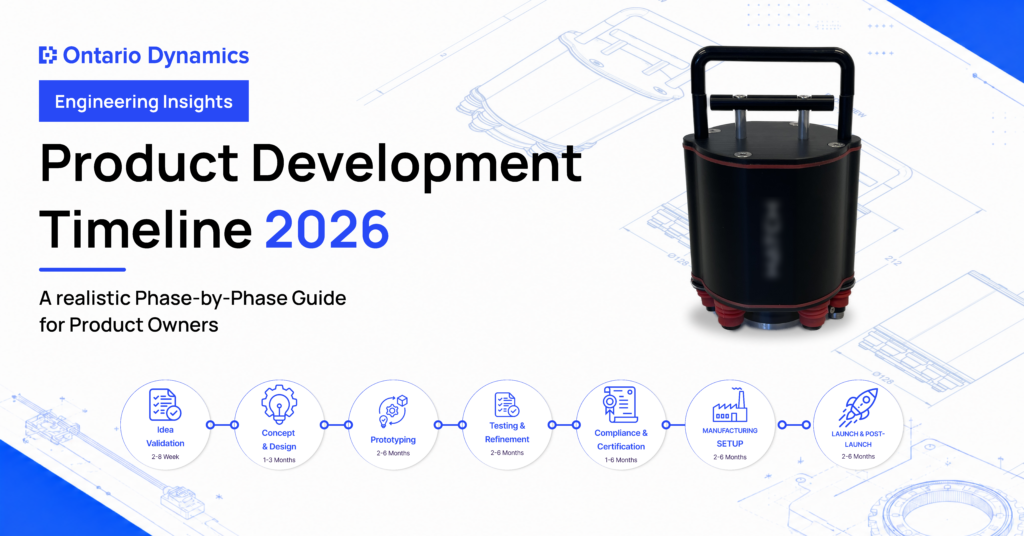
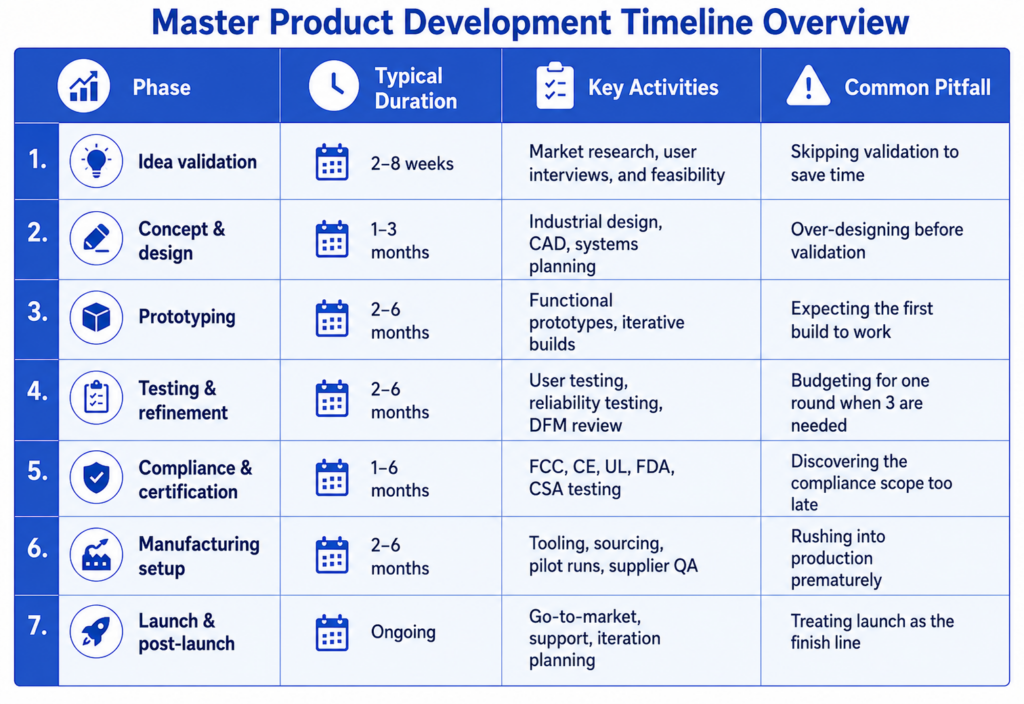
A realistic timeline breaks into seven phases: idea validation, concept and design, prototyping, testing and refinement, compliance and certification, manufacturing setup, and launch. Here’s what each one actually involves, and where the time really goes.
Phase 1: Idea Validation, What Problem Are You Actually Solving?
The goal here is simple: confirm the problem exists and that your product solves it, before any money goes into detailed design. That means market research, competitive analysis, and 5–10 structured interviews with people who’d actually buy the thing.
Skipping this to save two weeks is how teams end up spending six months building a product nobody wants. It’s a large part of why roughly two-thirds of new products fail. These early product development milestones are cheap to hit and expensive to skip.
Phase 2: Concept & Design, Does the Product Make Sense Before Detailed Work Starts?
This phase turns a validated problem into a manufacturable concept: industrial design, early CAD, and concept testing with real users. The pitfall is over-designing before the form itself is validated; teams jump straight to detailed CAD when a quick sketch model or physical mockup would have answered the same question for a fraction of the cost.
It also helps to know the difference between a model and a prototype at this stage. The concept phase is where models belong, not full prototypes.
Phase 3: Prototyping, How Many Builds Does It Actually Take?
Most hardware products need 3–5 build cycles of increasing fidelity before the design is production-ready: a proof-of-concept build, a functional build, then a near-final build. Each one answers a different question, so skipping straight to a polished build usually means re-answering an earlier question the hard way.
Rough benchmarks: a PCB build runs 4–12 weeks, a CNC mechanical build runs 4–8 weeks, and a 3D-printed mockup runs 1–4 weeks. The prototype timeline for product development almost never lands in a single cycle; budgeting for one build when three is the norm is the single most common cause of overrun in this phase. See our breakdown of the stages of prototyping for how each build stage differs.
Phase 4: Testing & Refinement, Is the Product Ready to Freeze?
This phase validates that the product works for real users under real conditions, and that it can actually be built reliably at volume: user testing, durability testing, and a design-for-manufacturing (DFM) review. It ends at design freeze, after which changes cost anywhere from 5 to 100 times more to make.
Most teams budget for one testing round. Most hardware products need three or more before DFM sign-off.
Phase 5: Compliance & Certification, What Did You Forget to Scope in Phase 1?
This is where the product earns the approvals it needs to legally sell in its target markets, FCC, CE, UL, FDA, or CSA for products sold into Canada. The standards that apply should be identified in Phase 1, not discovered here.
Lab lead times run 4–16 weeks, and FDA 510(k) clearance averages 3–6 months. This is the least compressible part of any compliance timeline for product development, labs, and regulators run on their own schedule, not yours. If a product needs FCC or CE and nobody flagged it until Phase 5, the timeline extends by months regardless of how efficiently everything before it ran. Any design change triggered by testing at this stage needs a formal change order process to stay controlled.
Phase 6: Manufacturing Setup, Are You Ready to Produce, or Just Ready to Try?
This phase moves a validated prototype into an actual production process: tooling design and build, supplier onboarding, a pilot production run, quality control setup, and final bill-of-materials sign-off.
The common pitfall is skipping a production validation run (PVT). First-off-the-shelf parts routinely surface issues that never showed up in any prototype test. Without a PVT run, those issues show up in the first real production batch instead.
Phase 7: Launch & Post-Launch, Is Launch the Finish Line or the Starting Gun?
Launch brings the product to market and opens the feedback loop that shapes the next version: go-to-market execution, distribution setup, sales training, and post-launch support.
Launch isn’t the finish line. It’s the start of the next cycle. The strongest product teams treat post-launch data as Phase 1 input for whatever comes next.
What Affects a Product Development Timeline, and What’s Actually in Your Control?
Not every variable in a timeline is controllable. Knowing which ones are, and acting on those specifically, is most of the skill in timeline planning.
Product complexity and technology readiness (not controllable, but predictable). A single-material mechanical product and a connected IoT device aren’t in the same category. Honest complexity assessment belongs in Phase 1, not halfway through Phase 3 once the cost is already locked in.
Build iteration count (partially controllable). Most hardware products need 3–5 build cycles before the design is production-ready. Teams that plan for one or two discover the gap during testing. Budget for three minimum, time saved in planning gets spent later in emergency rework.
Compliance and regulatory scope (predictable if scoped early). CE, FCC, FDA, CSA, and every applicable standard should be identified in Phase 1. Discovering compliance requirements in Phase 5 adds months regardless of how fast the rest of the work moves, since lab lead times aren’t negotiable.
DFM readiness before design freeze (fully controllable). A DFM review that happens after design freeze generates a wave of post-freeze change orders, and those change orders can consume a third to half of the total development capacity. Running DFM alongside detailed design in Phases 2–3 shrinks Phase 4 significantly.
Supplier and contract manufacturer selection timeline (controllable). Handoffs between development stages are one of the most consistent timeline killers; every handoff means re-briefing, re-aligning documentation, and rebuilding trust. A development partner who covers the full process removes these gaps entirely.
Change management discipline (fully controllable). Specification changes are consistently the leading cause of both delay and cost overrun. A formal change order process, where every change is checked for timeline impact before it’s approved, stops the informal change cascade that derails most hardware timelines.
How Top-Performing Teams Finish 20–25% Faster
- Lock requirements before detailed work starts, saving 4–8 weeks of rework.
- Run DFM alongside detailed design, not after it, removes the Phase 4 DFM rework cycle entirely.
- Identifying compliance standards in Phase 1, not Phase 5, avoids a 6–12 week lab backlog later.
- Build prototypes in stages, not as one big build, which cuts prototype cost by 30–40% and surfaces issues earlier.
- Bring your contract manufacturer in before design freeze, not after, to avoid supplier-driven redesign loops.
- Put a formal change order process in place before Phase 3 begins; this is the single biggest lever against the 90% launch-delay rate.
How Ontario Dynamics Builds a Realistic Timeline
At Ontario Dynamics, timeline planning starts before a single sketch is drawn. Every project begins with an honest scoping conversation, what the product needs to do, what constraints exist, and what’s actually driving the deadline, because a timeline built on guesses is a timeline that slips.
Full-phase coverage from concept through production. Does the partner support every phase from idea validation through manufacturing setup, or only a piece of it? Every handoff between vendors adds weeks of re-briefing and documentation cleanup. Ontario Dynamics manages the full process end-to-end, from concept sketch to production-ready documentation, so those gaps don’t exist in the first place.
DFM integration in Phase 2–3, not Phase 4. Does DFM review happen alongside detailed design, or is it bolted on afterward? DFM is built into Ontario Dynamics’ process from concept, which prevents the post-freeze change order pileup that eats development capacity and drags out Phase 4.
Compliance scoping in Phase 1. Does the partner flag regulatory requirements at project kickoff, or only once the product is ready for testing? Ontario Dynamics has supported programs that require design history file documentation, DFMEA, and full traceability from day one, the kind of documentation discipline that regulated development needs, scoped early rather than discovered late.
Formal change control from the outset. Does the partner have a documented process for evaluating every design change against the timeline before it’s approved? Informal change management is the most consistent single cause of the 90% launch-delay rate, and it’s one of the easiest things to fix with a defined process from the start.
Tell us your current phase and product type, and we’ll give you a realistic timeline estimate along with where your biggest timeline risk actually sits.
Conclusion
A realistic product development timeline isn’t a prediction; it’s a plan. The teams that hit their launch dates aren’t the fastest ones. They’re the ones who scope compliance in Phase 1, run DFM alongside design instead of after it, build prototypes in stages, and treat every change as a timeline decision, not just a technical one.
For startups and manufacturers across Canada navigating complex product and equipment development timelines, Ontario Dynamics provides the phase-by-phase depth and planning discipline that keeps projects on schedule from first concept through production handoff.
Timeline planning is one part of a bigger process. For the full picture of how a product moves from idea to market, see our guide to the new product development process.
Ready to talk through your timeline? Get in touch with Ontario Dynamics.
FAQ
For most physical products, 12–24 months from initial validation to launch. Simple consumer hardware can land closer to 12 months; connected or regulated products regularly run past 24.
A decision made too late usually involves complexity or compliance scope that should have been assessed in Phase 1, but wasn't caught until testing or certification.
Most need 3–5 build cycles of increasing fidelity before the design is production-ready. Budgeting for a single build is the most common planning mistake in Phase 3.
Some early compliance pre-testing can run in parallel, but full certification testing needs a near-final design. What can be compressed is the identification of which standards apply; that should happen in Phase 1, not Phase 5.
Add 3–6 months for FDA 510(k) clearance or 1–3 months for CE testing on top of a standard development timeline, and expect the overall project to run 24–48+ months depending on product complexity.
Ready to Build Your Product?
Let’s turn your idea into a production-ready product engineered for success.