Verification Vs. Validation Testing: Why Skipping These Kills Your Product Development Lifecycle
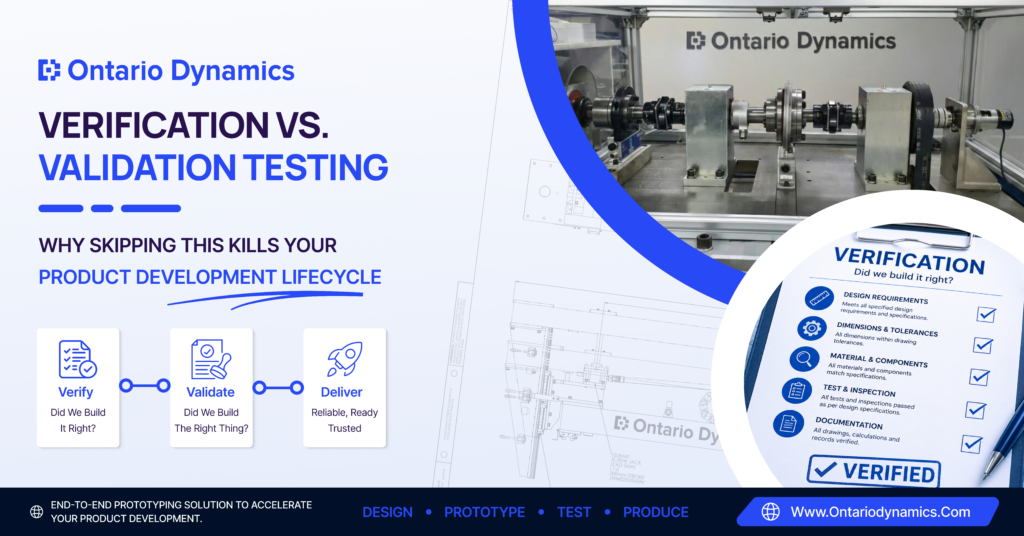
A product can meet every drawing requirement and still fail in the hands of a real user.That is why both verification testing and validation testing are important. Many hardware teams confuse the two. Some treat them as the same step. Others skip one because the prototype “seems to work.” That mistake can lead to redesigns at the last minute, failed audits, field failures, recalls, and a loss of customer trust. In product development, especially for startups and manufacturers in Canada, design verification and validation must be planned early. They should connect directly to the Product Requirements Document (PRD).
How Verification Vs. Validation Testing Differ Across 5 Key Dimensions
The difference is not just a matter of technical wording. It changes what gets tested, who runs the test, when it happens, and what counts as a pass.
Definition And Purpose
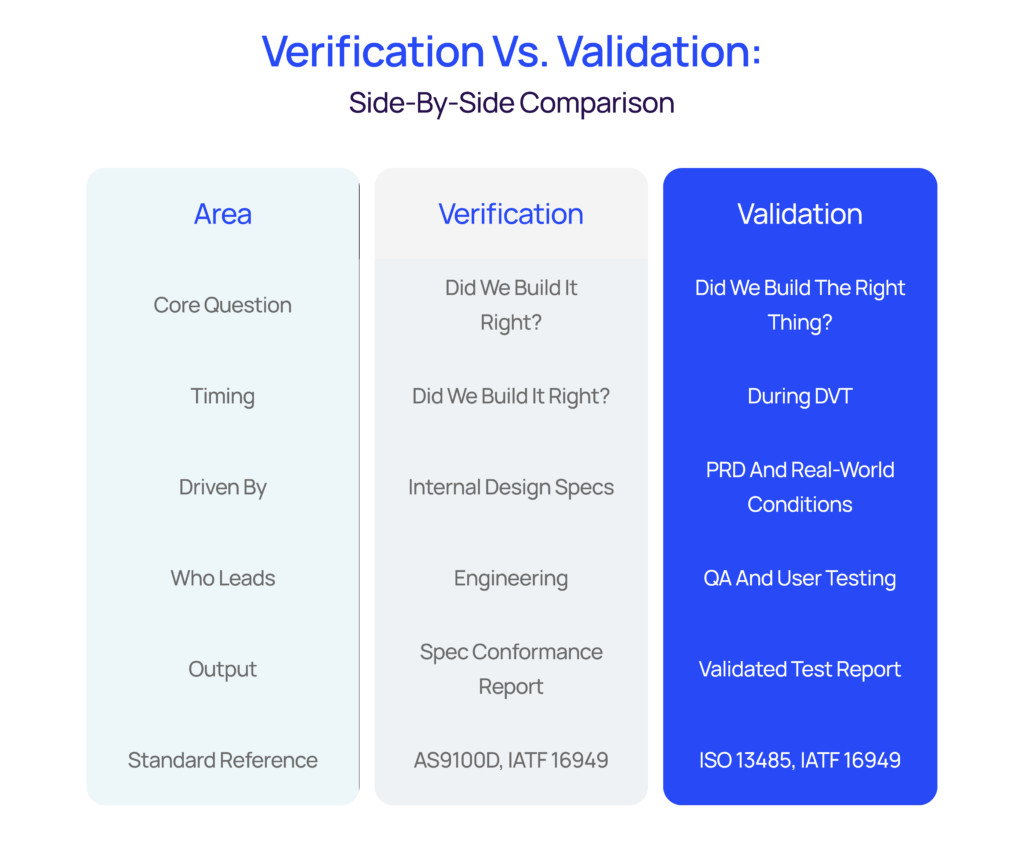
Verification testing checks whether the product was built according to the design specification. Validation testing checks whether the product meets the real user need and performs as intended in real conditions. In simple words, verification asks, “Did we build it right?” Validation asks, “Did we build the right thing?”
When Each Happens In The Development Timeline
Verification is active during EVT (Engineering Validation Testing). It helps confirm that the design meets internal engineering specifications. Validation is the main activity during DVT (Design Validation Testing). It checks the product against real-world use, user needs, and PRD acceptance criteria. Both verification and validation also support PVT sign-off. Production Validation Testing should not begin unless the team has already proven that the design works and the product is fit for use. Understanding where verification and validation sit within the broader EVT, DVT, and PVT product validation stages framework is essential for hardware teams planning their development timeline.
Who Runs Each Process
The engineering team usually leads verification. They test against drawings, CAD models, internal design specs, tolerances, calculations, and technical requirements. Validation is usually led by QA and product teams, and sometimes by real users or operators. It checks whether the product performs as expected outside the ideal lab setup. For industrial engineering projects, both teams need to work together. If engineering and QA work in silos, test results often become unclear.
What Constitutes A Pass
A verification pass means the product meets the approved design specifications.
A validation pass means the product meets every relevant PRD requirement under real-world test conditions. This is an important difference. A part may be verified against a drawing, but still fail validation if users cannot handle it safely, assemble it easily, or operate it reliably.
What Happens When Each Fails
A verification failure usually means the design needs revision before DVT.
A validation failure is more serious. It may require a design lock reversal, a DVT restart, or a PRD amendment. If validation is delayed, the team may need to reopen decisions they thought were finalized. This is where timelines and budgets start to suffer.
Verification Vs. Validation: Side-By-Side Comparison
What Happens When Verification And Validation Testing Are Skipped Or Confused?
Skipping verification and validation testing does not save time. It usually moves the problem to a later stage. If verification is skipped, the team may enter DVT with a product that does not even meet its own design specs. That means the validation results become unreliable. If validation is skipped, the team may approve a product that works on paper but fails in the field.
Both mistakes are expensive.A weak V&V process can lead to redesign loops, failed production runs, supplier confusion, customer complaints, warranty issues, and compliance problems. For regulated or high-risk industries, the issue becomes even more serious. Enterprise buyers, insurers, and regulatory reviewers often require documented proof that the product was properly tested. A verbal claim is not enough. This is where the Product Requirements Document becomes important. Both verification and validation testing are only as strong as the [Product Requirements Document for hardware development] they test against. A vague PRD produces vague tests.
For example, “the product should be strong” is not a useful requirement. “The product must withstand 10,000 operating cycles under defined load conditions” is testable.
Clear requirements create clear tests. Clear tests create reliable decisions.
How To Build A Verification And Validation Testing Plan
A good V&V plan should be built before testing begins. It should not be written after the team already has results.
Step 1-Map Every PRD Requirement To A Test Method
Start with the PRD.
Every product requirement should have a corresponding test method. Some requirements may need inspection. Some may need measurement. Others may need environmental testing, user testing, durability testing, or compliance review.
If a requirement has no test method, it needs to be rewritten.
Step 2-Assign Verification Or Validation Classification To Each Test
Not every test has the same purpose.
Some tests confirm design conformance. These are verification tests.
Other tests confirm real-world performance. These are validation tests.
This classification helps the team avoid confusion later.
Step 3-Define Pass And Fail Criteria Before Testing Begins
The team should agree on what counts as a pass before the test starts.
This prevents subjective decisions. It also avoids arguments after a result comes in.
A good pass/fail rule should be specific. It should include a measurable limit, condition, or acceptance range.
Step 4-Select The Right Standard For Your Industry
The standard depends on the product category.
Medical device teams may need to comply with ISO 13485. Aerospace and defence suppliers may need AS9100D. Automotive suppliers may need IATF 16949 and APQP-based quality planning.
The chosen standard affects documentation, traceability, sign-off, and audit expectations.
Step 5-Document The Test Plan With Traceability To Requirements
Traceability means every test result connects back to a requirement.
This is one of the most important parts of design verification and validation.
A test plan should show the requirement, the test method, the sample tested, the result, the person responsible, and the approval status.
Without traceability, teams may struggle to prove why the product was approved.
Step 6-Run Verification Tests Before Locking Design
Before the design is locked, the engineering team should confirm that the product meets the internal design specs.
This includes dimensions, tolerances, fit, movement, load limits, material choices, electrical behaviour, software logic, and assembly requirements.
Before locking the design, a design-for-manufacturability review should run in parallel with verification. Issues caught here are far less expensive than those found during validation.
Step 7-Run Validation Tests Under Real-World Conditions
Validation should test the product the way users will actually experience it.
This may include temperature, humidity, vibration, repeated use, operator handling, cleaning, transport, installation, service access, and misuse cases.
The point is not to create an easy test. The point is to determine whether the product can withstand real use.
Step 8: Produce A V&V Report Suitable For Audit
The final V&V report should be clear enough for an internal review, customer review, or regulatory audit.
It should include the PRD requirements, test methods, equipment used, samples tested, results, failures, corrective actions, retest results, and final approval.
A proper report protects the team later. It shows what was tested, what passed, what failed, and how issues were handled.
What ISO 13485, AS9100D, And IATF 16949 Each Require For V&V
Different industries use different quality standards, but the expectation is similar. Teams must prove that product requirements were checked, results were recorded, and approvals were controlled.
ISO 13485-Medical Devices
ISO 13485 sets quality management system requirements for the medical device industry. It focuses on organizations that need to show they can provide medical devices and related services that meet customer and regulatory requirements.
For V&V, medical device teams need strong documentation. That usually means approved requirements, controlled design inputs, design outputs, verification records, validation records, risk controls, change history, and sign-off evidence.
A non-conformance may occur when a requirement is not tested, a result is missing, a design change is not controlled, or validation does not reflect the intended use of the device.
AS9100D-Aerospace And Defence
AS9100D applies to organizations that design, develop, or manufacture aviation, space, and defence products. It includes ISO 9001:2015 quality management requirements and adds aerospace and defence-specific expectations.
In aerospace work, verification and validation records must be controlled carefully. The reason is simple. Products in this sector often have strict safety, reliability, and traceability requirements.
Compared with general commercial hardware, AS9100D projects usually need tighter documentation, stronger supplier control, clearer risk management, and better evidence of design conformity.
IATF 16949-Automotive
IATF 16949 is used in the automotive supply chain. Automotive development also relies heavily on APQP (Advanced Product Quality Planning). APQP is a structured method for product and process design that helps suppliers design products that satisfy customer requirements.
In automotive V&V, teams must connect design requirements, customer expectations, product testing, process planning, supplier inputs, and production approval.
This can include design records, FMEA, control plans, measurement system analysis, prototype testing, validation builds, and production readiness evidence.
What These Standards Have In Common
ISO 13485, AS9100D, and IATF 16949 serve different industries, but they share three core expectations.
First, the test plan must be documented before approval decisions are made. Second, results must be traceable to requirements. Third, sign-off authority must be clear.
That is the heart of strong V&V. A product should not move forward because the team feels confident. It should move forward because the evidence supports the decision.
How Ontario Dynamics Approaches Verification And Validation Testing
Ontario Dynamics treats verification and validation as part of the full product and equipment development process.
The work starts with clear requirements. A weak PRD leads to weak tests, so the team helps define what the product must prove before testing begins.
From there, verification checks whether the design meets internal engineering specifications. Validation then checks whether the product works under real conditions, with real use cases, and with the right acceptance criteria.
This approach is useful for startups and manufacturers across Canada because hardware development often moves quickly. Teams may be under pressure to build, test, and launch. But speed without evidence creates risk.
Ontario Dynamics provides end-to-end product and equipment development services for startups and manufacturers across Canada, with structured verification and validation support built into every development engagement.
The outcome is practical. Clients avoid unclear test results, late redesigns, weak documentation, supplier confusion, and production delays.
Conclusion
Verification and validation testing are not interchangeable terms. They answer different questions.
Verification proves the product was built according to the design specification. Validation proves the product is fit for its intended use.
For hardware development teams, both steps are necessary. Skipping one can lead to field failures, failed audits, expensive redesigns, and poor production handoff.
Startups and manufacturers in Canada need V&V plans that are clear, documented, and connected to the PRD from the start. That is how product development becomes more predictable.
Ontario Dynamics supports teams that need practical engineering help, structured testing, and cleaner validation before production.
Need help building a clear verification and validation plan for your product? Contact Ontario Dynamics to review your PRD, testing goals, and product development roadmap before costly issues appear later.
Ready to Build Your Product?
Let’s turn your idea into a production-ready product engineered for success.
Verification checks whether the product was built according to the design specs. Validation checks whether the product works for the real user in real conditions. In simple terms, verification asks if the team built it right. Validation asks if the team built the right thing.
Both are needed because a product can meet drawings and still fail in real use. Verification helps catch design and build issues. Validation helps confirm that the product is safe, useful, reliable, and ready for the customer.
Verification usually happens during or after EVT. It should be done before the design is locked. This helps the team confirm dimensions, tolerances, materials, movement, electrical behaviour, software logic, and assembly details before moving forward.
Validation usually happens during DVT. At this stage, the product is tested under real-world conditions such as use, handling, temperature, vibration, load, cleaning, installation, or service access. The goal is to prove that the product performs as intended.
Skipping either step can create serious problems later. The team may face redesigns, failed production runs, weak documentation, customer complaints, warranty issues, or audit problems. It may look faster at first, but it often costs more later.
A good verification and validation plan should include PRD requirements, test methods, pass and fail criteria, sample details, test conditions, responsibilities, results, corrective actions, and final approval. Every test should clearly connect back to a product requirement.