Project: High-Speed Motoring Test Bench for Transmission and EDU Performance Validation

High-Speed Motoring Test Bench for Transmission and EDU Performance Validation

Overview

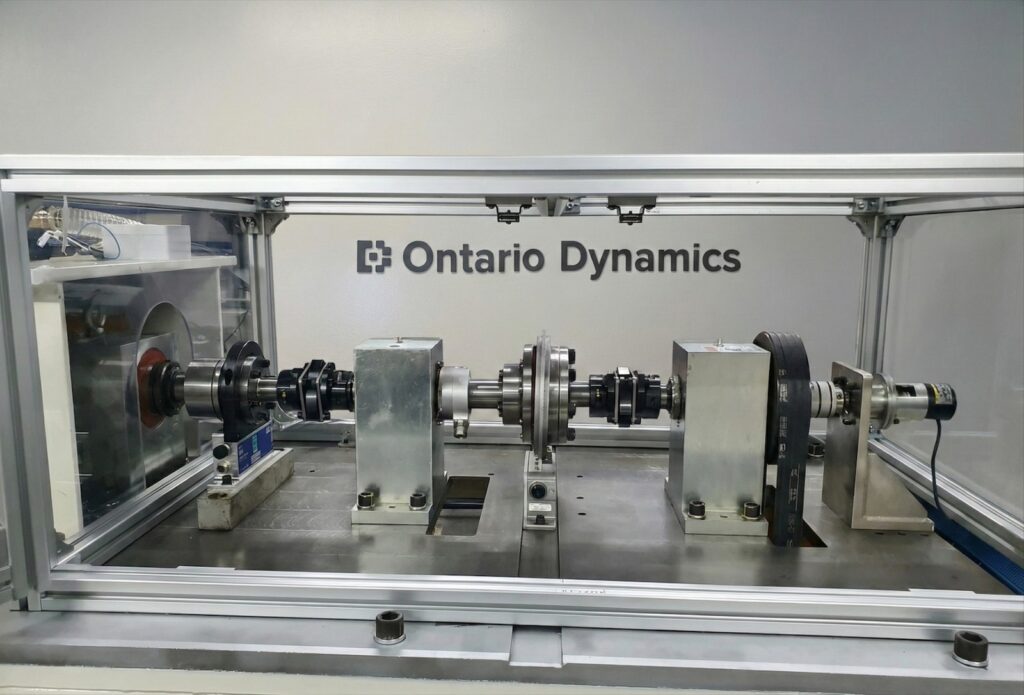
Ontario Dynamics recently engineered and deployed a high-performance motoring test bench designed for the comprehensive evaluation of automotive and EV powertrain components. This versatile rig is specifically engineered to measure parasitic friction losses and energy efficiency
in transmissions, internal combustion engines (ICE), and advanced 3-in-1 Electric Drive Units (EDU). By quantifying friction under varying conditions—such as different lubricants, component tolerances, and accuracy classes—our clients can optimize their hardware for peak efficiency and longevity.
Screen
motoring test bench
bluebox

The Challenge: Versatility on a Budget

The primary objective was to deliver a budget-friendly test rig without compromising on precision or versatility. The client required a single unit capable of testing a wide spectrum of components, from low-RPM industrial transmissions to high-speed EV transmissions and eaxles.

Key Technical Challenges Included:

  •  Achieving a broad speed range (up to 12,000 RPM) using a standard motor.
  • Designing a modular faceplate and mounting unit capable of accommodating various engine and EDU footprints.
  •  Ensuring absolute data integrity through dual-sensor validation.

Engineering Solutions & Technical Specifications

1. High-Speed Drive System & Versatility

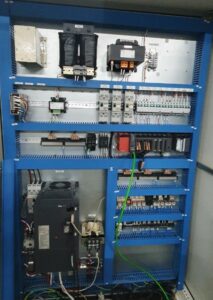
To meet the speed requirements while maintaining cost-effectiveness, we utilized a Mitsubishi MR-J4 Servo Motor system. While the motor natively supports high performance, we incorporated a dual-drive strategy:

  • Direct Drive: For high-torque, lower-speed transmission testing.
  • Pulley Mechanism: Utilizing V-belt drives to prevent slipping, we achieved a 1:3 ratio, boosting output speeds to 12,000 RPM.
  • Inertia Optimization: We carefully calculated the load-to-inertia ratio to ensure stable control and high response times during dynamic testing cycles.

2. Dual Torque Validation (HBM & Kistler)

Calibration errors can lead to expensive test re-runs. To mitigate this risk, Ontario Dynamics pioneered a redundant sensing architecture. We integrated two torque cells of different makes:

  • HBK (HBM) T40B Torque Transducer: Known for its 0.05 accuracy class and digital transmission, the T40B provided a stable, interference-immune baseline. It also features an integrated encoder for precise speed and angle measurement.
  • Kistler Optical Torque Sensor: Used as a secondary verification tool to cross-reference data in real-time.
  • Data Correlation: Data was collected via a National Instruments (NI) 32-channel DAQ system through an industrial computer with a high-speed contact card, ensuring that any calibration drift was immediately identified

3. Robust Mechanical Design (CNC Spindle Architecture)

The mounting unit was designed to endure significant axial thrust and provide long-term serviceability.

  • Bearing Arrangement: The head unit replicates a CNC machine spindle, utilizing cylindrical roller bearings for radial loads and angular contact ball bearings for axial thrust.
  • Modular Interface: A precision-engineered modular faceplate allows for rapid switching between different unit types, drastically reducing setup time for diverse testing batches.

4. Integrated Data Acquisition & Sensor Suite

The 32-channel NI DAQ provides a holistic view of the unit under test (UUT), capturing:

  • Cylinder Pressure: Using high-precision Kistler integrated pressure and temperature sensors.
  • Lubricant Health: Monitoring oil temperature via Omron sensors and high-accuracy Keyence temperature probes.
  • Vibration Analysis: Supporting multiple three-axis accelerometers to monitor NVH (Noise, Vibration, and Harshness).
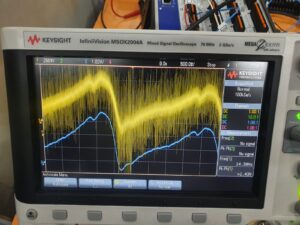
  • Signal Integrity: We optimized the response time by implementing digital filtering techniques that eliminate electronic noise without “over-correcting,” preserving the fidelity of high-frequency data.

Maintenance & Serviceability

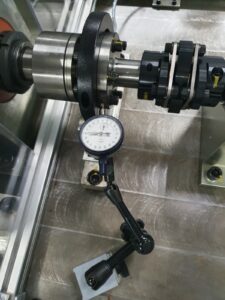
In alignment with our “simple is sustainable” philosophy, we prioritized off-the-shelf components from Misumi and McMaster-Carr. This ensures minimal downtime and short lead times for replacement parts. Additionally, we provided a custom torque calibration arm, allowing the client to perform in-house verification of the torque sensors without returning the unit to the manufacturer.

Precision & Sensing (HBM & Kistler)

  • HBK (HBM) T40B Transducer: We utilize the 0.05 accuracy class T40B, which offers a nominal torque range up to 10 kNm and rotational speeds up to 23,000 rpm. It features a digital transmission system with a linearity error of only 0.03%, ensuring interference-immune data for high-frequency torque ripple visualization
  • Kistler Optical Torque: By cross-referencing with a Kistler 4503B dual-range sensor, we achieve high-resolution speed/angle measurement up to 8192 pulses/rev.

Drive System (Mitsubishi & Belt Mechanics)

  • Mitsubishi MR-J4-RJ Servo: This system provides a speed frequency response of 2500Hz. We optimized the load-to-inertia ratio to maintain stability even during 12,000 RPM bursts.
  • Belt Ratio: By switching the motor position, the V-belt drive functions as a mechanical multiplier, allowing the same rig to test standard 6,000 RPM transmissions and highspeed 12,000 RPM e-axles.

DAQ & Signal Processing

  • NI 32-Channel System: We use National Instruments DAQ hardware to process highspeed signals from Kistler cylinder pressure sensors and Omron E8PC IoT pressure sensors, which feature a 2 ms response time for 90% of the signal.
  • Noise Elimination: To preserve a high response time, we implemented a digital filter that eliminates low-frequency noise without inducing signal lag, ensuring accurate starting moment and torsion vibration capture.
WordsCharactersReading time

Note: Certain images and mechanical details have been modified to maintain client confidentiality.