Design Validation Testing (DVT): Why Product Redesigns Often Happen When DVT Is Treated As A Formality
A product can pass early engineering checks and still fail later. That is the point many hardware teams miss. A working prototype does not mean the design is ready for production. It only means the first version works under limited conditions. Design Validation Testing (DVT) is where the product must prove it can perform in the real world.
For startups, manufacturers, and industrial engineering teams in Canada, DVT is a critical stage in hardware development. It protects the team from late redesigns, failed production runs, and expensive Production Validation Testing or PVT problems.
What Is Design Validation Testing?
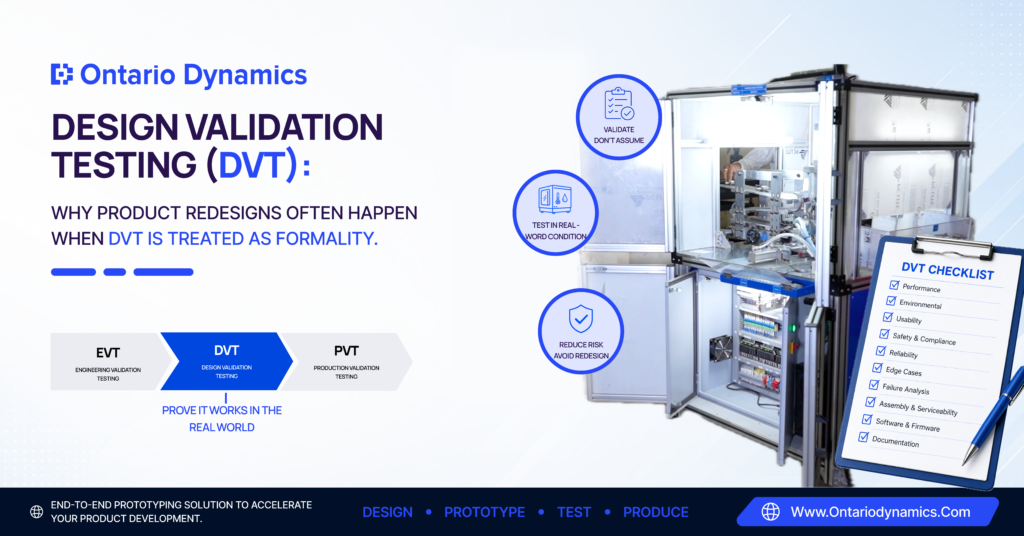
Design Validation Testing, or DVT, is the second stage of hardware product validation. It follows Engineering Validation Testing (EVT). DVT tests whether a product design performs reliably in real-world conditions that users will encounter. It not only checks whether the product works in a controlled lab setting, but also assesses its performance in real-world conditions. DVT is complete when every requirement in the Product Requirements Document, or PRD, has been tested, verified, and documented with real-condition test results.
Where DVT Sits In The Product Development Journey
DVT sits between EVT and PVT. EVT checks whether the engineering design works at a functional level. DVT checks whether the product can survive real use. PVT checks whether the product can be manufactured at scale with consistent quality. Before DVT can start, all design verification activities must be closed. The team should not enter DVT with open engineering questions, unclear requirements, or unstable prototype behaviour.
DVT receives two main inputs from EVT. The first is a revised prototype. The second is an updated PRD. If EVT found problems, those changes must be reflected before DVT begins. The output of DVT is a design-locked unit and a validated test report. These documents help the manufacturing and quality teams prepare for PVT. For a full breakdown of all EVT DVT PVT product validation stages, including how Engineering Validation Testing feeds into DVT, see our complete guide. A rushed DVT is one of the most common reasons PVT fails. When real-use problems are missed during DVT, they appear later during production validation. At that point, fixes are slower, more expensive, and harder to control. That is why design verification and validation testing should be treated as a formal part of the hardware product development process, not as a quick checkpoint.
The DVT Checklist: 10 Things You Must Validate Before Moving To PVT
DVT Checklist
A proper DVT checklist should map directly to a Design Validation Test Plan. This plan explains what will be tested, how it will be tested, who owns the test, and what counts as a pass.
1. Confirm All PRD Requirements Are Testable
The PRD is the foundation of DVT. Every requirement should be clear, measurable, and testable. A vague requirement like “the product should be durable” is not enough. The team needs to define what durable means.That may include cycle count, drop height, load limit, temperature range, vibration level, operating time, or safety performance. If a requirement cannot be tested, it cannot properly guide DVT.
2. Build And Lock Your Design Validation Test Plan
A design validation test plan is the formal document that controls DVT. It should include the test scope, test methods, equipment needed, sample size, acceptance criteria, reporting format, and responsible team members. This plan should be locked before testing begins. Without it, teams often add tests late, miss important checks, or argue over whether the product has truly passed.
3. Test Under Real-World Environmental Conditions
DVT must test the product in the conditions it will face after launch.
This may include heat, cold, humidity, vibration, dust, impact, repeated movement, pressure, or handling stress. The goal is simple. The product should not only work in a clean engineering space. It should work where customers will actually use it.
4. Design Validation Usability Testing
Engineers are not always the best judges of user experience. Design validation usability testing puts the product in front of real users or realistic operators. This helps the team see how people hold it, use it, service it, read it, move it, or misunderstand it. A product can meet technical requirements and still fail in terms of usability. DVT is the right time to catch that.
5. Validate Safety And Regulatory Compliance
Safety and compliance cannot be left until the end. Depending on the product, DVT may need to check against ISO, IEC, FDA, automotive, energy, industrial, or other industry-specific standards. The team should confirm which standards apply before testing starts. If safety requirements are discovered late, the design may need major changes.
6. Stress-Test Edge Cases, Not Just Normal Use
Normal use is only one part of the test. DVT should also check edge cases. What happens if the product is used for longer than expected? What happens if the load is near the limit? What happens if the environment is harsher than usual?
Edge-case testing helps reveal weak points before customers do.
7. Conduct Failure Mode Analysis
Failure Mode and Effects Analysis, or FMEA, helps the team understand how the product may fail. This includes part failures, assembly failures, user errors, electrical faults, mechanical wear, sealing problems, overheating, and sensor issues. The goal is not to imagine every possible disaster. The goal is to identify likely risks and reduce them before production.
8. Validate Assembly And Serviceability
A product should not only work. It should be buildable, serviceable, and practical. During DVT, the team should check how the product is assembled, opened, repaired, cleaned, adjusted, or maintained. If a technician cannot access a key part, replace a worn component, or inspect a failure point, that is a design issue. Assembly and serviceability validation is closely tied to a design for manufacturability review. Teams that complete DFM before DVT usually find these problems earlier.
9. Get Supplier And Vendor Sign-Off On Design-Locked Components
DVT should not rely on parts that are uncertain, temporary, or unavailable at production volume. Suppliers should confirm that key components can be sourced, built, repeated, and supported. This matters for custom parts, electronic components, machined parts, moulded parts, sensors, fasteners, and materials. A product can pass DVT with the wrong supply chain and still fail during PVT.
10. Document Everything In A DVT Report
A DVT report is not just paperwork. It is the evidence that supports the move into PVT. The report should include test procedures, samples tested, equipment used, test dates, pass/fail results, failure notes, corrective actions, retest results, and final approval. This report becomes part of the audit trail. It also helps manufacturing, QA, suppliers, and leadership understand what has been proven.
Common DVT Mistakes – And What They Actually Cost
Mistake | Stage It Surfaces | Cost Impact |
No formal test plan | DVT start | Scope creep, missed requirements |
Skipping usability testing | DVT mid | Redesign after PVT |
Testing only nominal conditions | DVT | Field failures post-launch |
PRD not updated from EVT | DVT | Testing against wrong spec |
No supplier sign-off | PVT | Tooling changes at volume |
What A Design Validation Test Plan Should Include
A DVT test plan does not exist in isolation. It is one milestone in a structured hardware product development roadmap that begins before EVT and ends at production sign-off.
A strong design validation test plan should include:
- Product requirements from the PRD
- Test objectives for each requirement
- Test methods and equipment
- Sample size and test conditions
- Pass and fail criteria
- Safety and compliance requirements
- Responsibility for each test
- Reporting and approval process
The most important part is the link between the test plan and the PRD. Each test should point back to a requirement. Each requirement should have a clear way to determine whether it passes or fails. This keeps the team focused and prevents random testing. A good DVT plan also reduces arguments. When the results come in, the team can compare them against agreed criteria instead of personal opinions.
How Ontario Dynamics Approaches Design Validation Testing
Ontario Dynamics treats DVT as part of the full product development and production-readiness process. The work does not stop at checking a prototype. The goal is to understand whether the product design is ready for real use, real manufacturing, and the next validation stage. Ontario Dynamics supports mechanical product development, equipment development, prototype review, DVT planning, test setup, and production handoff. This matters for startups and manufacturers that need more than a basic checklist. A robust DVT process considers the product from several angles. It checks performance, usability, reliability, assembly, serviceability, materials, supplier readiness, and documentation. For teams in Canada, working with a local engineering partner can also help with communication, timelines, regulatory awareness, and practical testing decisions. Ontario Dynamics provides end-to-end product and equipment development services for startups and manufacturers across Canada, including structured DVT support from test plan creation through PVT handoff. For teams entering DVT with a first-generation prototype, mechanical prototyping for hardware startups can help ensure the unit is DVT-ready before testing begins.
Conclusion
Design Validation Testing is not the stage where a team casually checks if the product still works. It is the stage where the product must prove itself under real conditions, with real users, and with a fixed set of requirements. For hardware development teams, DVT creates confidence before PVT begins. It shows whether the design is stable, testable, usable, safe, and ready for manufacturing validation. Startups and manufacturers in Canada should treat DVT as a serious stage in product validation. When handled properly, it reduces redesigns, improves documentation, and provides production teams with a cleaner handoff. Ontario Dynamics supports precision product development for manufacturers and startups by integrating design, prototyping, validation, testing, and production readiness into a single, clear process.
Need support with Design Validation Testing before moving to PVT? Contact Ontario Dynamics to review your PRD, prototype, and DVT test plan, so your product can move toward production with fewer surprises.
Ready to Build Your Product?
Let’s turn your idea into a production-ready product engineered for success.
Design Validation Testing, or DVT, checks whether a product can perform in real-world conditions. It comes after EVT and before PVT. The goal is to prove that the design is reliable, usable, safe, and ready for production validation.
DVT helps catch design problems before the product reaches the production stage. If issues are missed during DVT, they often appear during PVT, where changes cost more and take longer to fix.
A DVT test plan should include the product requirements, test methods, sample size, test conditions, pass or fail criteria, safety checks, responsibilities, and reporting process. Each test should connect clearly to the PRD.
DVT can find issues with performance, durability, usability, safety, materials, assembly, serviceability, and supplier readiness. It can also reveal problems that do not show up during early prototype testing.
Yes. EVT only proves that the core design works at a basic level. DVT is harder because it checks the product under real use, stress, handling, environment, and safety conditions.
If a product fails DVT, the team must find the cause, update the design, and retest the affected areas. In some cases, major changes may delay PVT until the product is stable enough to move forward.