How to Choose a Product Development Partner Before Timeline Risk Becomes Timeline Loss?
Objective
Give product owners a practical framework for evaluating a product development partner on the one thing that actually determines project success: whether their process protects the timeline.
Key Takeaways
- Partner selection is a timeline risk decision, not a procurement decision.
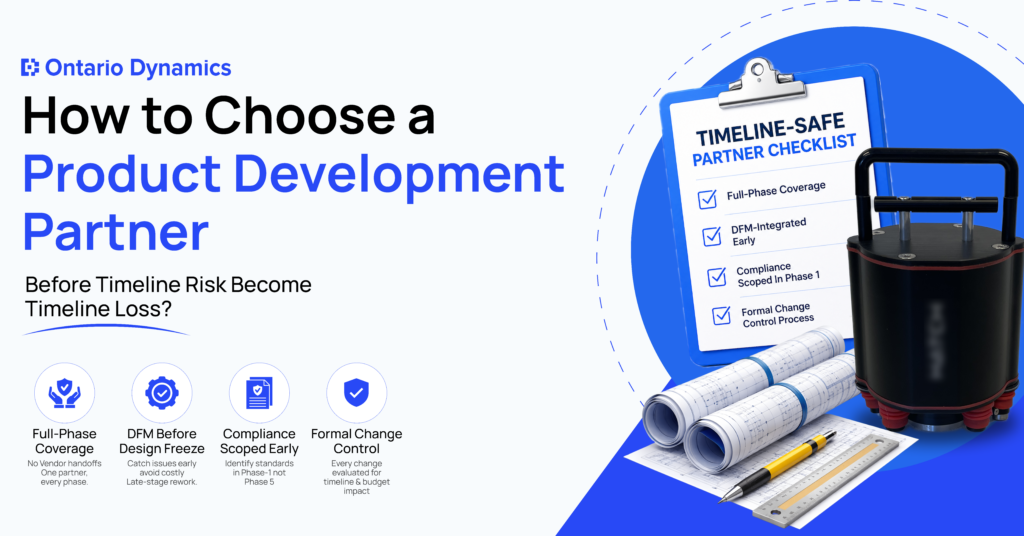
- Four criteria predict whether a partner protects your schedule: full-phase coverage, DFM before design freeze, compliance scoping in Phase 1, and formal change control.
- 20- 25% of outsourcing partnerships fail within two years, and the warning signs are visible before you sign.
- The wrong partner doesn’t cost you in the quote; it costs you in Phase 4 rework.
Most product teams treat partner selection like buying office chairs: compare quotes, skim portfolios, pick the option that feels safest on price. The problem is that the cost of the wrong choice never shows up in the quote. It shows up in Phase 4, when a late-stage design change triggers a cascade of change orders that eats a third to half of the development capacity you budgeted for the whole project.
This is about choosing a product development partner the same way you’d protect a product development timeline, as a risk decision, not a cost decision.
Partner selection determines timeline risk more than any single technical decision. Evaluate on four criteria: full-phase coverage (no vendor handoffs), DFM review that runs alongside design instead of after it, compliance scoped at kickoff, and a documented process for handling design changes. Roughly a quarter of outsourcing relationships fail within two years, and nine in ten product teams miss their original launch date, most of which traces back to how the partner was chosen, not what they were asked to build.
Why Does the Wrong Partner Always Show Up Late in the Schedule?
Three numbers explain why this matters more than most teams assume going in:
- 20- 25% of outsourcing partnerships fail within two years (Codebridge, 2026), usually not from bad work, but from a process mismatch that only becomes visible mid-project.
- 90% of product teams miss their launch date (CoLab Software, 2025), and a large share of that traces to coordination gaps between vendors, not technical difficulty.
- A 6-month delay destroys roughly 33% of lifetime profitability (CoLab / ASQ, 2025); timeline slippage isn’t a scheduling annoyance, it’s a margin problem.
Every handoff between development phases adds weeks of re-briefing and documentation realignment, and partners who work in silos accumulate these handoffs by design. This is also where product development timeline risk actually gets created, long before any prototype gets built.
4 Criteria That Define a Timeline-Safe Product Development Partner
Criterion 1: Full-phase coverage from concept through production. Does the partner support idea validation, concept design, prototyping, testing, compliance, manufacturing setup, and production handoff, or only a slice of it? Ask which phases they’ve delivered in the last 12 months, with documented handoff packages to show for it. A red flag: a partner who describes their service as “design and prototyping” and points to “their network” for manufacturing setup. Every handoff costs 3–6 weeks of re-briefing and trust-building.
Criterion 2: DFM integration in Phase 2–3, not Phase 4. Does design-for-manufacturing review happen alongside detailed design, or only after the design is already frozen? Ask when DFM review typically completes relative to the design freeze. A partner who calls DFM “a final review before production” is telling you it happens too late. Issues caught after freeze trigger change orders that consume 33–50% of development capacity.
Criterion 3: Compliance scoping in Phase 1. Does the partner identify every applicable standard, FCC, CE, UL, FDA, CSA, at kickoff, or only once the product is ready for testing? Ask for a sample Phase 1 deliverable and check whether it includes a compliance standards matrix. Treating compliance as “something we handle in Phase 5” adds 6–12 weeks regardless of how fast everything before it moved, since lab lead times don’t bend for anyone.
Criterion 4: Formal change control from the outset. Does the partner have a documented process that checks every design change against the timeline and budget before it’s approved? Ask how a mid-project change actually gets handled: a formal review, or an email thread. “We’re flexible with changes,” without a process behind it, is how informal change management becomes the most consistent cause of the 90% launch-delay rate.
7 Questions to Ask a Product Development Partner Before You Sign
- Which phases have you delivered in the last 12 months, with documentation from each? (Vague answer: “We cover the full journey.”)
- When in your standard process does DFM review happen relative to the design freeze? (Red flag: “before production.”)
- What compliance standards did your last three hardware projects require, and when did you identify them? (Red flag: “depends on the product.”)
- How is a mid-project design change handled? (Good answer: a formal change order with documented cost and timeline impact.)
- What does your production handoff package include, and who produces it?
- Can you show me a project where the timeline slipped, and what caused it? (Red flag: no project has ever slipped.)
- What happens to the project if a key person on your team leaves mid-engagement?
Which Partner Behaviours Predict a Blown Timeline, Before Any Work Begins?
They quote before asking about the compliance scope. A price given without asking which markets you’re selling into or which certifications apply is a price for a project that hasn’t actually been scoped. That gap resurfaces in Phase 5 as an “unforeseen” cost.
They describe the prototype as a single event. Most hardware products need 3–5 build cycles. A partner who talks about “the prototype” as one deliverable will bill each additional cycle as a scope change instead of planning for it upfront.
Nobody is named as responsible for DFM. DFM is either someone’s specific job or nobody’s job. If a partner can’t name who owns it, it happens informally, which usually means after design freeze, generating change orders instead of preventing them.
Changes get managed over email or Slack. Informal change management is the mechanism behind most overruns. Without a defined process, every design change is a conversation, not a decision with a documented timeline impact.
The handoff package isn’t defined upfront. Ask what’s included before you sign. If there’s no specific list, the handoff isn’t a real deliverable; it’s whatever’s convenient at the end.
How Does Ontario Dynamics Protect a New Product Development Timeline?
The four criteria above describe how a timeline-safe development partner operates. Here’s how Ontario Dynamics approaches each one:
Full-phase coverage: Ontario Dynamics supports projects from concept through production validation, single team, single documentation trail, no handoff gaps.
DFM in Phase 2–3: DFM review runs alongside detailed design, not as a gate before production.
Compliance in Phase 1: applicable standards are identified and documented in the project brief before the development scope is confirmed.
Formal change control: every design change is evaluated for timeline and budget impact before approval, using the same change order process that keeps a product and equipment development project on schedule from kickoff to handoff.
Tell us your current phase and product type, and we’ll give you a realistic timeline estimate and flag where your highest timeline risk sits right now.
Conclusion
A realistic product development timeline isn’t a prediction; it’s a plan. The teams that hit their launch dates aren’t the fastest ones. They’re the ones who scope compliance in Phase 1, run DFM alongside design instead of after it, build prototypes in stages, and treat every change as a timeline decision, not just a technical one.
For startups and manufacturers across Canada navigating complex product and equipment development timelines, Ontario Dynamics provides the phase-by-phase depth and planning discipline that keeps projects on schedule from first concept through production handoff.
Timeline planning is one part of a bigger process. For the full picture of how a product moves from idea to market, see our guide to the new product development process.
Ready to talk through your timeline? Get in touch with Ontario Dynamics.
FAQ
Ask for named projects and documented deliverables from each phase in the last 12 months, not a general claim about capability.
Rarely. A quote that doesn't account for compliance scope or DFM timing tends to resurface as "unforeseen" costs later, which usually cost more than the difference in the original quotes.
It depends on how far in you are, but ask the seven questions above at your next milestone review regardless. A partner without good answers by Phase 3 rarely improves by Phase 5.
Not necessarily. Size matters less than whether they can show a documented process for the four criteria above.
Ready to Build Your Product?
Let’s turn your idea into a production-ready product engineered for success.