Design Freeze in New Product Development: What It Is, When to Do It, and How to Get the Timing Right
Objective
Explain what a design freeze is, when it should happen in the product development cycle, and how to set it at the right point so it protects the project instead of stalling it.
Key Takeaways
- Design freeze is the milestone where a product’s architecture, specs, and design parameters get locked, and any change after that point needs a formal Engineering Change Order.
- There are four distinct types of design freeze, and each one locks different parts of the design at a different stage.
- The right timing for a detailed design freeze comes after prototype validation and DFM review, not before.
- A pre-freeze cooling period, typically two to four weeks, catches last-minute changes while they’re still cheap to make.
- Freezing too early or too late both create expensive rework, just from opposite directions.
Tooling quotes are sitting in your inbox. The supplier needs final drawings before they’ll commit to a lead time. Your contract manufacturer keeps asking when the specs will be locked. Meanwhile, your engineering team still wants another pass at the enclosure design.
Design freeze is the moment that resolves that standoff. Set it too early, and you lock in a design that hasn’t been proven yet. Set it too late, and you lose weeks of manufacturing time waiting on a team that keeps finding “one more thing” to improve.
Most product teams don’t get the timing wrong because they’re careless. They get it wrong because nobody defined what freeze actually means for their project, or which of the four types applies at which stage.
In Brief: A design freeze locks a product’s architecture, specs, and parameters so suppliers and internal teams can commit to tooling and procurement. It should happen after prototype validation and DFM review are complete, but before tooling is ordered. There are four types: concept freeze, external conceptual freeze, detailed design freeze, and tooling freeze, each locking different things at different points in the timeline.
What Is a Design Freeze in Product Development?
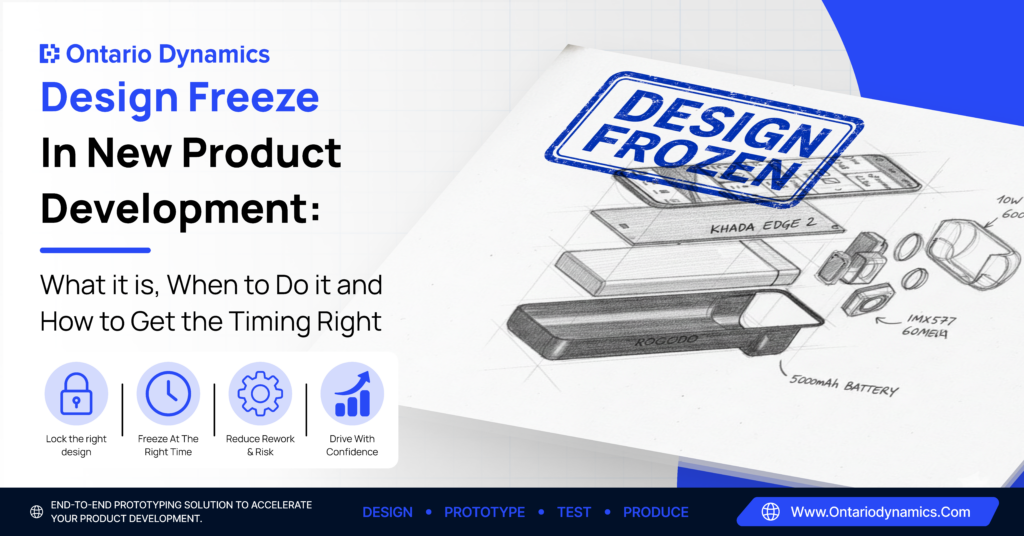
A design freeze is the formal point where a product’s structure, mechanical and electrical designs, materials, and interfaces get locked so suppliers and internal teams can commit to tooling and procurement. After this point, changes go through a documented process instead of an email thread.
Design freeze in product development typically happens after prototype validation and DFM review are done, but before production tooling gets ordered and supplier agreements get finalized. That sequencing matters. Freeze before validation, and you’re locking guesses. Freeze after tooling is already committed, and you’ve missed the window entirely.
Once frozen, any modification needs a formal Engineering Change Order, or ECO. That ECO gets evaluated for cost, schedule, quality, and risk before anyone touches the design again. It’s not bureaucracy for its own sake. It’s what keeps one team’s small fix from becoming another team’s six-week delay.
Four Types of Design Freeze, and What Each One Locks
Design freeze isn’t a single event. It’s a sequence of four freezes, each locking a different layer of the design at a different point: concept freeze, external conceptual freeze, detailed design freeze, and tooling freeze.
Concept and Specification Freeze
This locks customer requirements and the basic product architecture, what the product needs to do, its form factor, and its key performance targets. It happens early, before detailed engineering starts. Everything downstream depends on this staying stable, so treat scope changes at this stage seriously.
External Conceptual Freeze
This freeze locks boundaries set by forces outside the engineering team, a customer contract deadline, a tooling lead time, or a regulatory submission window. An automotive interior design freeze eighteen months ahead of series production, locking cabin dimensions so every component team can move forward, is a real-world example of this type.
Detailed Design Freeze
This is what most teams actually mean when they say “design freeze.” It locks exact tolerances, materials, and components so drawings can go out to suppliers. Some engineers call it the CAD freeze in product development, since this is the point where the CAD pens genuinely go down. It happens after prototype validation and DFM review, both of which we cover as design freeze entry criteria below.
Tooling Freeze
This downstream freeze happens once production tooling is ordered and committed. It usually follows a detailed design freeze for days to a few weeks, depending on supplier lead times. Past this point, any change means modifying or replacing tooling, which is the most expensive kind of change a product can absorb.
When Should a Design Freeze Happen in the NPD Cycle?
The timing of a design freeze is an economic decision, not an arbitrary date on a calendar. Freeze too early, and you give up optimization you’ll wish you had. Freeze too late, and you lose the manufacturing window entirely.
Freeze after prototype validation, not before. The detailed design freeze should land after the design has been validated through prototyping and testing, and before production tooling gets ordered. In practice, that means freezing after the Alpha prototype confirms functional requirements, after DFM review wraps, and after compliance pre-testing has passed.
Freeze before supplier quoting and tooling commitment. Suppliers quote against frozen specs. Change the spec after a quote goes out, and the quote is void, followed by a re-quote at a change premium. Order tooling before freeze, and you’re locking a design that might still move, which means expensive tooling rework later.
Use a pre-freeze cooling period. Best practice is a two to four-week cooling period before the formal freeze, during which any design change needs high-level sign-off and documented justification. This catches last-minute changes while they’re still cheap, and it stops teams from arriving at freeze with undocumented changes already sitting in the pipeline.
Freeze too early, and you generate a high volume of post-freeze engineering change orders, the “fast but fragile freeze” pattern that ScienceDirect research (cited by Vizcom in 2026) links to consuming up to half of a team’s engineering capacity.
Want a fuller picture of what happens before this milestone? Our guide to stages of prototyping covers each build phase leading up to freeze in more depth.
What Design Freeze Actually Protects You From
Design freeze isn’t about cost savings in the abstract. It protects specific, expensive failure modes that show up on real projects, usually all at once, and usually too late to fix cheaply.
- Uncontrolled change ripple. Without a clear freeze point, a design change ripples through tooling quotes, supplier drawings, material orders, and production schedules at the same time. Every team sees their own slice of the fallout. Nobody sees the full cost until it’s already spent.
- Wrong-revision production runs. When a supplier gets updated drawings after tooling has already started, they build to the revision they have, not the one you sent yesterday. That tooling now reflects an outdated design and needs modification or scrapping, which is the most preventable rework scenario on this list.
- Compliance baseline loss. Regulatory approvals, FDA, UL, CE, CSA, require a fixed, documented design baseline. A change after that baseline is set resets the certification clock. Without a design freeze, there’s no baseline to certify against in the first place.
- Engineering capacity lost to ECO processing. Teams that freeze at the wrong time generate high volumes of post-freeze engineering change orders. Across a typical product’s development lifecycle, ECOs can eat between a third and half of total engineering capacity, time that should be going toward the next product, not fixing the current one.
The Role of Prototyping in Design Freeze Readiness
Prototyping is what earns a team the right to freeze. Skip stages, and you’re freezing on assumptions instead of evidence.
The pre-production Alpha prototype is the trigger event that confirms a design is ready to freeze. It has to be built using near-production materials and processes, not shop-floor stand-ins. If the Alpha prototype behaves the way the design predicted, freeze is justified. If it doesn’t, freeze needs to wait.
The Production Validation Test run during this stage provides the documented proof that the design performs at production volumes, not just on a bench in isolation. PVT sign-off is one of the clearest design freeze criteria a team can point to, since it’s evidence rather than a schedule assumption.
Teams that skip from a functional prototype straight to freeze, bypassing the Alpha stage entirely, are consistently the ones generating the highest volumes of post-freeze ECOs. If you’re mapping out what each prototype stage should accomplish, our breakdown of the types of prototypes and the full prototype manufacturing process walks through what “done” looks like at each phase.
Conclusion
Design freeze is a quality gate, not a deadline. Teams that freeze on evidence, prototype sign-off, DFM completion, BOM confirmation, and a documented compliance baseline ship on schedule and on budget. Teams that freeze under pressure generate the post-freeze ECO volume that eats up half their engineering capacity and pushes launch back by months.
For startups and manufacturers across Canada navigating complex product and equipment development, Ontario Dynamics builds design freeze discipline into every project, from DFM review through Alpha validation and production handoff, so the freeze creates a clean handoff to manufacturing instead of a starting gun for rework.
Design freeze isn’t the end of development. It’s the beginning of manufacturing. If your team is approaching this milestone and wants a second set of eyes on the timing, talk to our team about where your project actually stands.
FAQ
Two to four weeks is typical. Shorter than that, and last-minute changes slip through undocumented. Longer than that, and you're just delaying the freeze without adding real validation.
You can, but it's a fast but fragile pattern. Freezing before DFM review usually means the design hasn't been checked for manufacturability yet, which shows up later as tooling rework, the most expensive kind of change to absorb.
Detailed design freeze locks tolerances, materials, and components so drawings can go to suppliers. The tooling freeze happens after that, once tooling is actually ordered. Past tooling freeze, a change means modifying or replacing tooling, not just revising a drawing.
Yes, even a lightweight one. Without a documented change process, a "small fix" made outside freeze can quietly ripple into supplier drawings and BOMs that nobody reconciles until the parts arrive wrong.
It goes through an ECO evaluation for cost, schedule, quality, and risk. At that point, the change usually requires tooling modification or replacement, so it gets weighed against the cost of living with the current design.
Ready to Build Your Product?
Let’s turn your idea into a production-ready product engineered for success.