7 Stages of New Product Development Process: A 2026 Decision Guide
Objective
This guide breaks down the 7 stages of the new product development process so founders and manufacturers know exactly where their idea sits, what each stage should deliver, and where projects usually stall. It also covers cost, timeline, and how to pick a partner who won’t drop the ball between stages.
Key Takeaways
- New product development (NPD) has 7 stages, from idea generation to commercialisation
- Only 1 in 7 ideas that enter the process reach market launch
- Companies with a structured NPD process hit a 76% success rate, versus 51% for those without one
- Stage 6 (prototyping) is really a 5-part sequence disguised as one step
- Picking the right development partner early cuts rework and protects the budget
Most product ideas never make it to a shelf. A founder gets excited about a concept, sketches it out, maybe builds a rough prototype in the garage, and then runs out of budget or direction before it ever reaches a customer.
That’s not a talent problem. It’s a process problem.
Manufacturers and startups that treat product development as one long build, instead of a series of checkpoints, end up spending money on ideas that were never going to work. The 7-stage new product development (NPD) process exists to catch that early, before tooling gets cut and suppliers get locked in.
What Is New Product Development (NPD)?
New product development is the structured path a product takes from a rough idea to a commercial launch. It’s not brainstorming, and it’s not just building. It’s a sequence of checkpoints designed to test whether an idea deserves the next round of investment.
The process is rarely a straight line. Teams loop back to earlier stages constantly as testing reveals gaps, as costs shift, or as suppliers flag issues that weren’t obvious on paper. A rigid, one-pass version of NPD is usually the version that fails.
The 7 Stages of New Product Development
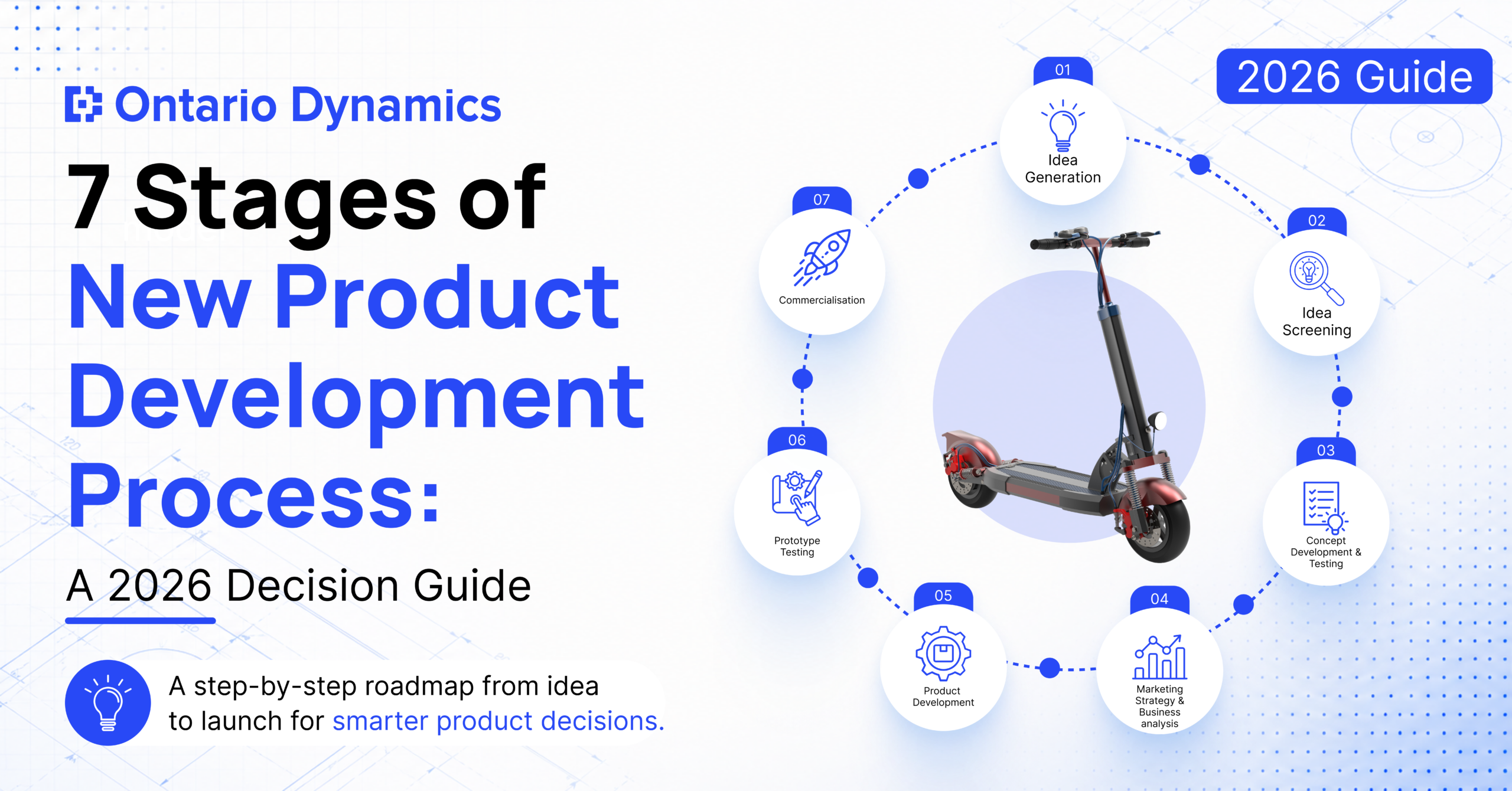
Here’s what a real stages of new product development framework looks like: idea generation, screening, concept development, business analysis, product development, prototyping and testing, and commercialisation. Each stage is a gate. Ideas that don’t clear the bar get stopped there, before they cost more.
Roughly 7 ideas enter the funnel. About 4 make it into development. Maybe 1.5 reaches launch. One survives long-term.
Stage 1: Idea Generation
The goal is a wide, evidence-based pool of concepts, not a whiteboard session. Ideas should come from customer complaints, supplier conversations, competitor gaps, and real market research for new product development, not internal enthusiasm alone.
Stage 2: Idea Screening
This is where weak ideas get cut. Feasibility, strategic fit, and business potential all get checked here. Of the ideas that started the funnel, only about 4 in 7 make it past this gate. That’s the process working, not a bad sign.
Stage 3: Concept Development and Testing
Screened ideas get turned into something testable, a description, a sketch, a rough mockup, and real users react to it. This is the cheapest point in the whole process to catch a flawed assumption. Fixing a bad idea here costs almost nothing compared to fixing it after tooling exists.
Stage 4: Marketing Strategy and Business Analysis
Now the numbers get built. Projected cost, pricing, market size, and distribution all get modeled. If the math doesn’t support the investment needed for the remaining stages, this is the last cheap exit ramp.
Stage 5: Product Development
The idea starts becoming a physical thing. CAD models, early builds, and manufacturability decisions all happen in this stage. This is also where a lot of the budget starts getting locked in, so decisions here carry weight.
Stage 6: Product Prototyping and Testing
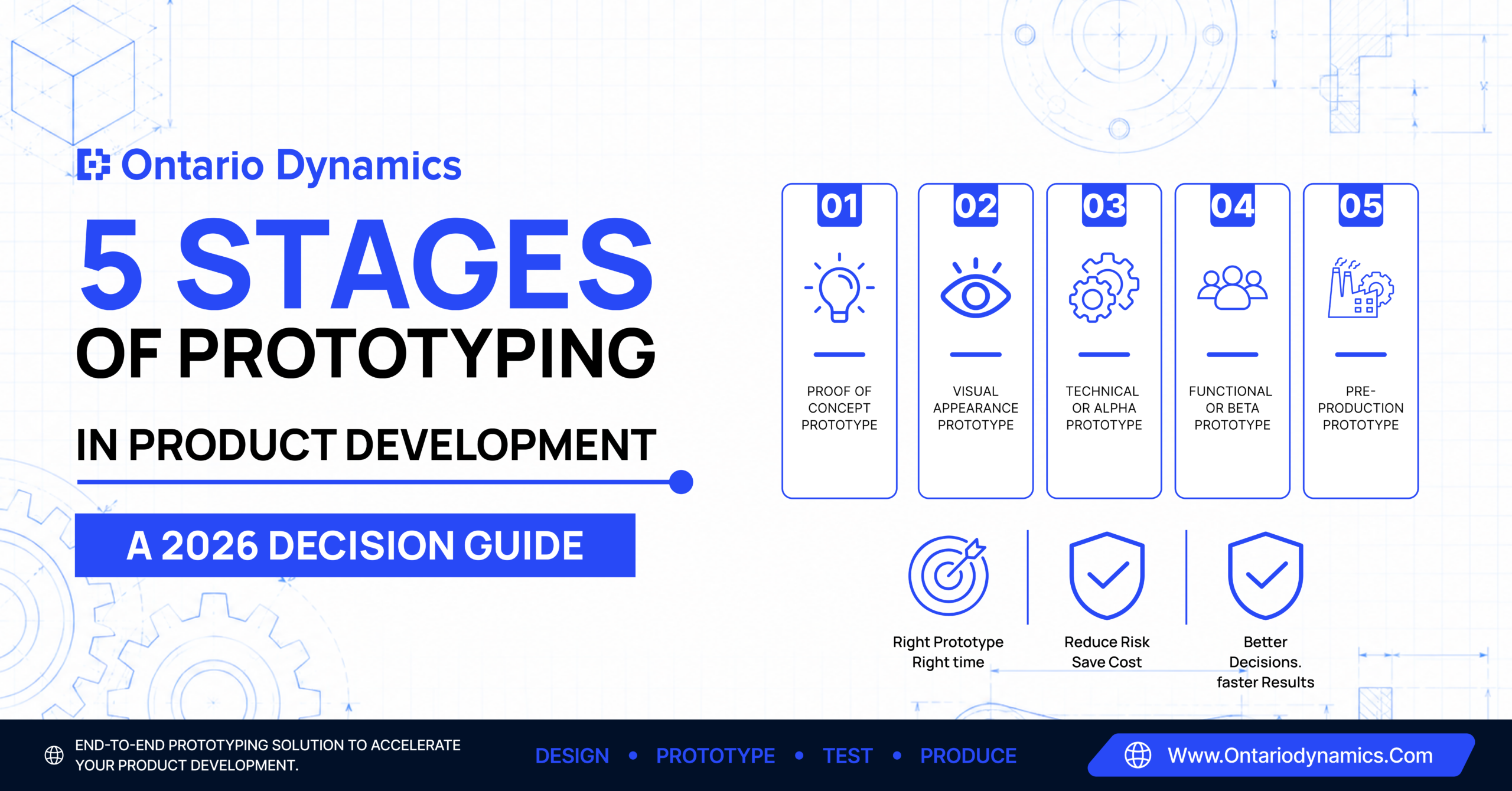
This single stage actually hides a 5-part sequence, [proof-of-concept through to pre-production]. Teams that treat this as one build instead of a progression are the ones who find expensive surprises after tooling is already cut. For a full breakdown, see the 5 stages of prototyping.
Stage 7: Commercialisation
The final stage of the new-product development process is commercialisation, the point where the product is officially launched to the market. Production ramps up, go-to-market campaigns start, and the product enters its lifecycle. This is where new product development and product life cycle actually meet, one process hands off directly into the other.
Why the NPD Process Matters (The Numbers)
A good reason to invest in new product development is that companies with a structured, stage-based process significantly outperform those without one.
- Top-performing companies hit a 76% product success rate, versus 51% for everyone else (PDMA research, cited by StudioRed, 2026)
- 66% of new products fail within two years of launch (Columbia Business School, cited by StudioRed, 2025)
- 49% of NPD projects approved for development never reach final launch; approval isn’t validation (PDMA 2021 Global Survey, Research-Technology Management, 2025)
- An estimated 46% of NPD resources go toward products that get cancelled or fail to deliver a return (Saylor/Lumen Learning, 2026)
The 25-point gap between top performers and everyone else isn’t about bigger budgets or luck. It comes down to process discipline at every one of the 7 stages, backed by PDMA’s own research.
Skipping stages doesn’t save time; it just moves the cost later, where it’s more expensive. For a closer look at where projects actually go wrong, see new product development risks and challenges.
Cost and Timeline for New Product Development
There’s no single number for the cost of new product development; it depends on complexity, materials, and how many prototype rounds a product needs. What’s consistent is where the money goes: early stages are cheap, later stages aren’t. A design change on a CAD file costs almost nothing. The same change after a mold is cut can run into the tens of thousands.
Timeline for new product development follows the same pattern, most projects run from a few months to well over a year, depending on how many prototype stages and rounds of market testing in new product development the product actually needs before launch.
How to Choose a Product Development Partner Who Understands Every NPD Stage
Not every vendor covers the full process. Here’s what to actually check before signing on.
Stage coverage from concept through commercialisation. Can they support a project from early concept testing through to production handoff, or only one or two stages? Vendor handoffs between stages are where requirements get lost. Ontario Dynamics runs projects from early feasibility through supplier-ready release, so there’s no handoff gap.
Business-analysis input before development begins. Does the partner flag manufacturability and cost issues during business analysis and early development, or only after a prototype already exists? Ontario Dynamics builds cost and manufacturability checks into the earliest CAD work, not after the fact.
Structured prototyping across all 5 prototype stages. Does the partner treat prototyping as a single build, or the full sequence it actually requires? Ontario Dynamics runs prototypes through defined proof-of-concept, alpha, beta, and pre-production rounds, so problems surface before tooling, not after.
Documented handoff into commercialisation. Does pre-production work feed directly into production documentation, or does the client have to rebuild that package with a new manufacturer? Ontario Dynamics delivers supplier-ready drawings, BOMs, and test documentation that carry straight through to launch.
These are also the exact steps in the development of a new product that Ontario Dynamics’ new product design & development services are structured around.
FAQ
Seven: idea generation, screening, concept development, business analysis, product development, prototyping and testing, and commercialisation.
Most fail because they skip a gate, usually concept testing or business analysis, and move forward on assumptions instead of validated data.
It depends on complexity and how many prototype rounds are needed. Early-stage changes are cheap. Late-stage changes, especially after tooling, are far more expensive.
Skipping stages usually costs more later. Problems that would've surfaced at stage 3 or 4 instead show up after tooling is cut, which is a much more expensive fix.
Prototyping validates whether a design works. Pilot production, part of commercialisation, validates whether the manufacturing process itself works at scale.
Tell us which NPD stage you're currently in, and we'll identify what the next stage actually requires. Talk to a product designer at Ontario Dynamics.
Written by the Ontario Dynamics team, product and equipment development for startups and manufacturers across Canada, from early concept through prototyping and commercialisation.
Ready to Build Your Product?
Let’s turn your idea into a production-ready product engineered for success.