Design for Assembly (DFA): Principles, Benefits, and When to Apply It
Objective: Give product teams and manufacturers a practical, no-fluff breakdown of Design for Assembly (DFA), why it matters before tooling is cut, and where it needs to be balanced against real-world serviceability.
Key Takeaways
- Design for Assembly (DFA) reduces part count and simplifies handling, orientation, and insertion to lower assembly cost and time
- Roughly 80% of manufacturing cost gets locked in during design, long before a supplier sees the drawing
- DFA connects directly to measurable reliability metrics: first-pass yield and assembly error rate
- In complex products, DFA has to be applied selectively so part-count reduction doesn’t remove the ability to service equipment later
A product costs more to assemble than it should. The instinct is to call the contract manufacturer and push on labor rates. That conversation rarely fixes anything, because the real cost was already decided months earlier, on a drawing nobody reopened.
That decision is exactly what Design for Assembly (DFA) addresses. It’s not a factory-floor fix. It’s a design-stage discipline that determines how expensive or how simple your product is to assemble before a single part is machined.
In Brief: Design for Assembly (DFA) is a systematic method for simplifying a product’s structure by reducing part count and making parts easier to handle, orient, and insert. This lowers assembly cost and build time. Published DFMA results show a 20 to 50% reduction in part count, a 10 to 30% reduction in assembly time, and a 15 to 40% reduction in total product cost, based on the Boothroyd Dewhurst methodology.
What Is Design for Assembly?
Design for Assembly is the practice of designing a product so it goes together with fewer parts, fewer steps, and fewer chances for error. It happens at the drawing stage, not on the assembly line. Trying to fix assembly problems after tooling exists is a repair job, not design.
The discipline traces back to Geoffrey Boothroyd and Peter Dewhurst at the University of Massachusetts in the late 1970s. Their research turned “make it easier to assemble” from a vague goal into a measurable, repeatable methodology. That history matters because DFA isn’t a trend. It’s decades of tested manufacturing data.
DFA is one half of a bigger framework. Pair it with DFM and DFA, and you get DFMA: design that’s both easy to build and easy to manufacture at the part level.
Why Is Design for Assembly Important?
Here’s the number that should change how a team looks at early design reviews: roughly 80% of a product’s manufacturing cost gets fixed during design, before a supplier ever sees the drawing.
That means a geometry change on screen costs almost nothing. The same change after tooling is built costs ten to a hundred times more. Every part you add during the concept phase is a decision your future self, or your production team, has to live with for the life of the product.
Ignoring DFA doesn’t remove the cost. It just moves the cost downstream, where it’s harder to see and more expensive to fix.
 The Core Principles of Design for Assembly
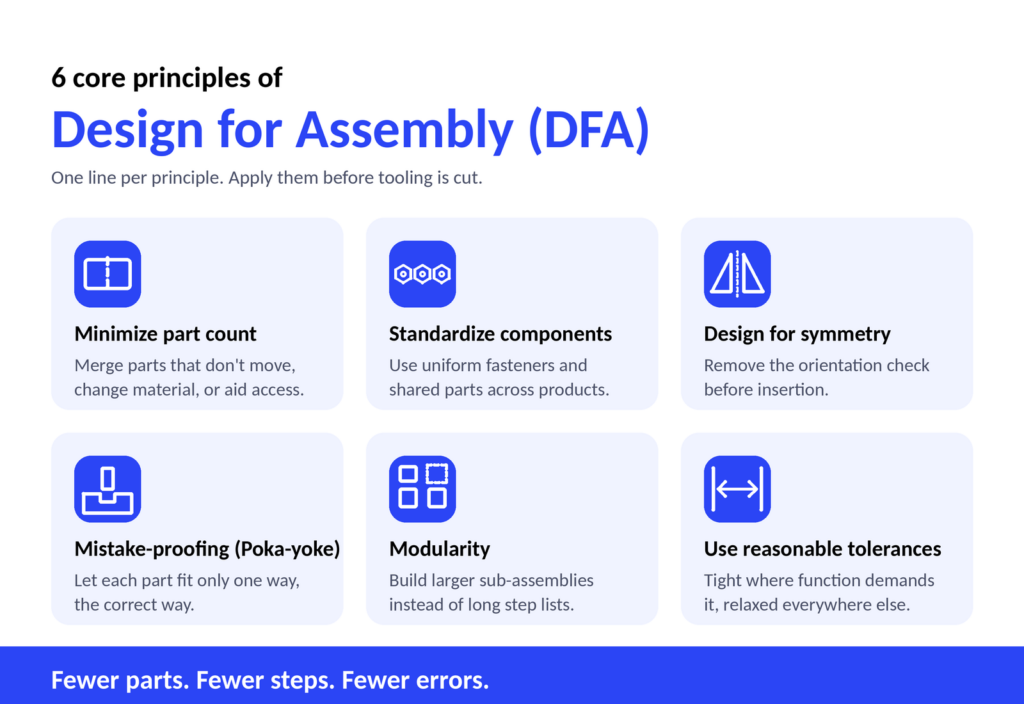
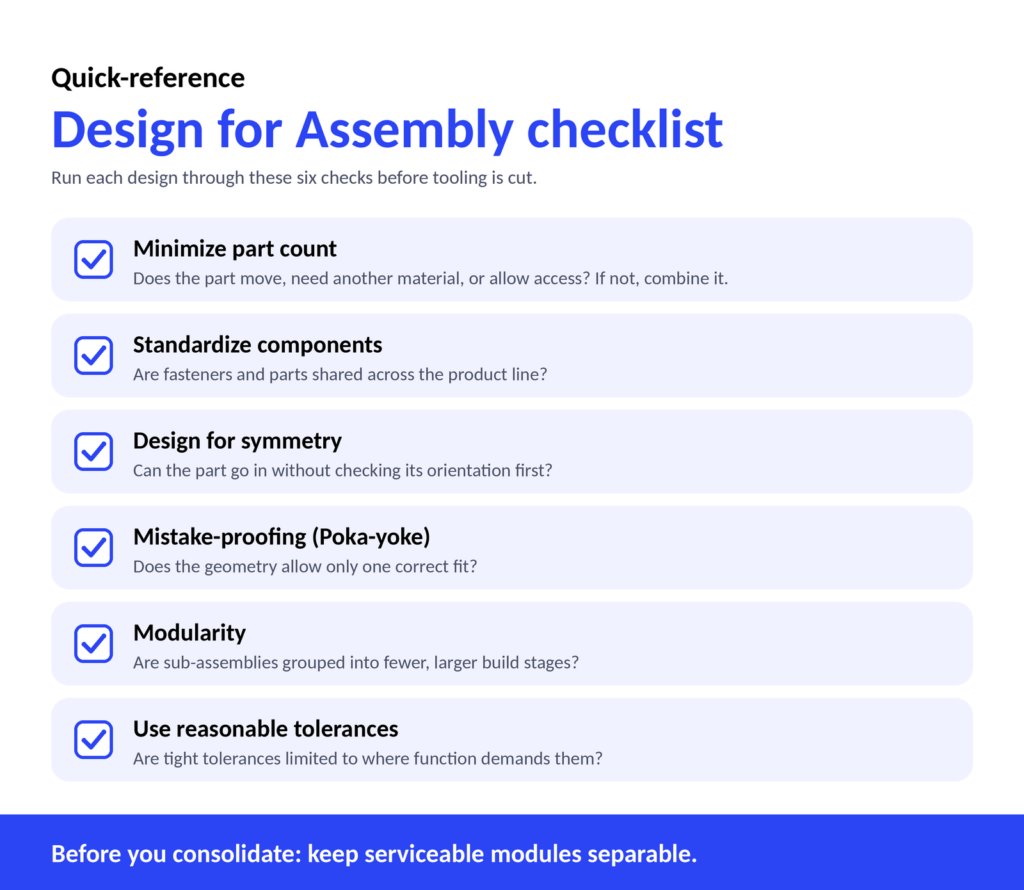
- Minimize Part Count
Run every part through three questions: does it move relative to its neighbors, does it need a different material, is it required for assembly access? If the answer is no on all three, it’s a candidate for elimination. Snap-fits and molded-in features fall under this same principle. A snap-fit isn’t a separate tactic. It’s part-count reduction built directly into the geometry, replacing a screw and a washer with one molded feature. - Standardize Components
Uniform fasteners and shared parts across product lines cut down on inventory and the number of SKUs a purchasing team has to track. Fewer unique bolts means fewer bins on the shop floor and less chance of the wrong part landing in the wrong build. - Design for Symmetry
Symmetrical parts remove the need for an orientation check before insertion. A worker, or a robotic arm, doesn’t have to pause and flip the part over. That single second, multiplied across thousands of units, adds up fast. - Mistake-Proofing (Poka-Yoke)
Guide pins and asymmetrical layouts let a part fit only one way, the correct way. Errors get prevented at the geometry level instead of caught later at inspection, which is always the more expensive place to catch them. - Modularity
Building larger sub-assemblies instead of hundreds of discrete steps keeps the final build workflow clean and logical. Workers move through fewer, larger stages rather than tracking a long, fragmented sequence. - Use Reasonable Tolerances
Match tolerance to what assembly actually requires. Over-tight tolerances add machining cost without adding assembly reliability. Tight where function demands it, relaxed everywhere else.
How Does DFA Benefit Product Development Overall?
DFA pays off in six connected ways: lower cost, less to source, higher quality, faster launches, easier repair, and less tooling investment.
- Lower labor and assembly cost. This ties directly to that 10 to 30% shorter assembly time from the intro. Fewer steps means fewer labor hours per unit.
- Fewer parts to source, stock, and inspect. A direct result of Principle 1. Fewer unique parts means a smaller supply chain to manage and fewer inspection points to staff.
- Higher first-pass quality. Fewer insertion points means fewer chances for a defect to slip through before final inspection.
- Faster time-to-market. Fewer drawings to release and fewer suppliers to qualify shortens the path from concept to shipping product.
- Easier field service and repair. Modular assemblies open up and get fixed faster, but only when consolidation hasn’t eliminated a serviceable access point. More on that trade-off below.
- Lower tooling investment. Fewer unique parts means fewer custom fixtures and jigs to build, maintain, and eventually replace.
Does Design for Assembly (DFA) Help With Product Reliability?
Yes, and the mechanism is straightforward: fewer parts means fewer failure points and fewer opportunities for an insertion error to happen in the first place.
Two metrics make this measurable instead of theoretical. First-pass yield tracks the percentage of units that pass quality checks without rework. Assembly error rate tracks defects per unit produced. When a DFA redesign pushes first-pass yield up, that’s a real, trackable reliability gain, not a design philosophy someone is asking you to take on faith.
Applying Design for Assembly in Complex Products
Minimum-part-count consolidation doesn’t always play nice with serviceability. Welding two parts into one saves assembly cost on day one. It can also make a field repair impossible five years later, because there’s no longer a seam to open.
The skill isn’t applying DFA everywhere. It’s applying DFA selectively. Consolidate non-serviceable structural elements aggressively. Keep serviceable modules separable, even if that means carrying a few extra parts.
This trade-off shows up constantly in the Special Purpose Machine Manufacturer & Automation Solutions work we do. Custom equipment built for a manufacturing floor needs field maintenance years after it ships, so part-count reduction gets weighed against what a technician will actually need to access on-site, not just what looks efficient on a CAD screen.
Conclusion: Real Takeaway on Design for Assembly
DFA isn’t a checklist you run once before tooling gets cut. It’s a lens for every design decision that follows, weighed against real trade-offs like serviceability.
Teams that apply it deliberately see the 20 to 50% part-count reductions the data promises. Teams that apply it mechanically, without judgment, lose the field-service benefit they didn’t realize they were trading away.
For manufacturers across Canada refining custom equipment designs, Ontario Dynamics applies DFA principles alongside real serviceability requirements, so part-count reduction lowers cost without making field maintenance harder.
DFA sits alongside DFM as the two halves of DFMA. Both are pieces of a larger product development journey, one that starts long before a part gets machined and doesn’t end when the product ships.
If your product’s assembly cost keeps climbing and the drawing hasn’t been reviewed in a while, that’s worth a conversation before the next production run. Request a consultation with the Ontario Dynamics team and get a second set of eyes on the design before tooling locks it in.
FAQ
DFA focuses on how parts go together. DFM focuses on how each part gets made. Run both together, and you get DFMA, which covers the full path from raw material to finished assembly.
There's no fixed number. The right count is whatever passes the three-question test: does the part move relative to its neighbors, does it need a different material, and is it required for assembly access. If a part fails all three, it's a candidate to remove or combine.
Usually, but not always. If consolidation removes a serviceable seam on equipment that needs field repair, the assembly savings can get erased by higher field service costs later. That's why complex products need selective application, not blanket consolidation.
It can be applied to either, though it's far cheaper on new designs. Redesigning an existing product for DFA still pays off if assembly volume is high enough, but the tooling investment already sunk into the current design has to be weighed against the savings.
If assembly cost keeps climbing, if defect rates aren't improving with more inspection, or if your team is negotiating labor rates instead of looking at the drawing, that's a sign the design itself hasn't been reviewed for assembly in a while.
Ready to Build Your Product?
Let’s turn your idea into a production-ready product engineered for success.