Iterative Product Development: What It Is and Should You Use It for Your Project?
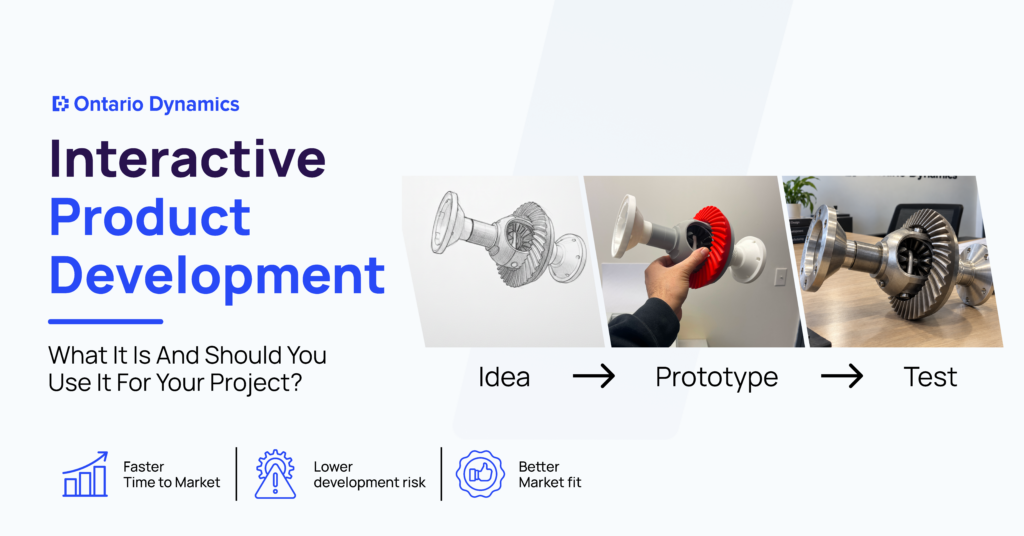
Explain what iterative product development actually means for physical products, where an “iteration” can cost thousands (not just a same-day patch), and give readers real decision criteria to know whether their project needs a fast iterative cycle, a fixed linear plan, or a hybrid.
Key Takeaways
- Iterative product development is a repeating cycle of plan, build, test, and refine, instead of building the whole product once and hoping it works.
- For hardware, an “iteration” isn’t free. It can mean a $15,000 tooling change instead of a same-day software patch, so knowing when to stop iterating matters as much as knowing how to start.
- Agile and iterative approaches succeed 64% of the time, versus 49% for traditional linear approaches.
- Most physical products need a hybrid approach: iterate fast and cheap early, then converge to a locked design before committing to tooling.
- Ontario Dynamics structures this process so speed early doesn’t turn into rework later.
Everyone’s heard the advice to “iterate fast.” It’s become startup gospel, repeated in every pitch deck and product blog. But nobody explains what that actually means once you’re building something physical.
In software, an iteration might mean pushing a same-day patch. In hardware, it can mean scrapping a $15,000 mold because the wall thickness was off by two millimeters. Same word, completely different stakes.
This guide breaks down what iterative product development actually looks like for a physical product, how the cycle works stage by stage, and how to tell if it’s the right approach for your project, or if you need something closer to a fixed, linear plan
What Is Iterative Development?
Iterative product development is a repeating cycle of planning, building, testing, and refining a product in stages, rather than building the entire thing once and hoping it’s right. Each cycle produces something real to react to, and that reaction shapes the next cycle.
The numbers back this up. Agile and iterative approaches succeed 64% of the time, compared to 49% for traditional linear approaches, according to Standish Group research cited in 2026. The difference comes down to how early problems get caught.
A traditional, linear process moves in a straight line: design, then build, then test, then ship. If something’s wrong, you find out at the end. An iterative product development cycle loops back on itself on purpose, catching that same problem three or four cycles earlier.
Implementation of an Iterative Product Development Approach
Here’s what the iterative product development cycle steps actually look like when you’re building a physical product, phase by phase.
Phase 1: Conceptual Phase
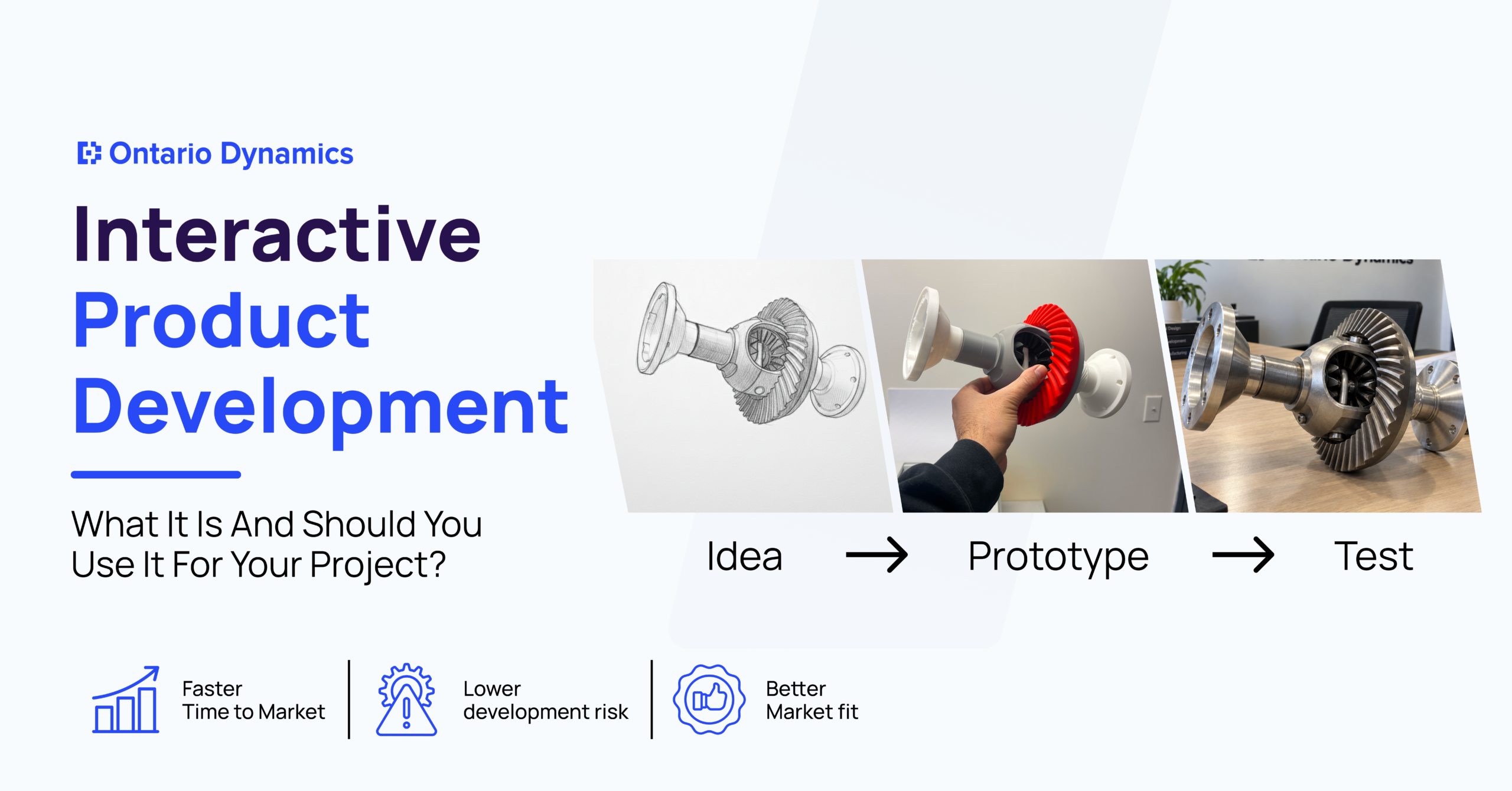
This starts with a sketch or a rough model, built from market research, shown to stakeholders or potential users before any real engineering resource gets spent. Then comes a basic physical prototype, maybe a simple model or a 3D-printed part, tested against that early feedback. This step often repeats. It’s common to build a prototype, learn something, and go back to the sketch stage before moving forward.
Phase 2: Engineering Phase
Now the prototypes get more serious. Teams build higher-fidelity versions using production-intent materials and methods, testing and refining each one before moving to the next. Quality control testing happens here too, and this is usually when planning for manufacturing at scale starts in parallel.
Phase 3: Pilot Phase
A short production batch goes out, and the team collects detailed, real-world feedback, not just internal review. If that feedback reveals a real problem, the honest move is back to engineering or prototyping. Not straight to full manufacturing. Skipping this step is how expensive mistakes make it into mass production.
Phase 4: Manufacturing Stage
The first production run happens, and the first few months are the highest-risk window for surfacing any design issue that slipped through earlier stages. Improvements don’t stop here either. A product’s iteration history stays useful for years. An idea logged and shelved two years ago can become viable again once new materials or manufacturing technology shows up.
Strip away the hardware-specific detail, and every iterative process, physical or digital, runs through the same four core stages:
- Plan – define the scope, goals, and tasks for this specific cycle.
- Design & Build – create the mock-up, prototype, or MVP for this cycle. This step compresses what a full stages of prototyping breakdown covers in detail.
- Test & Launch – release internally or to a small user group to catch bugs and usability issues.
- Review & Refine – gather real feedback and data, then apply it to the next cycle.
Whether you’re building a circuit board or a mobile app, this loop is the same. Only the cost of running it changes.
The Real Advantages of an Iterative Process in Product Development
Three advantages show up consistently: lower risk, better market fit, and faster learning. Each one deserves a closer look, because the generic version of this advice undersells how much they actually matter.
Lower Risk
Catching a design flaw at the sketch or digital-model stage costs a few hours. The same flaw, caught after tooling is cut, costs thousands. Small, frequent checkpoints mean no single mistake compounds silently for months before anyone notices. This is where the data gets stark: agile and iterative projects fail at a rate of only 9%, compared to 29% for traditional linear projects, based on 2026 project management research.
Better Market Fit
Real user reaction at the pilot or early-prototype stage can reveal a genuine mismatch between what got designed and what the market actually wants. That’s useful information while there’s still time and budget to change course. Finding the same mismatch after a full production run has already shipped is a much more expensive lesson.
Faster Learning
A team that ships a rough version and gets real feedback in a few weeks learns more than a team that spends those same weeks polishing a version nobody outside the company has seen. A slightly rougher early version that teaches you something beats a polished one that teaches you nothing.
How PCB Design Platforms Enable Rapid Iteration
This applies directly to electronics. Modern PCB design software lets teams simulate and revise a board layout digitally before committing to a physical fabrication run. That cuts the cost of an electronics iteration the same way a digital model cuts the cost of a physical prototype, catching a routing error on screen instead of in a $2,000 board spin.
Should You Use an Iterative Product Development Cycle for Your Project?
Not every project needs the same amount of iteration. Here’s how to tell where yours falls.
Question
Leans Iterative
Leans Fixed/Linear
How defined are requirements?
Still exploring the problem
Requirements are locked and regulatory-scoped
Cost of one iteration cycle?
Low (software, digital models)
High (tooling, hardware materials)
Access to real user feedback?
Frequent, fast feedback loop available
Limited access; feedback is slow or expensive to get
For most physical products, the honest answer is a hybrid. Iterate cheaply and fast early, sketches, digital models, low-cost prototypes, then converge to a fixed design before committing to tooling. That convergence point is usually called a design freeze, and it’s a deliberate decision, not something that happens by default once a deadline gets close.
How Ontario Dynamics Supports an Iterative Development Approach
Ontario Dynamics’ Product Development Services are built around this exact tension. Early on, the focus is fast, low-cost iteration through sketch models and digital prototyping, so ideas get tested before real money gets committed. As the design matures, the process deliberately converges to a locked, manufacturable design before tooling starts. That’s the bridge between “iterate fast” advice and the reality of building something physical: speed matters early, but it has to end somewhere.
Conclusion
Iterative product development isn’t a philosophy to adopt wholesale or reject outright. It’s a cycle to apply deliberately: fastest and cheapest where mistakes are cheap, concept sketches and digital models, more carefully as changes get more expensive, tooling and production. Teams that know where to stop iterating are the ones that ship on schedule.
For startups and manufacturers across Canada building market-ready products, Ontario Dynamics structures iterative hardware development to move fast early and converge to a locked, manufacturable design before tooling, so speed early doesn’t become rework later.
This same logic carries through the rest of the product development journey, the same thinking behind a design freeze and the prototyping stages that follow. If you’re mapping out where your project fits, Ontario Dynamics’ guide to the 7 stages of new product development is a useful next stop.
Ready to figure out where your project sits on that spectrum? Get in touch with Ontario Dynamics for a Product Development Services consultation.
FAQ
An MVP iteration cycle is one specific application of iterative development, usually for software or digital products, where you ship a minimum viable version and improve it based on real usage. Hardware follows the same underlying loop, but each cycle costs more and moves slower because you're dealing with physical materials, not code.
Partly. Fail fast product development makes sense at the sketch and digital-model stage, where a failed idea costs a few hours. It stops making sense once you're deep into tooling, where a failure costs thousands and weeks of delay. The goal is failing fast early, then getting it right before you commit.
Rapid prototyping and iteration are tools used inside the broader iterative process. Prototyping is how you build the thing to test in each cycle. Iteration is the repeating loop of planning, building, testing, and refining that the prototype feeds into.
It stops. Continuous product improvement happens after launch too, but the iteration that shapes the core design has to end at a design freeze, before tooling gets committed. Teams that keep iterating past that point usually end up with delays and cost overruns instead of a better product.
One of the clearest design iteration examples is a product that goes back to the sketch phase after an early physical prototype reveals a usability problem nobody caught on paper. That backward step feels slow in the moment, but it's far cheaper than catching the same problem after tooling.
Ready to Build Your Product?
Let’s turn your idea into a production-ready product engineered for success.