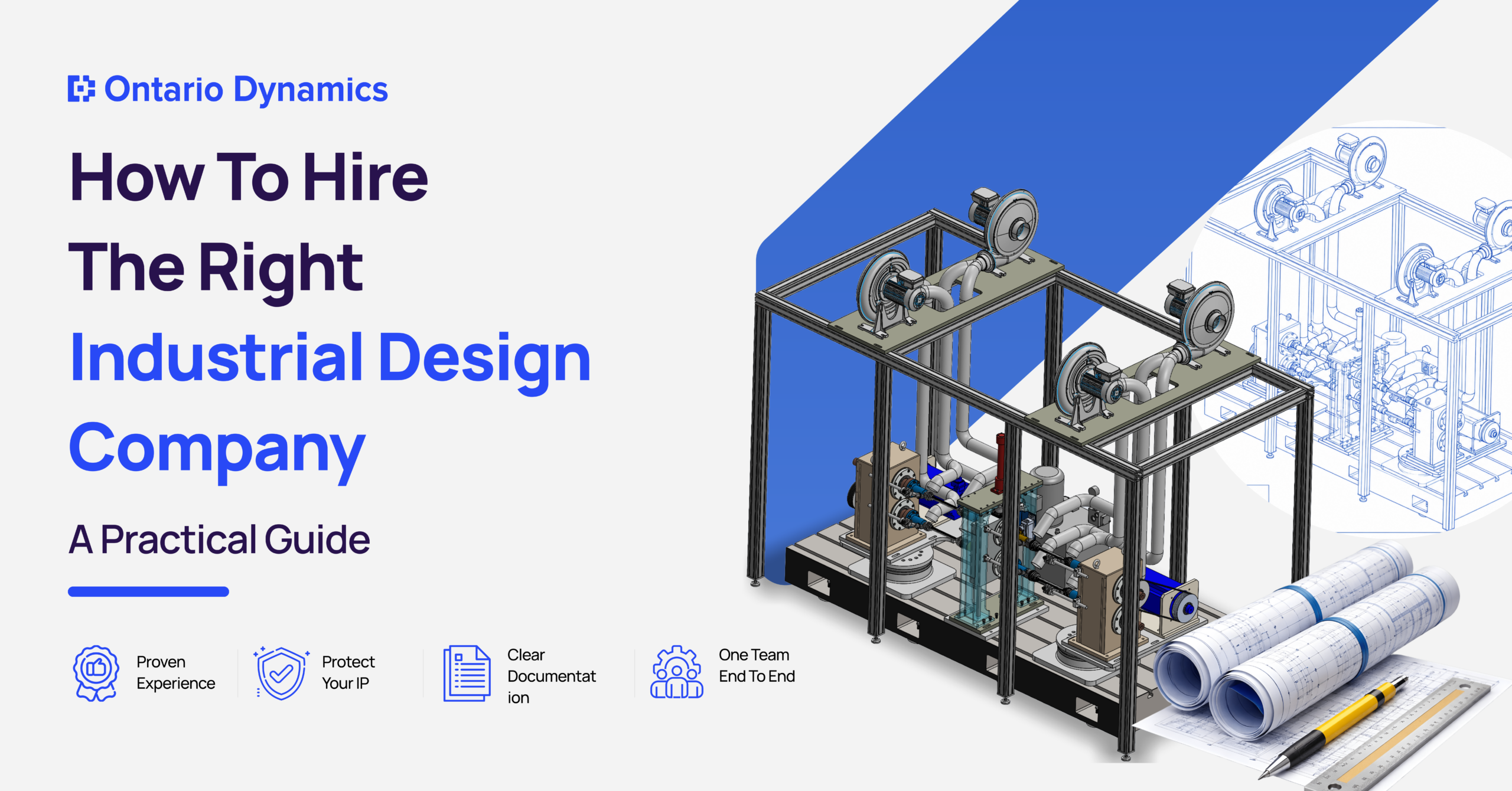
How to Hire the Right Industrial Design Company: A Practical Guide
Educate manufacturing leaders, product managers, and startup founders on how to evaluate and select an industrial design company for custom equipment or product development work, positioning Ontario Dynamics as a knowledgeable, trustworthy option by demonstrating industry insight rather than direct sales pitching.
Key Takeaways
- An industrial design company should show real experience in your industry, not just a general design portfolio.
- Ask about documentation. A machine without clear drawings, BOMs, and maintenance records becomes a liability within a year.
- Fixed-fee scoping after a requirements discussion is a sign of a company that knows what it’s doing.
- NDA-first workflows protect your IP before any technical conversation starts.
- The team that plans your project should be the same team that builds and supports it.
You’ve got a manufacturing problem that off-the-shelf equipment can’t solve. Maybe your line needs a custom test rig, or your product idea keeps stalling between CAD and a working prototype. You start searching for help, and every website says the same three things: experienced, reliable, quality-driven. None of that tells you who can actually build the thing.
Picking the wrong design partner costs more than money. It costs months. A machine that fails validation on the shop floor, or a product that gets redesigned after tooling is already cut, sets a project back further than starting from scratch would have.
This guide covers what to actually check before you hire, based on what separates a solid industrial design services from one that just talks a good game.
What an Industrial Design Company Actually Does
A good industrial design company takes a rough idea or a production problem and turns it into a physical, working solution. That means concept sketches, 3D CAD models, structural analysis, prototype builds, and testing, all before anything goes into full production.
For manufacturers, this often means custom equipment design: test rigs, special-purpose machines, or automated inspection systems built for one specific job on the floor. For product companies, it means taking an MVP from a napkin sketch to something a contract manufacturer can actually produce at volume.
The difference between a strong partner and a weak one shows up fast. Weak partners hand you a 3D model and disappear. Strong ones stay through prototyping, testing, and the awkward phase where the first build doesn’t quite work and needs a redesign.
Why This Decision Matters More Than It Seems
Manufacturing equipment doesn’t get second chances once it’s running shift after shift. If a test rig can’t handle the load profile of your actual product, you find out during validation, not before. That’s an expensive place to find out.
Product development has the same risk on a different timeline. A design that looks fine in CAD but ignores manufacturability decisions can pass every review and still fail at the tooling stage. That’s rework, and rework eats budgets and timelines equally.
Real-world example: a transmission test bench built without accounting for thermal loads under sustained cycling will pass a short bench test and then fail during actual EDU (electric drive unit) validation. Catching that during design review costs a conversation. Catching it after commissioning costs weeks.
What to Look For Before You Sign Anything
Here’s what actually separates a capable product development company from one that’s guessing:
- Industry-specific experience. Ask for examples close to your application, not just a general portfolio. A company that’s built test rigs for automotive powertrains understands duty cycles and vibration differently than one that hasn’t.
- A single point of contact. If your project gets handed between three different people at each phase, information gets lost. One lead who stays with the project from kickoff to delivery keeps things consistent.
- NDA-first process. Any company that wants technical details before signing a mutual NDA isn’t protecting your IP the way it should.
- Real documentation practices. Ask what you’ll receive at the end: CAD files, 2D drawings, BOMs, maintenance procedures. If the answer is vague, that’s your answer.
- Willingness to say no. A partner who tells you honestly when a project isn’t the right fit, or when your budget doesn’t match the scope, is more trustworthy than one who says yes to everything.
Questions to Ask During the First Call
- What’s your typical timeline for a project like mine?
- Who will be my main contact, and will that person also do the technical work?
- What CAD and simulation tools do you use, and does that match my industry’s standards?
- Can you share an example where a design had to change mid-project, and how you handled it?
- What does the final deliverable package include?
The answers matter less than how directly they’re given. A company that hedges on timeline or documentation is telling you something.
What Good Documentation Looks Like
Plenty of custom machines arrive on-site with a folder of files nobody on the floor can actually use. Good documentation isn’t just paperwork for the sake of it. It’s what lets your maintenance team troubleshoot a machine two years from now without calling the original design team.
That means clear tolerancing on drawings, BOMs that match what was actually built, and commissioning records written for the people who’ll run the equipment daily, not just for a compliance file. For regulated industries like medical devices or aerospace, this also means design history file documentation and DFMEA (a structured method for identifying where a design could fail) built in from day one, not added after the fact.
Cost: What Drives the Number
Pricing for custom equipment or product development varies with complexity, not with how many pages the proposal has. A focused proof-of-concept build typically runs four to six weeks. A full product development cycle, from early concept through production-ready documentation, often takes five to nine months. Custom equipment projects generally fall between three and six months from kickoff to commissioning.
Fixed-fee pricing after an initial scoping conversation is common practice among reputable partners, since it gives both sides clarity before real work starts. Longer or higher-uncertainty programs are sometimes broken into phases, each with its own fixed fee, so cost stays predictable as the project develops.
Final Thoughts
The right partner shows up in the details: how they document work, how directly they answer hard questions, and whether the people planning your project are the same ones building it. Ontario Dynamics has spent over 15 years on both sides of this process, which is exactly why documentation, ownership, and direct communication sit at the center of how the team works.
If you’re weighing a custom equipment build or a product that needs to move from concept to production, request a consultation and start with a real conversation about what your project actually needs.
FAQ
Budget a few weeks for real vetting. Talk to at least two or three companies, ask for project examples close to your application, and pay attention to how specific their answers are.
Yes, at a company built for that. Team size matters less than whether the project has genuine mechanical complexity worth solving.
Say so upfront. Mechanical design principles don't change much by industry, so a company with strong fundamentals can usually still help, or will tell you honestly if it can't.
No. A rough description of what the product or machine needs to do, plus your constraints and timeline, is enough to start a real conversation.
Yes, this is standard across the industry. It confirms commitment on both sides before detailed scoping and design work starts.
Ready to Build Your Product?
Let’s turn your idea into a production-ready product engineered for success.