23% of Product Development Investment Fails Because of an Unclear Strategy, Here's How to Build One That Doesn't
Objective
Most product teams have a roadmap, a backlog, and a launch date. What they don’t have is a document that ties any of that to why the product exists or what business result it’s supposed to produce.
That gap stays invisible until launch misses its numbers. Then the team spends weeks arguing about which decision caused it, because nobody wrote down what “success” was supposed to mean in the first place.
A new product development strategy is the master plan that defines why a company is building a product, who it’s for, and how the product ties back to business goals, before a single roadmap item or backlog ticket gets written. It’s the compass. The 7-stage NPD process is the map you use to walk the route.
In Brief: A new product development strategy is the decision layer that comes before roadmaps and backlogs. It defines vision, market fit, resource allocation, and success metrics up front. Companies with a formal strategy hit a 64.4% five-year success rate versus 45.4% for those without one. Skipping it is the single biggest reason product investment fails.
Key Takeaways
- Strategy answers why, who, and what business result; process answers how
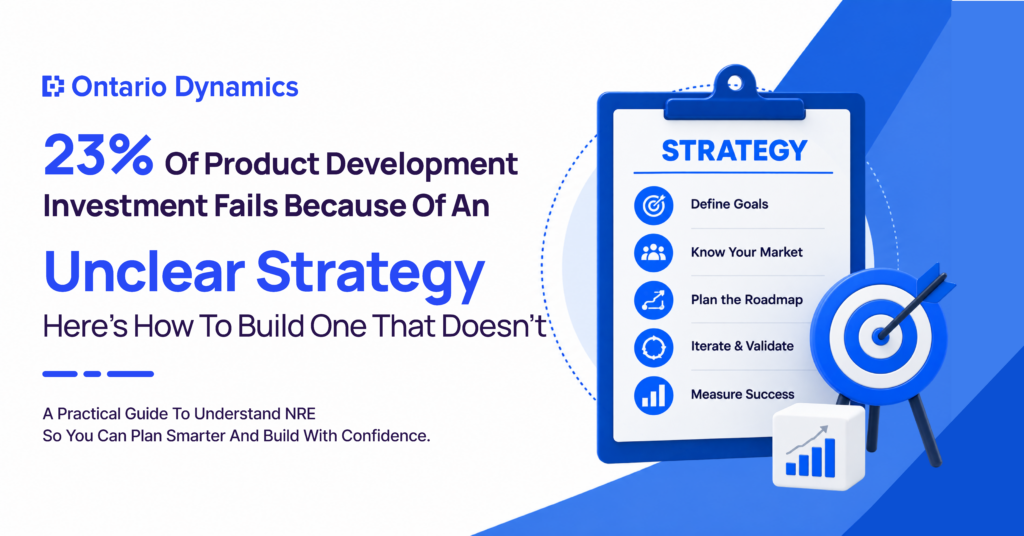
- 23% of product development investment fails specifically due to unclear strategy, not poor technical work
- A strategy has 6 core components, but not every product needs full depth on all 6
- Manufacturability and compliance should be scoped into the strategy, not discovered later
- The right partner joins at the vision stage, not after specs are already locked
What Is a New Product Development Strategy?
A new product development strategy is different from a product development process. Strategy is the why and the direction. Process, like the 7 stages of new product development, is the how and the execution.
A real strategy answers four questions before anything else gets built: why are we building this, who is it for, what business result does it need to produce, and how do resources get prioritized when everything feels urgent? Skip any one of these, and you get a team that’s very good at building, moving fast in a direction nobody agreed on.
Why NPD Strategy Predicts Launch Success
Here’s the uncomfortable number: only 30% of NPD projects that get formal approval go on to become commercial successes. Even the best-performing companies average a 76% launch success rate, compared to just 51% for everyone else (PDMA research, cited by Customcy/StudioRed, 2026). That gap is process discipline. It isn’t budget.
PDMA’s research draws an even sharper line. Companies it calls “Prospectors”, proactive, strategy-led, had 48% of their teams rank as best performers, compared to just 11.5% of “Reactor” companies with no formal strategy. Prospectors also hit a 64.4% five-year success rate against 45.4% for Reactors (PDMA, cited by Customcy, 2026).
Strategy, specifically, is the variable. 23% of product development investment fails because the company strategy was unclear (WeAreTenet, 2026), not because the technical work was wrong.
The 6 Components of an NPD Strategy That Actually Drive Decisions
A working strategy is built from six components: product vision and business objectives, market intelligence, roadmap and backlog, feedback loops, lifecycle strategy, and resource allocation with performance metrics.
Product Vision & Business Objectives. These are two halves of one decision, not separate steps. Vision is why you’re building the product. Objectives make it measurable, for example, “capture 8% of the mid-market segment within 18 months of launch.”
Market & Competitive Intelligence. This should inform your vision and objectives, not follow them as an afterthought. Primary research, interviews, and usability testing tell you what real users need. Secondary research, like industry reports and competitor teardown, tells you where the gaps are.
Roadmap & Prioritized Backlog. The roadmap is your strategic sequencing document. The backlog is its tactical breakdown; one flows from the other. Frameworks like RICE or MoSCoW help decide what ships first. Only 13% of companies maintain a detailed roadmap beyond one year (WeAreTenet, 2026); most roadmaps are shorter-lived than teams assume, and that’s a planning decision worth making on purpose.
Feedback Loop & Iteration. Feedback exists to validate assumptions, refine features, and trigger changes to the roadmap and backlog. Collected and filed away, it’s worthless.
Lifecycle Strategy. A strategy doesn’t end at launch. Pricing at launch looks different from pricing at maturity: market-penetration pricing early, cost reduction once the product is established.
Resource Allocation & Performance Metrics. Budget and capacity planning need to sit next to the KPIs that prove the strategy is working. Track three dimensions: market performance, customer value, and business value.
How to Decide Which Components Your Strategy Actually Needs
The 6 components are a checklist, not a mandate. The right depth depends on what’s actually at stake.
Situation | Depth Needed | Why |
Early-stage startup, first product | Lightweight: vision, roadmap, feedback loop | Speed to validated learning matters more than formal metrics infrastructure |
Manufacturer adding a product line | Full 6 components, resource and metrics heavy | Existing production capacity makes resource allocation and lifecycle planning high-stakes |
Regulated or safety-critical product | Full 6 components, plus compliance built into vision | Certification requirements make skipping lifecycle or resource planning expensive later |
Most first products need lightweight versions of all 6. Only regulated or capital-intensive products need full depth on every one from day one.
How to Develop and Implement a New Product Strategy, Step by Step
Building the strategy is six steps, each building on the one before it.
- Define business and product goals. Tie every goal back to the vision. Don’t start research until the goal is written down.
- Ground the strategy in market and competitive research. This should change your goals, not just confirm them.
- Build a cross-functional execution team. Technical, design, and manufacturing input from day one, not handed off in sequence.
- Build in compliance and manufacturability from day one. Design for manufacturing and regulatory scoping belong in the strategy phase, not discovered once technical work has already started.
- Validate through iteration, not assumption. Pilot programs and concept tests before full commitment- this is what an iterative product development approach looks like in practice.
- Use AI-supported digital tools. 60% of new products in 2026 use AI for market analysis (Six Paths Consulting, 2026); think demand forecasting and competitive scanning, not a vague “use AI” checkbox.
What to Look for in a Partner Who Can Execute the Strategy
Four criteria separate a real execution partner from a vendor who just takes orders.
Cross-functional involvement from the strategy stage, not after. Does the partner join at the vision and roadmap stage, or only once specs are already locked? Early involvement is what makes vision and market research actionable instead of theoretical.
Manufacturability input during strategy, not later. Does manufacturability get scoped into the roadmap before commitments are made, or discovered once design work is underway? This is where a design-for-manufacturing-first approach connects directly to strategy.
Documented roadmap and metrics tracking. Does the partner maintain a shared, dated roadmap and report against real KPIs, or is progress tracked informally, in someone’s head?
Iterative validation built into the engagement. Does the partner build in pilot and feedback checkpoints, or leave validation entirely to the client? A partner without this pushes all the iteration risk onto your team.
Tell us what stage your strategy is at. We’ll help identify which components need the most work before you commit budget to technical development.
Conclusion
A new product development strategy isn’t paperwork that precedes the real work. It’s the decision layer that determines whether the rest of the effort goes toward the right product.
Teams that treat it as a formality end up with a roadmap and no compass. Teams that treat it as the compass ship fewer products, and better ones.
For startups and manufacturers across Canada shaping a new product development strategy, Ontario Dynamics brings manufacturability and design-for-manufacturing input into the vision and roadmap stage, so the strategy reflects what’s actually buildable, not just what’s desirable.
Strategy is the compass. Execution happens across the 7 stages of new product development that follow it. Ready to pressure-test your product strategy before you commit budget to it? Talk to the Ontario Dynamics team about where your strategy needs the most work.
FAQ
Strategy defines why you're building and what business result you need. The roadmap is the sequenced execution plan that comes out of that strategy; one is direction, the other is the route.
For a first product, a lightweight version covering vision, market research, and a roadmap can take two to four weeks. Regulated or capital-intensive products need longer, since compliance and resource planning have to be built in from the start.
Yes, but it can be lightweight. Even a one-page document covering the vision, target market, and success metric prevents the most common failure: a team building fast in a direction nobody agreed on.
Unclear strategy, not poor technical execution. 23% of product development investment fails specifically because the strategy wasn't clear going in (WeAreTenet, 2026).
It belongs in the strategy phase. Scoping manufacturability and compliance early prevents expensive redesign once tooling or production commitments are already made.
Ready to Build Your Product?
Let’s turn your idea into a production-ready product engineered for success.