Non-Recurring Engineering (NRE) Costs: What They Cover, Who Pays, and How to Budget for Them
Objective
A quote lands in your inbox showing tens of thousands of dollars in one-time fees, and not a single unit has shipped yet. The contract manufacturer wants a purchase order before they touch the tooling. You want to know why the number is that high, and whether any of it is negotiable.
That number is Non-Recurring Engineering, or NRE. Get it structured right, and it’s a one-time investment that protects your margins for years. Get it wrong, and you either overpay upfront or get squeezed by inflated per-unit pricing once volume production starts.
TL;DR: Non-Recurring Engineering (NRE) costs are the one-time expenses paid before mass production begins — design work, prototyping, tooling, and certification. Simple products often run $10,000–$30,000 in NRE. Products needing custom tooling and certification can exceed $250,000. Tooling alone usually accounts for 60–70% of the total.
Key Takeaways
- NRE is paid once, upfront, and doesn’t scale with production volume — recurring cost does.
- Tooling and equipment are typically the largest NRE line item, not design work.
- A low NRE quote is often a warning sign of higher recurring unit pricing later.
- Ownership of tooling, CAD files, and IP should be written into the contract before NRE is paid.
- A design for manufacturing review, done before tooling is cut, is the single best way to control NRE.
What Are NRE Costs, and Why Are They a One-Time Expense?
Non-Recurring Engineering costs cover the work done before production begins: design, prototyping, tooling, and certification. Once a product is in mass production, none of that work repeats. It’s paid once, not per unit.
Costs vary a lot by product complexity. Simple products often land around $10,000–$30,000 in NRE. Products that need custom tooling, formal certification, and complex firmware can exceed $250,000 (Titoma, NRE budgeting guide, 2026).
The line between NRE and recurring cost comes down to timing versus scaling. NRE is a lump sum, paid before the first unit ships. Recurring cost — parts, labor, packaging — repeats with every unit, forever. Getting this straight early makes the rest of your budget planning and your product development timeline, a lot easier to plan around.
The 4 Categories of NRE Costs in a Product Development Project
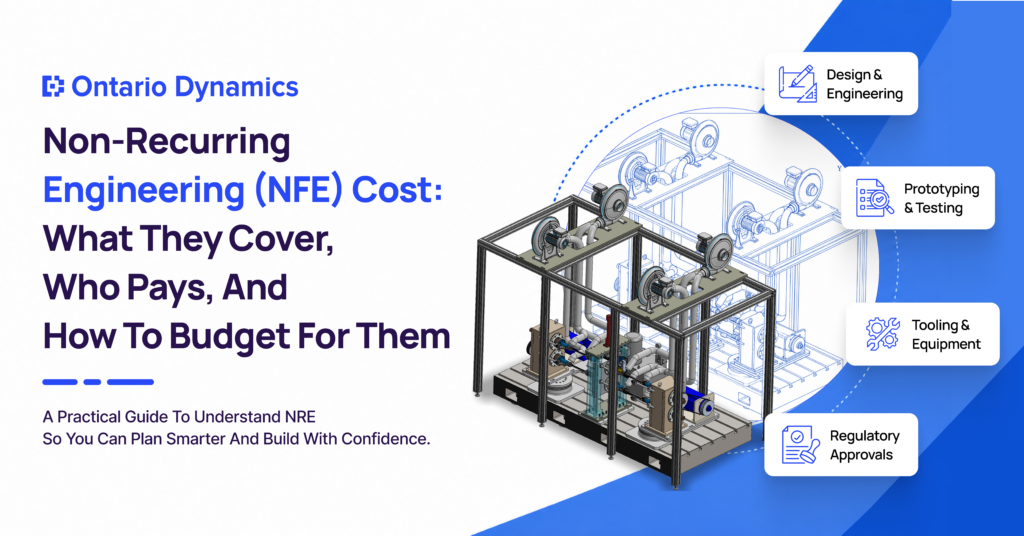
NRE isn’t one lump fee. It’s four distinct categories of spend, each landing at a different stage: initial design work, prototyping and testing, tooling and equipment, and regulatory approvals.
Category 1: Initial Product Design and Engineering
This covers CAD modeling, design for manufacturing review, and — where relevant — PCB layout and firmware work. It’s the labor that turns a concept into a file a supplier can actually build from. This is the earliest NRE spend, paid before any physical prototype exists.
Category 2: Prototyping and Testing
Alpha and beta builds validate physical and functional performance before tooling gets committed. Each round should close open questions before the next, more expensive stage begins.
Category 3: Tooling and Equipment
Custom molds, dies, fixtures, and jigs are unique to your product. This category almost always drives the total NRE bill.
Prototype aluminum tooling typically runs $1,500–$8,000. Production-grade steel tooling runs $15,000–$120,000 or more, depending on class and complexity (Jaycon, 2026 Injection Molding Pricing Report). Mold design and creation alone can account for an estimated 60–70% of a hardware startup’s total NRE spend (2026 injection molding cost research, PlasticMoulds.net). Design features like undercuts can add another 20–30% to mold cost on their own (Weilin Plastic, 2026 Pricing Guide).
Category 4: Regulatory Approvals
Certification testing — safety, EMC, FCC-type approvals — that you need before you can legally sell the product. It gets scoped early and tested late, but it should be budgeted from day one. Teams that treat it as a formality tend to find out otherwise, right when it’s most expensive to fix.
How NRE Costs Are Factored Into a Product Development Timeline
Where NRE lands in the budget is a sequencing decision, not just a line-item cost. Concept work, design, prototyping, tooling, and pre-production all happen before a single unit sells — meaning all of that spend hits your cash flow with zero revenue coming in against it.
That’s why sequencing matters as much as the total dollar figure. A team that front-loads design work and testing spends less on tooling and rework later. A team that rushes to tooling to save time often pays for it twice.
Why NRE Matters in Product Development
NRE planning isn’t about shrinking a number. It’s about avoiding four specific, expensive outcomes.
Underestimated tooling scope. Manufacturability issues surface after tooling is already cut, forcing expensive rework or a second tool.
A suspiciously low quote. An unusually low NRE number can signal that the recurring unit price is inflated to make up the difference once volume production starts. Worth flagging directly when you’re comparing quotes.
No ownership clause. Without a contract stating that tooling, CAD files, and IP transfer once NRE is paid, you can end up funding tooling you don’t legally own.
A skipped design for manufacturing review. This is the highest-cost category of late-stage change, because it surfaces after tooling commitment instead of before it.
How Do You Reduce Recurring Costs After NRE Is Paid?
NRE is a one-time decision. Recurring cost is the one you keep optimizing after.
Lever | What It Does |
Simplify the bill of materials (BOM) | Fewer unique parts means fewer suppliers, less inventory risk, and lower per-unit cost |
Standardize components | Off-the-shelf fasteners and hardware are cheaper and easier to replace than custom parts |
Negotiate volume-based supplier pricing | Unit cost drops as order quantity rises — worth locking in early |
Revisit tooling utilization | A single tool running higher volumes lowers the effective per-unit tooling cost |
Audit the supply chain regularly | Material and freight costs shift; a yearly review catches savings you’d otherwise miss |
Conclusion: The Partner Decision Happens Before the Timeline Does
NRE is not a fee to minimize at all costs. It’s a one-time investment that can be structured well or poorly. Teams that treat it as negotiable and ownership-defined protect their margins for the life of the product. Teams that treat it purely as a number to shrink usually pay for it later, either in recurring costs or in tooling they never legally owned.
For startups and manufacturers across Canada navigating complex product and equipment development, Ontario Dynamics structures NRE around clear ownership terms and designs for manufacturing review from day one — so the upfront investment sets a project up for predictable production, not costly surprises after tooling is cut.
NRE isn’t the finish line on cost. It’s the foundation that the rest of your unit economics get built on.
Ready to plan your NRE budget correctly the first time? Talk to the Ontario Dynamics team about structuring your product development costs from day one.
FAQ
The buyer pays NRE costs, whether that's a startup or an established manufacturer. It's a one-time fee separate from the per-unit price you pay once mass production starts.
No. Tooling is one category inside NRE, usually the largest one. NRE also includes design work, prototyping, and certification.
Yes, some contract manufacturers will roll NRE into a higher per-unit price over an agreed volume instead of charging it as a lump sum. This lowers upfront cash needs but raises your recurring cost, so it's worth modeling both scenarios against your production volume.
Compare it against the breakdown, not just the total. A quote with almost no tooling or certification cost usually means those costs are hidden in the unit price instead.
Only if your contract says so. Get tooling, CAD file, and IP ownership written in before you sign, not after.
Ready to Build Your Product?
Let’s turn your idea into a production-ready product engineered for success.