
Ontario Dynamics developed a custom destacker-feeder system for front-of-line stamping automation, built to separate, prepare, centre, and deliver single blanks to a press line with controlled speed, accuracy, and safety.
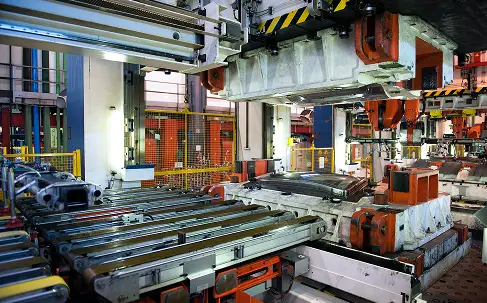

A custom front-of-line automation system designed to turn stacked blanks into a clean, centred, single-blank flow ready for press loading.
Press-Line Support Speed
Up to 30 SPM, depending on blank size, mass, and transfer path
Stack Capacity
Up to 5 metric tons
Transfer Speed
Rear-feeder transfer speed up to 2.5 m/s
Confidential industrial manufacturing project.
Automotive stamping, sheet metal forming, and front-of-line press automation
Custom destacker-feeder design and development for stamping press lines.
The D-Stacker was developed as a custom front-of-line stamping machine. Its job is to take stacked blanks and deliver one clean, correctly separated, accurately centred blank to the press loading system.
This is more complex than simple material handling. A stamping line needs the right sheet, at the right time, in the right position, with the right oil condition, and without surface damage.
Ontario Dynamics approached the project as a special-purpose machine manufacturer, not as a catalogue equipment supplier. The system had to be designed around the blank family, press line layout, available floor space, safety needs, maintenance access, and future serviceability.
Core Machine Functions
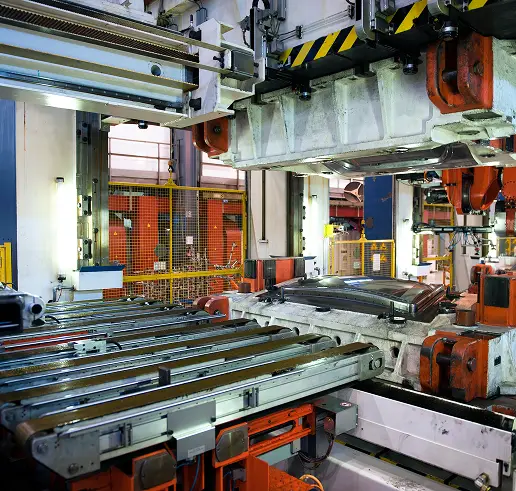
The D-Stacker had to support fast, reliable, and repeatable front-of-line automation for stamping press operations.
The machine was not designed around one simple motion. It had to manage stack loading, blank lifting, sheet separation, material-specific handling, optional cleaning, centring, rejection, and press synchronization.
Key Requirements
Area
Function
Blank Material
HR steel and aluminum
Blank Thickness
Blank Thickness
Stack Height
500 mm to 1800 mm
Stack Mass
Up to 5 metric tons
Transfer Architecture
Rear-feeder or gantry
Separation Method
Fanner magnets, air knives, vacuum pick
Detection
Inductive and/or optical double-blank detection
Cleaning
Optional washing, brushing, spray, or roller oiling
Press Integration
Controlled handoff with machine and press signals
The biggest requirement was not only speed. It was controlled handling. A fast machine is not useful if it scratches panels, misses a sheet, sends a double blank, or loses press synchronization.
Problem
Stamping lines depend on clean, single-blank feeding. If two blanks stick together, the press can stop or damage the tooling. If a blank is skewed, the next station may misload. If the surface is scratched or contaminated, the defect can appear after forming.
The D-Stacker had to solve these problems at the front of the line.
It had to move blanks quickly, but also gently. It had to separate sheets without damaging surfaces reliably. It had to support different materials, because steel and aluminum do not behave the same way during separation and transfer.
A weak front-of-line system can slow down the entire press line.
Common issues include:
For manufacturers, these problems affect output, quality, labour use, and machine uptime.
The project had several engineering pain points:
The real challenge was not one single component. It was the interface between every part of the system.
Ontario Dynamics developed the D-Stacker as a modular custom machine for stamping press line automation.
The solution was built around three clear areas: machine strategy, mechanical implementation, and controls technology.
The first step was to treat the destacker-feeder as a full blank preparation system.
That meant the design had to cover the complete flow:
Loading → Stack Transfer → Lifting → Separation → Single-Blank Transfer → Optional Cleaning/Oiling → Centering → Detection → Handoff
This approach reduced the risk of designing separate modules that worked alone but failed when connected to the press line.
This layout is well-suited for ferrous steel blanks.
A central stack lifter presents the top sheet. Fanner magnets and air knives help separate the blank
A vacuum matrix picks the sheet, then a rear-feeder transfers it forward.
For steel blanks, magnetic transfer can be used where suitable. For aluminum, vacuum or air-assisted handling is required because it cannot be moved using magnetic transport.
This layout is better suited for aluminum, irregular blanks, cosmetic outer panels, and scratch-sensitive applications.
An overhead gantry or destack head picks the blank and transfers it to the next station. This provides better control when the panel surface is sensitive or when vision-based centring is required.
The system can use either a scissor lift or a guided four-post hydraulic lift.
A scissor lift is compact and cost-effective. A four-post lift gives better guidance and stronger control for heavier or eccentric stack loads.
The D-Stacker design uses practical, serviceable automation technology.
This includes:
The D-Stacker design uses practical, serviceable automation technology.
This includes:
Clear Engineering Outcomes
Area
Results
Blank Flow
Designed a controlled process from stack loading to press handoff
Material Flexibility
Supported steel and aluminum handling through different transfer methods
Speed Target
Planned for up to 30 SPM where blank size, mass, and movement allow it
Surface Protection
Included low-mark handling, cleaning options, and controlled contact surfaces
Detection
Added mandatory double-blank detection before press handoff
Integration
Built around press synchronization, recipe control, and clear machine states
Maintenance
Favoured off-the-shelf components and practical spare parts planning
Before And After Showcase
Manual or semi-automated blank handling created more variation
Controlled blank preparation with defined loading, separation, and transfer steps
Risk of double blanks reaching the press
Double-blank detection included as a mandatory design feature
Material handling approach could vary by operator or setup
Material-specific transfer strategy for steel, aluminum, and sensitive panels
Stack changeover could slow production flow
Two-stack loading supports one active stack and one standby reload position
Surface damage risk from poor contact or contamination
Cleaning, oiling, low-mark cups, and contact surface planning included in design
Press handoff depended on accurate timing and alignment
Centering and press synchronization built into the system architecture
The D-Stacker was not positioned as a generic conveyor or simple feeder.
It was designed as a custom front-of-line automation system where mechanics, controls, utilities, safety, maintenance, and press integration all had to work together.
The D-Stacker provides manufacturers with a more robust way to manage the first step of a stamping line.
It helps reduce manual handling, improves blank preparation, supports safer press feeding, and gives the production team better control before the blank reaches the press.
For a manufacturing business, this can improve uptime, reduce handling-related issues, and support more consistent press line performance.
The system is built to separate one blank at a time and confirm the sheet before it moves forward. This helps reduce press interruptions and quality issues caused by double blanks.
Steel and aluminum need different handling methods. The D-Stacker design accounts for this with rear-feeder, gantry, vacuum, magnetic, and air-assisted options.
In stamping, a small scratch or particle can become a larger defect after forming. The system treats cleaning, oil control, contact material, and transfer stability as part of the main design.
A destacker-feeder cannot work as an isolated machine. It must communicate clearly with the press, safety system, and downstream automation.
The design supports industrial components, clear diagnostics, and planned spare parts. This makes the machine easier to service after installation.


Services
Company