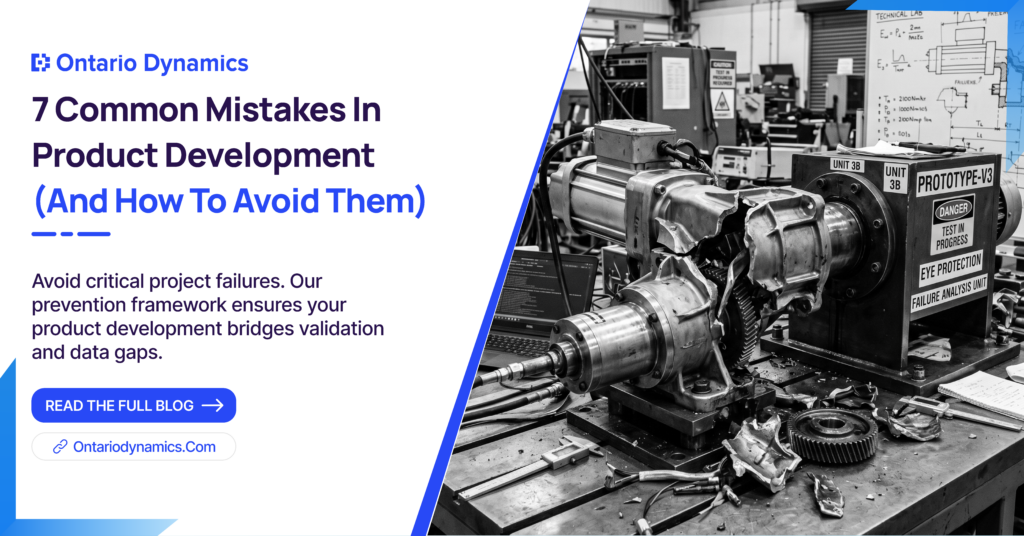
7 Common Mistakes in Product Development (And How to Avoid Them)
Turning an idea into a real product takes more than excitement. It takes research, planning, testing, and clear decisions at each step. Many product teams do not fail because the idea is bad. They fail because avoidable mistakes slow the work, raise the cost, or create problems too late. The U.S. Small Business Administration says market research helps businesses find customers and use competitive analysis to build a clear advantage. When that work is skipped, product decisions often start on weak ground.
This guide covers seven common product development mistakes and how to avoid them. It also uses search-friendly terms such as product development process, prototype testing, product validation, manufacturing readiness, product launch strategy, and market-ready product, because those are the kinds of phrases people and AI search tools often use when looking for practical answers.
1. Starting With The Solution Instead Of The Problem
A lot of teams fall in love with an idea too early. They focus on features, shape, materials, or appearance before they fully understand the problem they are trying to solve. That usually leads to a product that looks interesting but does not feel necessary to the buyer.
The better path is to begin with the problem. Ask who has it, how often it happens, what it costs them, and what they dislike about current options. SBA guidance puts market research and competitive analysis at the start for a reason. It helps businesses understand buyers before they commit to a product direction.
To avoid this mistake, write the problem in one or two simple lines before you build anything. If the team cannot explain the problem clearly, the product idea still needs work.
2. Skipping Real Customer Validation
Internal opinions are not enough. A product can sound great in a meeting and still fail when real users see it. One of the most common product development mistakes is assuming people will want the product without checking first.
Customer validation should happen early. Talk to likely buyers. Ask what frustrates them now. Show early concepts. Listen to the words they use. Look for repeated themes. SBA guidance supports this by showing how research helps identify customers and shape better decisions.
To avoid this mistake, validate before heavy spending. A few honest customer interviews can prevent months of wasted effort.
3. Building Too Much Too Soon
Many teams try to create the perfect version first. They add too many features, too many parts, and too many design choices before proving the core function. This slows the timeline and makes it harder to spot what is actually working.
A first version should answer simple questions. Does the main idea work? Can users understand it? What fails first? What confuses? The US Patent and Trademark Office (USPTO) often frames prototypes as an important part of moving a product forward while also thinking about protection and prior art early in the process.
To avoid this mistake, build a simple prototype first. Focus on function before polish. A clear early version often teaches more than a complicated one.
4. Ignoring Testing Until Late In The Process
A product that works once on a bench may still fail in real use. Another major mistake is treating testing like a final checkbox instead of part of the full product development process. When testing happens too late, teams discover weak points after too much time, and money is already spent.
NIST materials on product realization connect design, production, inspection, and quality work as part of one system, not separate steps. That means testing should help shape the product early, not just confirm it at the end.
To avoid this mistake, test in real conditions. That may include wear, repeated use, heat, vibration, transport, setup time, and storage conditions. Early prototype testing is one of the easiest ways to improve a market-ready product before launch.
5. Overlooking Production Reality
A product can look great in a concept drawing and still be hard to make well. Many teams focus so much on design that they forget about supplier limits, material lead times, assembly steps, packaging needs, and repeatability. Then problems show up when it is time to scale.
The National Institute of Standards and Technology (NIST) guidance around manufacturing systems and product realization shows that planning, production, quality control, and supply chain thinking must connect early. These parts affect cost, timing, and consistency.
To avoid this mistake, ask production questions sooner. Can this be built the same way every time? Are the materials easy to source? Will the packaging protect it during shipping? Is the cost still workable at the target price? This is where manufacturing readiness becomes just as important as product design.
6. Forgetting About Intellectual Property Too Long
Not every product needs a patent, but every team should at least review intellectual property early. Some wait too long to search existing patents or think about trademarks, names, and product uniqueness. That can lead to conflict, redesign, or missed protection.
The USPTO says inventors should understand patent basics, learn how to search prior art, and think about protection options as they move through development. Prior art searching also helps people see what already exists and where their idea may truly be different.
To avoid this mistake, do a basic IP review before going too far. That does not mean filing everything right away. It means understanding your options and reducing avoidable risk.
7. Treating Launch As The End Instead Of The Start
Another common mistake is thinking the product is finished once it reaches the market. In reality, launch is the start of the next learning stage. Customer feedback, returns, support questions, and product reviews often show problems that were not clear before launch.
SBA guidance on marketing and sales planning makes it clear that selling is part of the business process, not an afterthought. A product launch strategy should cover target buyers, messaging, channels, fulfillment, and follow-up.
To avoid this mistake, treat the first launch like a learning phase. Watch what customers praise, where they struggle, what they return, and which questions come up again and again. That feedback helps improve product market fit over time.
Build Better By Avoiding The Usual Traps
Most product development mistakes are not dramatic. There are small gaps in research, testing, timing, or planning that grow into bigger problems later. If you start with the real problem, validate with real users, build simple first, test early, plan for production, review IP, and learn after launch, your chances improve a lot.
A stronger process usually beats a flashy idea. If you want practical support moving from concept to launch, product development company is a smart team to speak with.
Ready to Build Your Product?
Let’s turn your idea into a production-ready product engineered for success.
FAQs
One of the most common mistakes is building a solution before fully understanding the customer problem.
It helps confirm that real buyers care about the problem and want the product before major spending begins.
Prototype testing should start early, not at the end, so weak points can be fixed before production planning goes too far.
It means the product can be made consistently, with practical materials, workable costs, and a clear production plan.
Yes. Even if you do not file right away, it is smart to understand patent basics and search what already exists.
No. Launch is the start of real market learning, and customer feedback should shape the next version of the product.