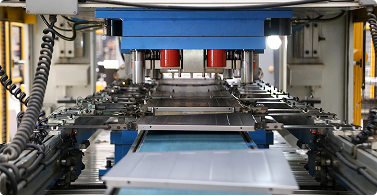
An automotive client operated a tandem stamping press line where parts were manually transferred between presses. This manual process limited production speed and posed safety risks on the shop floor. Ontario Dynamics was tasked with retrofitting this existing line with press line automation – specifically a servo-driven transfer bar feeder system – to automate part transfer without expensive press replacements or extensive modifications. The goal was clear: deliver a low-cost transfer bar system that could meet or exceed the performance of big-name automation vendors, while fitting seamlessly into the client’s current equipment and workflow. By leveraging off-the-shelf components and clever engineering, our team set out to eliminate manual handling, improve cycle time, and ensure a quick, hassle-free integration into the old presses.
Ontario Dynamics’ approach centered on a custom transfer bar feeder automation solution built from readily available components. We designed a lightweight transfer bar structure using modular aluminum extrusion profiles. This bar spans the distance between press stations and carries the part-handling “fingers” that grip and move stamped parts. Motion is achieved via three coordinated axes (X, Y, and Z), each driven by commercial linear actuators powered by Mitsubishi servo motors. The X-axis shuttles the transfer bar longitudinally from one press to the next, the Y-axis provides in-and-out motion to reach into die areas, and the Z-axis raises/lowers the bar for part pickup and placement. All axes are synchronized through a Mitsubishi PLC controller, which ensures multi-axis motions occur in harmony with the press cycle.
Crucially, we added a custom encoder assembly to the existing mechanical presses to monitor the crankshaft position of each press. This encoder feed allows the PLC to precisely time the feeder’s motions with each press stroke. As the press cycles, the PLC commands the servos to enter the die, grasp the part, and retract just after stamping – transferring the part to the next station exactly when needed. By synchronizing the transfer bar feeder motion with the press stroke in real-time, we achieved seamless integration without requiring any changes to the presses’ core controls. The entire automation sequence is run by the Mitsubishi PLC in a master-slave arrangement with the press: the PLC reads the press encoder and sends coordinated commands to the servo drives, resulting in a smooth, synchronized retrofit stamping automation of the line.
Ontario Dynamics delivered a customized, lower-cost alternative to the big-name automation vendors, demonstrating how intelligent design can beat one-size-fits-all solutions. Traditional press transfer systems from big companies tend to be heavy-duty and complex, often designed for brand-new lines or very large presses. For example, a standard 3-axis transfer system uses specialized hardware like helical rack-and-pinion drives, pneumatic bar locking mechanisms, and even vacuum-based end-of-arm tooling. These systems are highly capable but come with a large physical footprint and significant integration overhead. Similarly, one-bar transfer systems can automate multi-press lines (up to 10 presses in sequence) with high-speed servo axes, but such scale and complexity can be overkill for a moderate-size line and require substantial reconfiguration of the press layout and controls.
In contrast, our solution was purpose-built for the client’s specific needs. By using modular components and a lean design, we kept the hardware size and weight to a minimum while still covering the required X/Y/Z motions. The entire transfer bar feeder system has a much smaller footprint than typical commercial transfer robots – it tucks right into the existing line without a dedicated gantry or platform. Fewer custom-machined parts and no redundant features meant a lower overall cost. In fact, the Ontario Dynamics feeder achieved the same core functionality (part pick-and-place between presses with synchronized timing) at a fraction of the price that major OEMs would charge for a full-scale transfer line retrofit.
Integration was also faster and simpler. Large vendor systems often demand new control cabinets, press retrofits, and weeks of on-site integration work by their engineers. Our system, on the other hand, was installed and commissioned by our team in a matter of days, thanks to thorough offline testing and the plug-and-play nature of the off-the-shelf actuators and Mitsubishi control package. The intelligent component selection – using just the right size actuators, adding a counterbalance to avoid oversized motors, choosing a familiar PLC platform – meant the final machine is both efficient and easy to support. The client’s maintenance staff can service the feeder without needing specialized training or expensive proprietary parts.
Another competitive edge is the flexibility of our design. The quick-release finger tooling allows rapid retooling for different parts, which is something not easily achieved in many standard transfer systems that use bolted or welded gripper setups. This gives the client the agility to run new product variants or adjust to design changes with minimal additional investment. In essence, Ontario Dynamics provided a tailor-made automation solution that combines the best of both worlds: the performance of a servo-driven transfer bar system and the agility of a custom-engineered machine, all delivered in a cost-effective package.
The results of the project were immediately tangible on the production floor. The custom transfer bar feeder successfully automated the part transfer between the stamping presses, eliminating the need for manual handling by operators. This led to improved safety (no more staff working between active presses) and a more consistent, predictable production flow. The line’s throughput increased because the feeder can transfer parts quickly enough to keep up with the presses’ ideal cycle rate – there is no waiting on human operators, and the presses can run continuously in synchronized mode. In fact, the client observed a significant reduction in idle time between stamping operations, effectively boosting overall equipment efficiency.
Equally important, the solution was delivered on budget, costing far less than quotes the client had obtained from larger automation firms for a similar scope. The use of off-the-shelf components and minimal custom fabrication kept costs low. Moreover, because we avoided major modifications to the presses, the client saved on potential re-certification or extended downtime costs. The installation was completed over a short maintenance interval, and full production resumed shortly after with the new automation in place.
The low-cost transfer bar system has now been running reliably, with the Mitsubishi-driven control ensuring accurate and repeatable movements every cycle. Maintenance feedback has been positive – operators find the HMI controls intuitive, and technicians appreciate the straightforward mechanical design when performing routine checks. The quick-release tooling feature has already proven its worth by allowing faster die changes and setup for new parts, contributing to reduced changeover times on the line.
In summary, Ontario Dynamics transformed a manual, labor-intensive process into a highly efficient automated operation. By delivering a servo-driven transfer bar feeder that marries smart engineering with practical component choices, we provided the client with a retrofit stamping automation solution that not only meets their technical requirements but also gives them a competitive edge in production. This case study showcases Ontario Dynamics’ commitment to technical excellence, cost-effective design, and tailored solutions that outperform the “off-the-shelf” offerings of larger competitors – all while maintaining a minimal footprint and maximum flexibility for the customer. We also offer Equipment Design services and Product Design services as part of our comprehensive engineering solutions.
Note: Certain images and mechanical details have been modified to maintain client confidentiality.